By Team INVC | INVC NEWS
NEW DELHI, India | September 14, 2026 —
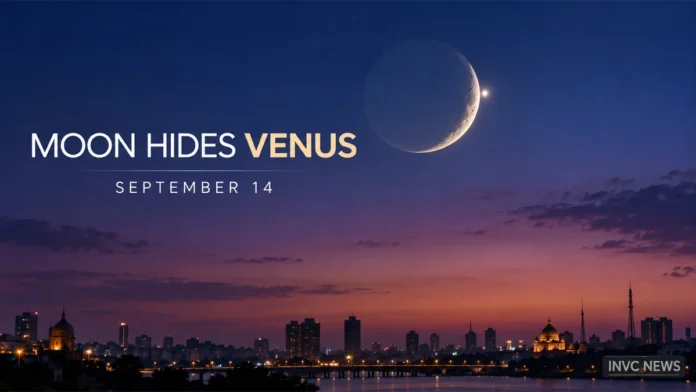
Moon-Venus Occultation Today will give skywatchers a striking celestial spectacle on Monday as the crescent Moon moves directly in front of Venus, temporarily hiding the brilliant planet from view across parts of Asia and other regions.
The September 14 event, known as a lunar occultation of Venus, will unfold during daylight and early evening hours depending on location.
Parts of India fall within the broader visibility region, although the exact moment when Venus disappears behind the Moon and reappears will vary significantly from one city to another.
For many people across India, the easiest spectacle will come around sunset and shortly afterward, when the young crescent Moon and exceptionally bright Venus appear very close together in the western sky.
What is the Moon-Venus occultation?
A lunar occultation occurs when the Moon passes directly between Earth and a more distant celestial object.
From the observer’s perspective, the Moon temporarily covers that object.
On September 14, the object being covered is Venus, one of the brightest objects visible from Earth after the Sun and Moon.
Unlike an ordinary conjunction, where two objects only appear close together, an occultation means the Moon actually blocks Venus from view for observers positioned within the occultation path.
Venus will first appear to approach the lunar edge, disappear behind the Moon and later emerge on the opposite side.
What time is the Venus occultation on September 14?
The overall global occultation runs approximately from 09:26 UTC to 13:42 UTC.
That corresponds to roughly 2:56 PM to 7:12 PM IST.
However, Indian observers should not treat this entire period as the viewing window for one city.
The occultation footprint moves across Earth, so individual locations experience different circumstances.
Across the Indian portion of the visibility zone, the broader event falls approximately within the late-afternoon to early-evening period, roughly 5:00 PM to 7:10 PM IST.
Actual disappearance and reappearance times depend on geographic location.
Some parts of the country may see only part of the occultation, while places outside the exact path will instead witness an extremely close Moon-Venus conjunction.
Will the Moon hide Venus everywhere in India?
No.
This distinction is important.
A lunar occultation is highly location-dependent because the Moon sits relatively close to Earth. Observers separated by hundreds of kilometers can see the Moon in slightly different positions against the distant background sky.
As a result, Venus may disappear completely behind the Moon from one region while observers elsewhere see the planet pass just beside the lunar crescent.
Therefore, readers should avoid assuming that Venus will vanish at the same time—or at all—from every Indian city.
What will people in Delhi, Mumbai, Chennai and Bengaluru see?
Even where the complete occultation proves difficult to observe, the evening sky can still offer a beautiful Moon-Venus pairing.
After sunset, viewers should look toward the western to west-southwestern sky.
Venus will appear as an exceptionally bright point of light close to the thin waxing crescent Moon.
The planet is approaching one of its brightest appearances of 2026, making it much easier to identify than most stars.
Delhi, Mumbai, Bengaluru, Chennai and several other Indian cities may therefore get a strong evening view of the close pairing if skies remain clear.
Cloud cover, buildings, trees and haze near the horizon can affect visibility.
Why Venus will look unusually bright
Venus is entering an especially bright period in its current evening appearance.
The planet is moving into a geometry where it appears relatively large from Earth while still showing enough of its illuminated side to reflect large amounts of sunlight.
Venus is expected to reach its greatest evening brilliance around September 18.
That makes this week’s Moon-Venus encounter particularly eye-catching.
Even people who do not normally follow astronomy may notice the bright planet near the crescent Moon after sunset.
Can you see the occultation with the naked eye?
The daytime portion will be challenging.
Although Venus is extremely bright, spotting it against a bright blue daytime sky requires experience and favorable conditions.
The Moon can help observers locate the planet, but people should exercise extreme caution when using binoculars or telescopes during daylight.
Important safety warning
Never point binoculars, a telescope, camera lens or other magnifying optical equipment toward the Sun.
Accidental solar viewing through magnifying optics can cause severe and permanent eye damage.
Inexperienced observers should wait until the Sun has set before attempting to view the Moon-Venus pairing.
After sunset, no special equipment is required to enjoy the close conjunction.
A clear western horizon and unobstructed view will usually provide the best chance.
Why this occultation happens
The Moon moves rapidly eastward against the background of stars and planets as it orbits Earth.
Occasionally, its path lines up precisely with a distant planet.
When that alignment occurs from a particular region on Earth, the lunar disk passes in front of the planet and produces an occultation.
Because observers across Earth see the nearby Moon from slightly different angles, the occultation path covers only a limited region.
That is why someone in one country—or even another part of the same country—can see a different version of the event.
Is Moon-Venus occultation an eclipse?
No.
An occultation and an eclipse describe different astronomical situations.
During a lunar occultation, the Moon blocks another distant object from the observer’s line of sight.
An eclipse generally involves one celestial body entering another body’s shadow or blocking the Sun.
Monday’s event involves the Moon physically appearing in front of Venus from Earth’s perspective.
Moon and Venus remain close after the occultation
Even readers who miss the actual disappearance of Venus still have a reason to look up.
As twilight deepens, the Moon and Venus will remain visually close in the evening sky.
The thin crescent Moon should provide an attractive contrast with brilliant Venus.
Because the pairing will sit relatively low toward the western horizon, viewers should choose a location without tall buildings, trees or hills blocking the view.
Clear weather will remain the biggest deciding factor.
A major September skywatching event
The September 14 Moon-Venus occultation combines several factors that make it especially interesting.
Venus is unusually bright.
The Moon is a young crescent.
Parts of Asia fall within the occultation path, while a much wider region can enjoy the close conjunction.
For Indian skywatchers, the safest and easiest opportunity will generally arrive around and after sunset, when the pair becomes easier to identify against a darker sky.
Those positioned inside the actual occultation path may witness an even more dramatic sight: Venus disappearing behind the crescent Moon before returning to view.