By Team INVC | INVC NEWS
DUBAI, United Arab Emirates | September 9, 2026 —
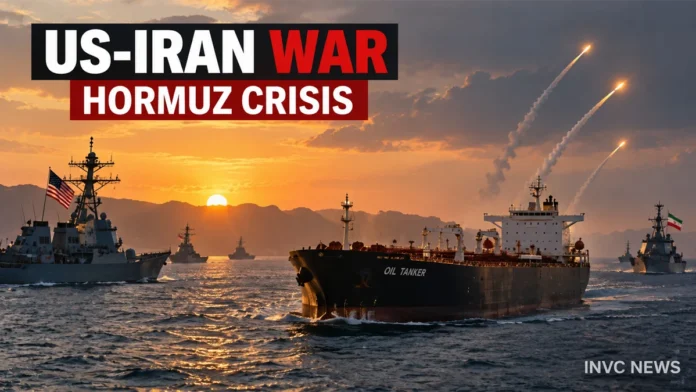
US Iran War tensions escalated sharply on Wednesday after Iran launched ballistic missiles toward a base hosting U.S. forces in Jordan, while Tehran also threatened maritime traffic around the Strait of Hormuz following American strikes that destroyed five Iranian oil tankers.
The latest exchange has pushed the six-month conflict into another dangerous phase and intensified concerns about the security of Gulf shipping, regional military bases and global energy supplies.
Jordan said its air defenses intercepted most of the missiles fired toward the Al Azraq area and reported no casualties from the attack.
Meanwhile, Iran’s Islamic Revolutionary Guard Corps said it had also targeted vessels around the Strait of Hormuz as retaliation expanded from military installations to the strategically vital maritime corridor.
The escalation has already shaken energy markets, with Brent crude moving close to the $100-per-barrel level.
US Destroys Five Iranian Oil Tankers
The latest confrontation accelerated after U.S. forces struck five Iranian oil tankers on Tuesday.
U.S. Central Command said the strikes came after Iran attempted to hit an American Navy warship with ballistic missiles.
American forces targeted four tankers in the Gulf of Oman and another vessel near Kharg Island, one of the most important hubs for Iranian crude exports.
U.S. forces instructed the crews to leave the vessels before carrying out the attacks, according to American military statements.
Washington linked the tankers to Iran’s Islamic Revolutionary Guard Corps and described the operation as retaliation for Iranian attacks against U.S. naval assets.
The strikes represent a significant escalation because they directly target the infrastructure Iran uses to move oil through the region.
Iran Retaliates Against US Base in Jordan
Iran responded with missile attacks targeting the Al Azraq area in Jordan, where U.S. forces maintain a military presence.
Jordanian authorities said air-defense systems engaged the incoming missiles.
Reports from the region indicated that 18 of 20 missiles were intercepted, while the remaining projectiles fell in unpopulated areas.
No casualties were reported.
The attack expanded the geographical scope of the confrontation and reinforced concerns among Gulf and Middle Eastern governments that further U.S.-Iran exchanges could spread across national borders.
Strait of Hormuz Becomes Center of Crisis Again
The Strait of Hormuz has once again emerged as the most important pressure point in the conflict.
Iran said its forces targeted ships operating around the strategic waterway and issued warnings involving maritime activity near Gulf states.
The narrow strait connects major Persian Gulf oil producers with global markets.
Any sustained disruption can affect crude supplies, shipping costs, insurance premiums and fuel prices around the world.
The latest shipping data already shows a significant decline in commercial activity.
Only six commodity vessels crossed the Strait of Hormuz on Tuesday, compared with nine a day earlier and a recent 10-day average of about 12.
Five of those vessels were entering the strait and only one was exiting.
Although ship-tracking figures can change because some vessels turn off their transponders, the decline highlights growing caution among commercial operators.
Iran Says Ships Violated Restricted Area
Iran’s Revolutionary Guard said vessels targeted around Hormuz had entered what Tehran described as a prohibited maritime area.
The United States and its regional allies have challenged Iran’s attempts to impose restrictions on international navigation.
That disagreement has turned freedom of navigation into one of the central military and diplomatic disputes surrounding the conflict.
Commercial shipping companies now face a difficult calculation.
They must balance contractual obligations and global demand for energy against the growing risk of missiles, drones, naval encounters and possible vessel seizures.
Houthis Expand Pressure on Saudi Arabia
The conflict has also widened through Iran-aligned armed groups elsewhere in the region.
Houthi forces in Yemen launched missile and drone attacks against targets in Saudi Arabia as the broader confrontation intensified.
The attacks injured dozens of people and damaged energy-related infrastructure, further increasing concern about the security of regional oil production and transport networks.
Saudi Arabia has responded militarily to Houthi attacks, adding another potential front to an already complex regional conflict.
The development matters for global markets because Saudi Arabia remains one of the world’s largest oil producers.
A simultaneous threat to Iranian shipping, Saudi energy facilities and the Strait of Hormuz would create a much more serious supply risk than disruption in any single location.
Brent Crude Moves Close to $100
Oil markets reacted quickly.
Brent crude moved toward $100 a barrel as traders assessed the possibility that military operations could reduce energy exports or disrupt shipping.
The market had already been tightening before the latest tanker strikes.
However, attacks involving crude carriers and threats around Hormuz have increased the geopolitical risk premium.
Oil prices do not depend only on the volume of crude physically removed from the market.
They also reflect expectations about what could happen next.
Even without a complete closure of Hormuz, insurance costs, shipping delays and rerouting can make energy more expensive.
Why the US-Iran War Matters for India
India has a particularly strong economic interest in developments across the Gulf.
The country imports most of the crude oil it consumes, making a prolonged rise in international oil prices a potential challenge for inflation, the rupee, government finances and corporate costs.
Higher oil prices increase India’s import bill.
A weaker rupee can make those imports even more expensive because international crude transactions are largely priced in U.S. dollars.
Indian airlines, logistics companies, paint manufacturers, chemical producers and other fuel-intensive industries can also face higher input costs when crude rises sharply.
For Indian investors, that makes developments in Hormuz almost as important as domestic economic data in the short term.
Sensex, Nifty and Rupee Feel Oil Pressure
Indian financial markets have already started reflecting those concerns.
The rupee has moved close to the psychologically important 95-per-dollar level, while the Sensex and Nifty have faced sustained selling pressure.
A rapid cooling in crude prices could provide relief.
However, another round of attacks on tankers, ports or energy facilities could push investors toward safer assets and increase pressure on oil-importing economies.
Markets will therefore continue tracking every military development around the Gulf.
Could Iran Close the Strait of Hormuz?
A complete closure of Hormuz would represent a far more severe development than the current reduction in traffic.
Iran has repeatedly used the strategic waterway as leverage during periods of confrontation with the United States.
However, completely shutting the strait would carry enormous economic and military consequences for Iran itself as well as neighboring states.
For that reason, the more immediate risk involves partial disruption, threats to individual vessels, higher shipping costs and sporadic military incidents.
Those developments alone can keep oil prices elevated.
Washington Signals More Retaliation Is Possible
The United States has signaled that attacks on American naval forces will trigger further consequences.
U.S. officials have framed the tanker strikes as a direct response to Iranian attempts to attack American warships.
That approach increases the risk of an escalating retaliation cycle.
Iran attacks a U.S. asset.
Washington responds against Iranian military or energy-linked targets.
Tehran then strikes another regional base or vessel.
Without renewed diplomacy, that pattern could repeatedly expand the conflict.
No Sign of Immediate De-Escalation
The latest events offer little evidence of an immediate diplomatic breakthrough.
Previous attempts to establish ceasefire frameworks and negotiate maritime-security arrangements have struggled to survive repeated military confrontations.
The current round is especially dangerous because it connects three highly sensitive areas at once:
U.S. military forces, Iranian oil exports and the Strait of Hormuz.
Each has the potential to trigger a larger response.
What Happens Next
Three developments will determine whether the crisis intensifies further.
First, markets will watch whether Iran carries out additional attacks on commercial tankers or American naval vessels.
Second, attention will focus on whether Washington launches another round of strikes against Iranian energy or military infrastructure.
Third, shipping data through Hormuz will show whether commercial traffic continues to decline.
Any significant fall in tanker movements could push oil markets into another period of extreme volatility.
US-Iran War Enters Another Dangerous Phase
The US Iran War has now moved beyond another round of rhetorical threats.
American forces have destroyed five Iranian oil tankers. Iran has retaliated against a base hosting U.S. forces in Jordan. Maritime traffic through Hormuz has dropped, while Iran-aligned forces have expanded attacks elsewhere in the Gulf region.
For the world economy, the central question is no longer simply whether Washington and Tehran exchange additional strikes.
The bigger question is whether the conflict begins to seriously restrict the movement of oil through one of the world’s most important energy corridors.
With Brent crude already approaching $100 a barrel, the answer could have consequences stretching far beyond the Middle East.