SYDNEY, Australia | September 8, 2026 —
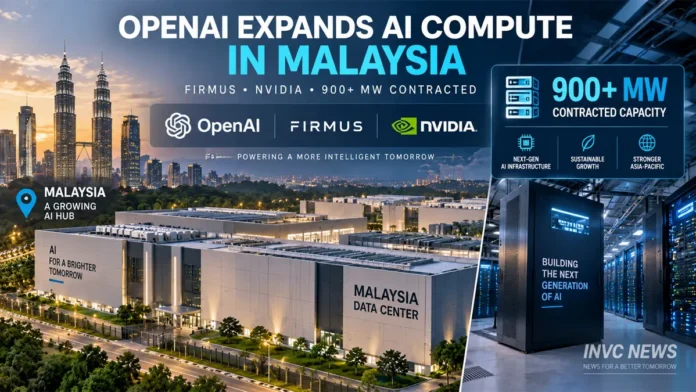
OpenAI Malaysia AI Data Center Deal took center stage Tuesday after OpenAI and Nvidia-backed Firmus announced a multi-year partnership that will give the ChatGPT maker dedicated computing capacity from two new AI data center sites in Malaysia.
The agreement makes OpenAI an anchor customer for Firmus as the Australian infrastructure company expands deeper into Southeast Asia.
With the new contract, Firmus says its total contracted capacity across customers has now crossed 900 megawatts.
Neither company disclosed the financial value of the agreement.
The deal highlights how quickly the global AI race is moving beyond software and into physical infrastructure. Powerful AI models need huge amounts of computing capacity, advanced chips, electricity, cooling and high-speed networking.
Malaysia will now play a larger role in that race.
OpenAI Signs Multi-Year Malaysia Compute Deal
OpenAI will contract dedicated AI computing capacity from two Firmus AI Factory sites planned for Malaysia.
The companies announced the partnership on September 8, 2026.
Firmus described OpenAI as an anchor customer across the new Malaysian facilities.
An anchor customer can provide an important base for a major data center project because a long-term computing commitment gives the developer clearer demand before it adds new infrastructure.
For OpenAI, the agreement creates another source of high-performance computing capacity outside its existing infrastructure network.
Firmus Crosses 900 MW of Contracted Capacity
The OpenAI agreement pushes Firmus’ contracted customer portfolio beyond 900 MW.
That figure reflects total committed capacity across its customers rather than the power assigned only to OpenAI.
Firmus now operates or develops AI infrastructure across Australia, Singapore, Indonesia and Malaysia.
Its wider portfolio includes seven AI Factory sites across four countries.
Two facilities currently operate in Australia and Singapore.
Five additional sites remain under development.
The company expects those projects to become ready for service over roughly the next 24 months.
Malaysia Becomes Firmus’ Latest AI Market
The deal marks Firmus’ expansion into Malaysia.
Malaysia has quickly become an important data center destination in Southeast Asia as technology companies look for more land, power and computing capacity close to major Asian markets.
Singapore already serves as one of the region’s biggest digital hubs, but limits on land and power have encouraged developers to expand into nearby markets.
Malaysia offers a strong location for that growth.
Johor and other parts of the country have attracted increasing attention from global cloud and data center companies.
OpenAI’s agreement with Firmus adds another major AI name to that trend.
Nvidia Vera Rubin Systems Will Power Expansion
Firmus plans to deploy Nvidia’s next-generation Vera Rubin computing platform across its Asia-Pacific infrastructure.
The company says its AI factories will use Nvidia Vera Rubin NVL72 systems.
Those systems will form part of a larger infrastructure design that combines computing, networking, power and liquid cooling.
Firmus will also use Nvidia’s DSX AI Factory platform.
The infrastructure company has developed its own HyperCube system to combine cooling, mechanical equipment and electrical systems into repeatable modules.
That design aims to speed up deployment as AI companies demand larger computing clusters.
Why OpenAI Needs So Much Computing Power
Modern AI systems require enormous computing resources.
Training a large model can involve thousands of advanced processors running for long periods.
Serving millions of users creates another major demand.
Every prompt, generated image, code request or AI-agent task needs computing capacity somewhere inside a data center.
As AI products become more capable, infrastructure needs continue to grow.
OpenAI has therefore been building a broader network of computing partners rather than depending on one single source.
The Firmus partnership fits that strategy.
New Malaysia Sites Will Serve Regional and Global Demand
OpenAI said the Malaysian data centers will help it meet rising demand for its products across the region and globally.
That regional element matters.
Asia-Pacific contains some of the world’s largest and fastest-growing digital markets.
Businesses across India, Southeast Asia, Australia, Japan and other markets are increasing their use of artificial intelligence.
More regional infrastructure can reduce dependence on distant computing centers and create additional capacity as demand rises.
However, OpenAI and Firmus have not disclosed exactly how much of the 900+ MW portfolio OpenAI itself has contracted.
AI Data Centers Become the New Technology Battleground
For years, the technology race focused heavily on software, smartphones and cloud services.
Artificial intelligence has changed that equation.
Now, access to physical computing infrastructure can determine how quickly an AI company grows.
Four resources have become especially important:
Advanced AI chips
Reliable electricity
High-speed data connections
Efficient cooling
A shortage in any one of these areas can slow AI development.
That is why companies are making infrastructure commitments years before all capacity comes online.
Nvidia Gains Another Major AI Infrastructure Deployment
Nvidia also benefits from the Firmus expansion.
Its processors dominate much of the current AI computing market.
Every large data center project that adopts Nvidia’s latest systems strengthens that ecosystem.
Vera Rubin represents the company’s next major architecture after Blackwell.
Firmus plans to deploy the platform at scale across Asia-Pacific.
That gives Nvidia another route into a region where AI infrastructure spending continues to increase.
Firmus Builds Presence Across Asia-Pacific
Firmus has expanded rapidly in recent months.
Its projects now stretch from Australia into Southeast Asia.
The company has also secured major investment backing.
Its investors include Nvidia and other large global investment firms.
Earlier expansion plans focused heavily on Australia.
Malaysia now adds another major market.
The company’s strategy centers on building high-density AI infrastructure that can handle the power and cooling demands of advanced processors.
Energy Use Will Remain a Major Question
Rapid growth in AI data centers also creates challenges.
Large facilities consume huge amounts of electricity.
Cooling can add further demand.
Governments therefore need to balance technology investment with grid reliability, water availability and environmental goals.
Malaysia faces the same question as other fast-growing data center markets.
New projects can bring investment, construction activity and technology jobs.
At the same time, authorities need to ensure that infrastructure growth does not place excessive pressure on local energy systems.
Efficiency will become increasingly important as more AI capacity comes online.
Why the Deal Matters for Southeast Asia
The OpenAI-Firmus partnership strengthens Southeast Asia’s role in the global AI infrastructure map.
Singapore has long served as a regional technology hub.
Malaysia is now building a larger position.
Indonesia is also attracting new digital infrastructure.
Together, these markets could become important computing centers for the next stage of AI growth.
Competition between countries will depend on more than tax incentives.
Power supply, regulation, connectivity, land and skilled workers will all matter.
OpenAI Adds Another Piece to Its Global Compute Strategy
OpenAI’s Malaysian agreement should not be viewed as an isolated data center deal.
It forms part of a much larger race to secure enough computing power for future AI systems.
The company needs capacity for model training, product use and new AI services.
Firmus offers another platform in a fast-growing region.
Malaysia gains a high-profile AI customer.
Nvidia secures another large deployment path for Vera Rubin.
Firmus, meanwhile, strengthens its position with one of the world’s best-known AI companies as an anchor customer.
The OpenAI Malaysia AI Data Center Deal therefore shows where the AI industry is heading next.
The race is no longer only about building smarter models.
Increasingly, it is about who can secure the chips, power and data centers needed to run them.