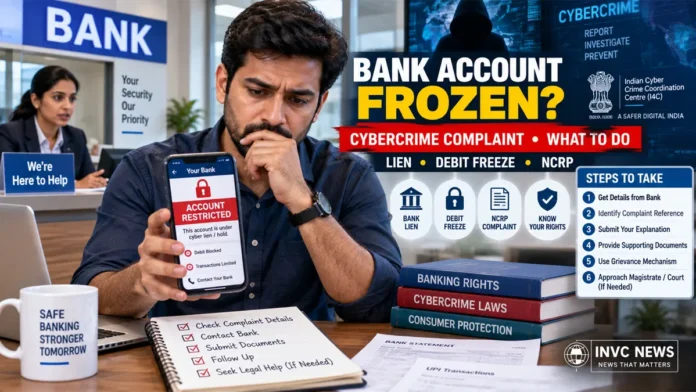
NEW DELHI, India | September 6, 2026 —
Bank Account Frozen Due to Cybercrime Complaint has become an increasingly common and deeply confusing problem for ordinary bank customers as money stolen through online fraud moves rapidly through multiple UPI, IMPS and bank accounts before investigators can trace it.
A person may discover the problem only when a UPI payment fails, an ATM withdrawal gets declined or the bank suddenly says the account carries a “cyber lien,” “debit freeze,” “hold” or police instruction.
The account holder may never have spoken to the fraud victim.
They may not be named as an accused.
In some cases, the disputed transaction can represent only a small part of the balance.
Yet access to the entire account may stop.
Recent High Court orders and India’s 2026 cybercrime grievance framework have brought greater attention to a crucial principle: investigators must protect suspected proceeds of cyber fraud, but authorities should also avoid unnecessarily paralysing the legitimate finances of innocent account holders.
So what should you actually do if your account gets frozen?
First Understand What ‘Frozen’ Actually Means
Not every restriction on a bank account is the same.
Before taking any action, ask the bank precisely what restriction has been placed.
Lien or Hold on a Specific Amount
A lien generally means a specified amount remains blocked while the rest of the account may remain usable.
For example, if ₹20,000 received in the account has been linked to a disputed cyber-fraud transaction, authorities may ask the bank to keep that amount unavailable.
Debit Freeze
A debit freeze prevents the account holder from withdrawing or transferring money.
Credits may sometimes continue entering the account, but the customer cannot use the balance.
Complete Account Freeze
A more severe restriction can block virtually all normal operations.
This causes the greatest hardship because salaries, business payments, rent, EMI obligations and household spending may all depend on the account.
The first step is therefore not simply asking, “Why is my account frozen?”
Ask:
Is this a lien, a debit freeze or a full freeze?
Why Can an Innocent Person’s Account Get Linked to Cyber Fraud?
Cybercriminals rarely keep stolen money in one account.
Funds can move within minutes through multiple bank accounts.
Investigators often describe these as transaction layers.
A fraud victim may send money to one account.
That money may then move to another account.
It may be transferred again through UPI, bank transfer, cash withdrawal, cryptocurrency purchases or business payments.
An innocent merchant, freelancer, customer or individual could therefore receive money that investigators later identify as part of a fraud trail.
That does not automatically prove the recipient participated in the fraud.
But the transaction can still trigger investigative action.
Mule Accounts Are a Different Matter
Authorities also investigate so-called mule accounts.
These are accounts knowingly or unknowingly made available to move suspected criminal proceeds.
Some people deliberately rent, sell or hand over access to their bank accounts.
Others may give their ATM card, PIN, SIM, UPI credentials or internet-banking access to someone else without understanding the consequences.
That can create serious legal problems.
An innocent account holder should therefore clearly document why a disputed payment entered the account and what legitimate transaction, if any, it represented.
Step 1: Contact the Bank Immediately
Do not rely only on a verbal conversation at the branch.
Ask the bank for as much written information as it can lawfully provide about the restriction.
Request:
- Nature of restriction
- Amount under lien or hold
- Date the restriction started
- Cybercrime complaint or acknowledgement reference, if available
- Police station or cyber cell that issued the request
- Investigating officer’s details, where available
- State or Union Territory from which the request originated
The bank may not disclose every investigative detail.
However, you need enough information to identify which authority placed the restriction.
Step 2: Get Your Bank Statement and Trace the Disputed Transaction
Download or request the relevant bank statement immediately.
Identify the transaction connected with the cyber complaint.
Then ask yourself:
Who sent the money?
Why did they send it?
What product, service, loan repayment or other transaction did it relate to?
Did you know the sender?
Did the funds move onward?
Do you have invoices, chats, receipts or agreements?
The clearer your transaction trail, the easier it becomes to explain that the money entered your account for a legitimate reason.
Step 3: Preserve Every Document
Do not delete messages or payment records simply because you fear they may create questions.
Preserve evidence.
Useful documents may include:
- Bank statements
- UPI transaction records
- Invoices
- GST invoices
- Purchase orders
- Delivery records
- WhatsApp or email conversations
- Loan agreements
- Salary records
- Freelance contracts
- Marketplace receipts
- Proof of goods supplied
- Identity documents
- Any communication received from the bank
The objective is to show the commercial or personal reason behind the disputed transaction.
Step 4: Contact the Investigating Officer
Once you identify the cyber cell or police authority, send a written representation.
Explain:
Who you are.
How the disputed money entered the account.
Why the transaction was legitimate.
Whether you know the alleged fraudster.
Whether you received any commission for moving money.
Whether the account was ever shared with another person.
Attach supporting documents.
Keep proof that you submitted the representation.
A written record becomes particularly important if the matter later reaches a senior police officer, grievance mechanism, Magistrate or High Court.
Step 5: Ask Whether the Freeze Can Be Limited to the Disputed Amount
This has become one of the most important legal issues in cybercrime account-freezing cases.
Several High Courts have dealt with situations where a relatively small disputed transaction resulted in restriction of an entire account.
Courts have, depending on the facts, directed banks to allow normal operation while preserving only the amount linked to the alleged fraud.
For example, courts in different states have ordered that the disputed amount remain under lien while the rest of the balance becomes accessible.
But this is not an automatic nationwide rule applicable identically to every case.
A full freeze may still be justified where investigators have specific reasons to suspect the account itself forms part of a fraud or mule-account network.
The account holder should therefore ask for proportional relief rather than assume the entire freeze is automatically unlawful.
2026 I4C SOP Creates Grievance Mechanism
A major development in 2026 has been the Standard Operating Procedure dealing with the National Cybercrime Reporting Portal and Citizen Financial Cyber Fraud Reporting and Management System.
The framework covers:
- Holding suspected fraud amounts
- Seizure or restriction of accounts
- Custody and restoration of money
- Accountability
- Grievance redressal for affected account holders
Recent court orders have specifically referred to Clause 10 of the SOP as providing a time-bound grievance-redressal mechanism for account holders whose money has been placed on hold or whose account operation has been suspended.
That gives affected customers another formal route to challenge or seek review of a restriction.
Step 6: Use the Grievance Process
If a normal representation to the investigating officer does not resolve the issue, ask the bank or investigating authority how to invoke the applicable grievance mechanism.
Provide:
- Account details
- Freeze/lien information
- Complaint reference
- Disputed transaction amount
- Your written explanation
- Supporting financial records
- Proof that you are not connected with the alleged fraud, where available
Avoid sending sensitive banking credentials such as PINs, passwords or OTPs.
No legitimate police officer or bank employee needs your OTP to investigate a frozen account.
Step 7: Escalate Within the Bank
You should also follow the bank’s formal grievance process.
Start with the branch.
Then escalate, where necessary, to the bank’s designated grievance or nodal officer.
The bank may not have the power to independently ignore a lawful police or court instruction.
However, the bank should be able to explain the restriction and communicate with the relevant authority regarding modification or release.
Written escalation also creates a clear paper trail.
Step 8: Consider the Jurisdictional Magistrate
If the investigating authority does not provide relief, legal proceedings may become necessary.
Recent court decisions have recognized that an account holder can approach the jurisdictional Magistrate in appropriate circumstances to challenge or seek modification of freezing or attachment action.
Which Magistrate has jurisdiction can depend on:
- Police station handling the complaint
- Place where the cybercrime case is registered
- Nature of the order
- Applicable procedural law
This is where qualified legal assistance becomes particularly useful.
Step 9: High Court May Be an Option in Appropriate Cases
High Courts across India have increasingly heard petitions involving prolonged or disproportionate bank-account freezes.
Petitioners have challenged situations where entire accounts remained unusable even though only a limited amount was connected with the alleged fraud.
Courts have sometimes directed banks to permit operation while keeping only the disputed amount under lien.
In other cases, courts have allowed restrictions to continue because investigators produced reasons indicating wider suspicion.
This shows why each case turns heavily on its facts.
A writ petition should not be treated as the automatic first step.
But where a freeze becomes prolonged, disproportionate or procedurally questionable, a lawyer may advise approaching the appropriate High Court.
Recent Courts Push Back Against Blanket Freezes
The issue has received growing judicial attention in 2026.
The Rajasthan High Court considered a large batch of petitions involving cybercrime-related freezes and issued guidelines aimed at balancing investigation with the rights of legitimate account holders.
The Madhya Pradesh High Court has also emphasized proportionality in cases where only a particular amount appeared connected with the alleged fraud.
Kerala High Court decisions have repeatedly directed banks in appropriate cases to confine restrictions to amounts mentioned in investigative requisitions while allowing customers to operate the remaining balance.
Other High Courts have taken similar approaches depending on the circumstances.
These rulings do not eliminate police powers.
Instead, they increasingly focus on whether the restriction is necessary and proportionate.
Can a Bank Freeze an Account Only Because of an NCRP Complaint?
This question requires careful distinction.
Banks participate in India’s cyber-fraud response system because speed is critical.
If fraud proceeds remain movable for hours, criminals can withdraw or transfer them beyond recovery.
The system therefore allows rapid action to secure disputed money.
However, courts have drawn distinctions between placing a lien on a disputed amount and imposing a broader debit freeze or attachment.
The legal authority and procedural requirements can differ depending on the action taken.
That is another reason account holders should demand clarity about exactly what restriction exists.
What If the Disputed Amount Is Only ₹1,000 or ₹5,000?
Small amounts can still trigger account restrictions because investigators follow the transaction trail rather than the account holder’s overall balance.
Recent court cases have involved disputed amounts of only a few thousand rupees while considerably larger balances or normal banking operations were affected.
Courts have sometimes responded by allowing the account to operate while retaining the disputed amount under lien.
But again, the outcome depends on whether authorities suspect only one transaction or the wider account activity.
What If Several Cyber Complaints Hit the Same Account?
This situation becomes more complicated.
One account may receive multiple lien requests from different states or police units.
This can happen where an account receives money connected with several complaints.
Each complaint may carry its own acknowledgement number and disputed amount.
The account holder should create a table containing:
Complaint reference – State – Investigating agency – Disputed amount – Transaction date – Current status
This makes it far easier to identify what must be resolved.
Do Not Pay Anyone Who Promises Instant ‘Unfreezing’
Frozen accounts have created a secondary scam market.
Fraudsters may claim they can:
- Remove a cyber lien
- Cancel an NCRP complaint
- Bribe a police officer
- Delete a fraud record
- Obtain instant bank clearance
Do not pay such people.
A legitimate resolution should move through the bank, investigating authority, grievance mechanism or court.
Never share:
- OTP
- UPI PIN
- Debit-card PIN
- Internet-banking password
- Screen-sharing access
Anyone asking for those details creates another fraud risk.
What If You Are the Actual Cyber-Fraud Victim?
The situation is different if money has been stolen from your account.
Financial cyber-fraud victims should report the incident immediately.
India’s cyber-fraud reporting system includes the 1930 helpline and the National Cybercrime Reporting Portal.
Speed matters because authorities may be able to stop or hold money before criminals move it through additional accounts.
Victims should preserve:
- Transaction IDs
- Bank messages
- Screenshots
- Phone numbers
- UPI IDs
- Bank-account details
- Email addresses
- Chat records
Do not delay reporting because you feel embarrassed.
How Long Does It Take to Unfreeze a Bank Account?
There is no single national timeline that applies to every case.
Resolution depends on:
- Number of complaints
- Investigating state
- Transaction layer
- Amount involved
- Whether the account holder is a suspect
- Whether supporting documents are available
- Whether a Magistrate or court is already involved
Some cases resolve after representations.
Others require legal proceedings.
The 2026 grievance framework aims to improve time-bound handling, but practical timelines can still vary.
Seven Things to Do Immediately
If you suddenly discover a cybercrime-related freeze:
1. Ask the bank what kind of freeze exists.
2. Obtain the disputed amount and complaint reference.
3. Identify the investigating cyber cell or police station.
4. Download statements and preserve transaction evidence.
5. Send a written representation to the investigating officer.
6. Ask whether the restriction can be confined to the disputed amount.
7. Use the grievance mechanism or seek legal remedies if the issue remains unresolved.
One Thing You Should Never Do
Do not create a false explanation for the disputed transaction.
Investigators can trace banking trails.
If you sold a product, show the invoice.
If it was repayment of a loan, show the earlier transfer or agreement.
If someone used your account, explain exactly how and why.
If you gave another person access to your credentials, disclose that to your lawyer.
A truthful, documented explanation is far safer than an invented story.
The Bigger Problem: Innocent Accounts in a Digital Money Trail
India’s digital-payment infrastructure moves money almost instantly.
That convenience also allows cybercriminals to route stolen funds rapidly through many accounts.
Investigators therefore need the ability to stop suspected fraud proceeds quickly.
But the same mechanism can affect people and businesses that had no knowledge of the original offence.
That creates a difficult balance.
Victims deserve a realistic chance to recover stolen money.
Investigators need access to transaction trails.
Banks need clear instructions.
And innocent account holders should not lose access to their entire financial lives merely because one disputed payment touched their account.
The growing body of 2026 court decisions and the new grievance framework are beginning to address that balance.
For affected account holders, the most important response is not panic.
It is documentation.
Find the transaction.
Identify the complaint.
Contact the investigating authority.
Put your explanation in writing.
And seek proportionate relief through the formal system.
Quick Answer
Why was my bank account frozen?
A transaction linked to a reported cyber fraud may have passed through the account, or investigators may suspect broader involvement.
Does a freeze mean I am guilty?
No. A freeze or lien is an investigative measure and is not by itself proof of guilt.
Can only the disputed amount remain blocked?
Courts have granted this relief in many cases, but it depends on the facts and the nature of the investigation.
What is a cyber lien?
It generally means a specified amount has been placed on hold and cannot be withdrawn.
Who should I contact first?
Your bank and the investigating cybercrime/police authority identified in the freeze request.
Is there a grievance mechanism?
The 2026 I4C SOP provides a grievance-redressal mechanism for affected account holders.
Can I approach a court?
Depending on the circumstances and jurisdiction, remedies may include approaching the jurisdictional Magistrate or an appropriate High Court.
Cyber Fraud Helpline: 1930
Important Note
This article provides general information about cybercrime-related bank-account restrictions in India. It does not constitute legal advice. Procedures and remedies can depend on the investigating agency, bank, court jurisdiction and specific facts of each case.