By Team INVC | INVC NEWS
Published: September 2, 2026 |10 : 59 AM IST
KOROR, Palau | September 2, 2026 —
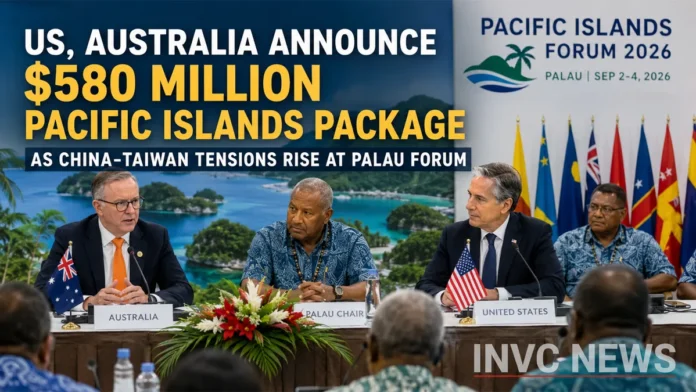
US Australia Pacific Islands funding moved to the centre of Indo-Pacific geopolitics on Wednesday as Washington and Canberra announced a combined $580 million support package for Pacific Island nations, expanding security and energy assistance while China challenged Taiwan’s participation at the region’s premier political gathering.
Australia unveiled an A$600 million package, worth about $430 million, to help Pacific countries fight drug trafficking and organised crime.
The United States separately announced $150 million in new regional support, including $60 million for energy infrastructure and resilience.
Both announcements came during the Pacific Islands Forum Leaders’ Meeting in Palau, where leaders are confronting security threats, energy pressures and growing strategic competition among major powers.
Australia Commits $430 Million to Fight Organised Crime
Australian Prime Minister Anthony Albanese announced a major new package aimed at strengthening policing, border protection and anti-drug operations across the Pacific.
Australia will commit A$600 million, or about $430 million, to the initiative.
The programme will support expanded aerial surveillance and additional training for police and border officials.
Canberra wants Pacific governments to improve their ability to intercept illegal drugs, track trafficking routes and respond to organised criminal networks operating across vast maritime territories.
The Pacific’s enormous distances make law enforcement particularly difficult.
Small island nations often control extensive ocean zones with limited surveillance resources.
Australia now wants to strengthen that capacity.
Albanese Puts Pacific Security at Centre of Strategy
Prime Minister Albanese has framed regional security as a shared challenge rather than a problem Australia can manage alone.
Drug trafficking networks increasingly use international shipping routes, remote islands and maritime corridors to move illegal substances.
Those networks can create domestic security problems across the Pacific while also affecting Australia and New Zealand.
Canberra therefore sees regional policing investment as both foreign assistance and national security policy.
Australia already maintains deep development, policing and defence relationships across the Pacific.
The latest package significantly increases that commitment.
US Adds $150 Million for Pacific Nations
Washington announced its own package during the same forum.
The United States will provide $150 million in new support to Pacific Island countries.
Energy resilience forms a major part of the package.
The US will direct around $60 million toward helping countries expand fuel-storage capacity and strengthen electricity-grid stability.
Many Pacific Island economies depend heavily on imported fuel.
Global energy shocks can therefore hit them quickly through higher electricity costs, transport expenses and supply shortages.
Washington wants the new programme to reduce that vulnerability.
Energy Security Becomes Strategic Issue
Energy may look like an economic issue, but it increasingly carries strategic importance across the Pacific.
Island nations often rely on long supply lines.
A disruption in shipping or a sudden rise in oil prices can create immediate pressure.
The renewed US-Iran conflict has added another layer of uncertainty to global energy markets.
Pacific governments therefore want more reliable fuel reserves, stronger electricity grids and greater resilience against international shocks.
The US package directly targets those concerns.
China-Taiwan Dispute Shadows Palau Forum
The funding announcements arrived while another major geopolitical argument dominated the Pacific Islands Forum.
China has objected to Taiwan’s participation at the meeting.
Beijing considers Taiwan part of China and strongly opposes international arrangements that it believes give Taipei the status of a sovereign state.
Palau, the host of this year’s forum, maintains formal diplomatic relations with Taiwan.
That fact has placed the meeting under greater geopolitical scrutiny.
Australia and New Zealand have pushed back against external pressure over participation arrangements.
They have argued that Pacific Islands Forum members should decide their own guest list.
Pacific Leaders Push Back on Great-Power Pressure
The dispute highlights an increasingly important issue for Pacific governments.
Many island nations want economic partnerships with China.
They also maintain deep relationships with Australia, New Zealand, the United States and Japan.
Some continue diplomatic relations with Taiwan.
Pacific leaders repeatedly insist that outside powers should respect their sovereignty and allow them to make their own decisions.
That puts regional governments in a difficult position.
Major powers bring investment, infrastructure, development assistance and security support.
But Pacific states do not want those benefits to force them into rigid geopolitical camps.
China Has Expanded Pacific Influence
China has significantly expanded its economic and diplomatic presence across the Pacific during the past two decades.
Beijing has funded infrastructure, provided development assistance and strengthened political relationships with several island governments.
China has also persuaded multiple countries to switch diplomatic recognition from Taiwan to Beijing.
That competition has increased strategic concern in Washington and Canberra.
Australia remains the region’s largest traditional development partner, while the United States has renewed diplomatic and financial engagement after years of comparatively limited attention.
The Pacific has consequently become one of the clearest arenas of competition between China and Western-aligned powers.
Palau Holds Special Strategic Position
Palau occupies an especially sensitive position.
The island nation maintains diplomatic relations with Taiwan while also sharing a particularly close relationship with the United States.
Under its Compact of Free Association with Washington, Palau receives substantial US support and maintains important security ties.
Its geographic location also gives it strategic significance in the wider Indo-Pacific.
Hosting the Pacific Islands Forum during an intensifying China-Taiwan dispute therefore puts Palau directly at the centre of regional diplomacy.
Pacific Islands Forum Runs Until September 4
The annual meeting began on August 30 and will continue through September 4.
The 18-member Pacific Islands Forum serves as the region’s most important political organisation.
Leaders use the gathering to address climate change, economic development, maritime security, organised crime, energy, fisheries and regional diplomacy.
Climate threats traditionally dominate Pacific diplomacy because rising sea levels pose an existential challenge for several island states.
However, strategic competition among China, the United States and their partners now adds another major layer to the forum.
Why $580 Million Matters
The combined package sends a clear message about priorities.
Australia is concentrating heavily on policing, border security and organised crime.
The United States is adding energy infrastructure and resilience.
Together, the commitments reach approximately $580 million.
Money alone will not determine political influence in the Pacific.
Island governments increasingly judge partners on whether projects respond to local needs, arrive on time and respect national sovereignty.
That reality forces major powers to compete not only with diplomatic rhetoric but also with practical programmes.
Australia and US Step Up Pacific Competition
For Canberra, the Pacific represents its immediate strategic neighbourhood.
For Washington, the islands sit across critical Indo-Pacific maritime routes.
For Beijing, the region offers diplomatic partnerships, access to emerging markets and an opportunity to expand China’s global influence.
Taiwan adds another dimension because diplomatic recognition remains intensely contested.
The result is a region where infrastructure, policing programmes, energy projects and diplomatic invitations can all carry geopolitical meaning.
Pacific Nations Hold the Real Leverage
The biggest mistake outside powers can make is treating Pacific states as passive pieces in a strategic competition.
Regional governments increasingly demand that major powers listen to their priorities.
They want stronger economies.
They want reliable energy.
They want help fighting organised crime.
They want climate financing.
And they want freedom to decide their own diplomatic relationships.
That gives Pacific governments leverage.
China, Australia, the United States and other partners must increasingly demonstrate what they can actually deliver.
Today’s Announcement Raises the Stakes
The US Australia Pacific Islands funding announcement shows how quickly strategic competition in the region is accelerating.
Australia has committed roughly $430 million for security and anti-crime programmes.
The United States has added $150 million, with major funding for energy resilience.
At the same time, China’s objection to Taiwan’s participation has turned the Palau meeting into a test of regional political independence.
The Pacific Islands Forum will continue through September 4.
That means further diplomatic clashes, funding announcements or regional agreements could still emerge.
For now, September 2 has delivered a clear signal: the Pacific Islands are no longer sitting on the margins of global power politics.
They are moving rapidly toward its centre.