By Team INVC | INVC NEWS
Published: August 29, 2026 | 11 : 01 AM IST
NEW DELHI, INDIA | August 29, 2026 —
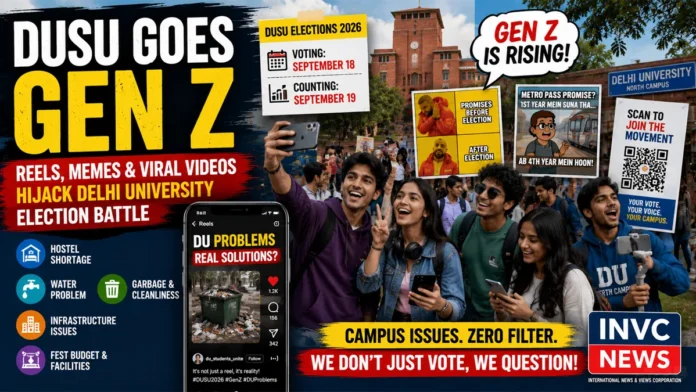
The DUSU Elections 2026 battle is getting a distinctly Gen Z makeover—and this time, students are not waiting for political organisations to tell them what the election should be about.
Weeks before voting, Delhi University campuses are filling up with reels, memes, sarcastic videos, QR-code campaigns and viral posts targeting everything from hostel shortages and broken infrastructure to drinking water, fest budgets and promises that students say disappear after election season.
The Delhi University Students’ Union election is scheduled for September 18, with counting on September 19.
But on Instagram and across campus WhatsApp circles, the campaign has effectively started already.
And the message from students is blunt:
Don’t just ask for our votes. Tell us what happened to last year’s promises.
Students Turn Water, AC and Hostel Problems Into Viral Content
One of the clearest signs of the changing campaign came from a viral student jamming session built around everyday college frustrations.
Instead of a conventional protest speech, students turned complaints about missing water and non-functioning air-conditioning into a song.
That is increasingly how political dissatisfaction is being expressed across DU:
less pamphlet, more reel.
less slogan, more meme.
Long-running problems involving hostel capacity, sanitation, garbage, infrastructure and campus facilities are being compressed into short-form videos designed to travel quickly across phones.
The result is that students themselves are beginning to define the questions candidates will have to answer.
‘Gen Z Is Rising’ Enters the Campaign
Student organisations have noticed.
The All India Students’ Association has used the slogan “Gen Z is rising” while mobilising students around campus issues and a September 2 protest.
The National Students’ Union of India has also adopted Gen Z-oriented language and imagery in its campaign communication.
ABVP, meanwhile, has been presenting its record on hostels, safety, Wi-Fi, internships, sports, examination reforms and campus facilities as it prepares to defend its position in university politics.
The election is therefore becoming more than the usual ABVP-versus-NSUI contest.
It is also turning into a competition over who understands the language—and frustrations—of today’s students best.
Also Read – : BJP vs Congress Battle for Gen Z: Jobs, Exams and Student Politics Take Center Stage
Metro Pass Promise Becomes a Meme
Even old campaign promises are being dragged back into the conversation.
One viral post mocks the repeated promise of discounted Metro passes for students, essentially saying the student first heard the promise in first year and is now in fourth year still waiting.
That is exactly why memes can become politically damaging.
A manifesto can be forgotten.
A meme reminding thousands of students that a promise remains incomplete can travel again and again.
Students are also posting videos asking candidates to show what percentage of promises from previous manifestos were actually delivered.
That changes the direction of campaigning from:
“Here is what we promise.”
to:
“Show us what you already did.”
From Handwritten Posters to QR Codes
Even the mechanics of student politics are changing.
QR codes are appearing on campaign material, allowing students to connect with organisations directly through their phones.
Messages once written on walls or distributed through paper posters now appear on mobile screens, Instagram accounts and digital campaign cards.
It is a small technological change with a larger political meaning.
DUSU campaigning is moving toward the same digital battlefield already reshaping national politics.
For candidates, visibility is no longer determined only by how many posters appear outside a college gate.
A 20-second video can potentially matter more than hundreds of printed leaflets.
Gorilla Costumes and ‘Rooftop Campaigns’ Enter DUSU Politics
The visual side of campaigning is getting stranger too.
After a person wearing a black gorilla costume attracted attention during an earlier protest at Jantar Mantar, similar campaign imagery has appeared around Delhi University.
At the same time, luxury cars and road convoys linked to campaigning have become a major talking point online.
Students have begun referring to some of these displays as “rooftop campaigns”, with participants visibly campaigning from vehicles.
The spectacle may attract attention—but it also gives meme creators fresh material.
For candidates attempting to project power and popularity, that creates a new risk:
What looks impressive on the road can become satire on Instagram within minutes.
Independent Students Are Challenging Party Politics Too
Perhaps the more important change is that unaffiliated students are increasingly entering the debate.
Some viral videos question why student leaders become difficult to find after winning elections.
Others argue that voters should stop choosing candidates purely on name, surname or political organisation and instead ask who will actually help students after the votes are counted.
That frustration cuts across party lines.
It suggests DUSU 2026 could become as much a referendum on the culture of student politics as a contest between individual candidates.
Also Read – : Rahul Gandhi Launches Nationwide Student Outreach From Kota, Signals Congress’ Long-Term Youth Strategy
Why DUSU 2026 Matters Beyond Delhi University
DUSU elections have long attracted national political attention because several leaders who began in student politics later moved into mainstream public life.
But 2026 carries an additional significance.
Political parties across India are actively trying to understand Gen Z voters—a generation shaped by smartphones, short-form video, competitive exams, expensive education, employment uncertainty and instant online scrutiny.
Delhi University offers a live laboratory for that transformation.
Issues such as:
- Hostel availability
- Campus safety
- Drinking water
- Fees
- Metro concessions
- Internships
- Examination systems
- Mental health
- Infrastructure
are no longer discussed only in meetings.
They are turned into content.
And content can become political pressure remarkably quickly.
The DUSU Battle Has Already Started
Formal manifestos, candidate lists and rallies will dominate closer to September 18.
But Gen Z students may already have changed the terms of the contest.
Political organisations can still choose the candidates.
They can still organize the rallies.
They can still release manifestos.
But they may no longer fully control the narrative.
This year, a sarcastic meme about an old promise, a reel showing a broken campus facility or a viral student video asking an uncomfortable question could travel faster than the campaign vehicle parked outside the college gates.
DUSU 2026 is therefore shaping up as more than another student election.