NEW DELHI, India | August 27, 2026 —
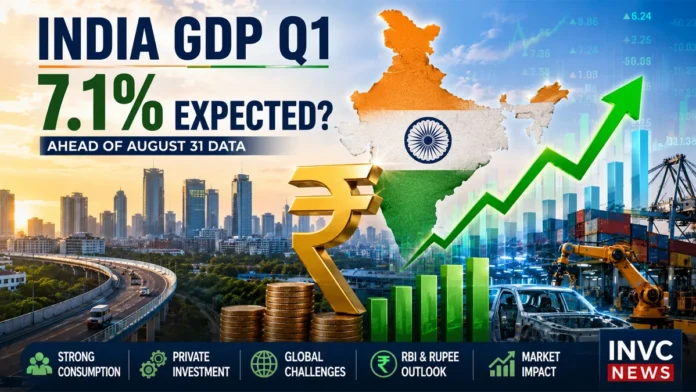
India GDP Q1 FY27 is set to become one of the most important economic releases of the week, with official April-June growth data scheduled for August 31 and economists expecting the world’s fastest-growing major economy to lose some momentum after a strong finish to the previous financial year.
A poll of economists puts median real GDP growth for the April-June quarter at around 7.1% year over year, compared with 7.8% growth in the January-March quarter.
India’s economy expanded 7.7% in FY2025-26, according to official government estimates.
The Q1 number will therefore answer a critical question:
Can strong household consumption and government spending keep India above 7% growth even as expensive crude oil, a weaker rupee and cautious private investment create fresh pressure?
When Will India Q1 FY27 GDP Data Be Released?
The Ministry of Statistics and Programme Implementation will release the Quarterly Estimates of GDP for Q1 FY2026-27 on August 31, 2026.
A government press conference is scheduled for 5:15 PM IST.
Official PIB media invitation:
https://www.pib.gov.in/MediaInvitationDetail.aspx?InvitationID=159342&lang=1®=48
That means the official growth number will arrive after regular stock-market trading has closed for the day.
The immediate equity-market reaction could therefore become more visible in the next trading session.
Economists Expect Growth Near 7.1%
A survey of 58 economists produced a median forecast of approximately 7.1% real GDP growth for the April-June quarter.
If that estimate is correct, growth would slow from 7.8% in Q4 FY26 but remain historically strong.
The expected moderation does not necessarily signal a major economic slowdown.
Instead, economists point to a combination of resilient domestic demand and weaker private investment.
Consumer spending has remained relatively supportive, helped in part by previous tax relief and income growth.
Government expenditure has also provided support.
Business investment, however, has remained more cautious amid geopolitical uncertainty, expensive energy and a weaker currency.
India Grew 7.7% in FY2025-26
The comparison base is strong.
Official provisional estimates show that India’s real GDP expanded 7.7% during FY2025-26.
Growth accelerated to 7.8% in the January-March quarter.
Official GDP data:
https://www.pib.gov.in/PressReleasePage.aspx?PRID=2269286&lang=1®=1
Also Read – : India GDP Growth Hits 7.7%, Rajnath Singh Hails Economic Strength Amid Global Uncertainty
That makes Q1 FY27 important because investors will want to know whether last year’s momentum is carrying into the new financial year.
Consumption Could Remain a Major Support
Private consumption is one of the most important components of India’s economy.
Consumer spending can support growth across:
- Retail
- Automobiles
- Travel
- Financial services
- Consumer goods
- Housing
- Telecommunications
The April-June quarter benefited from relatively resilient household demand.
Previous tax measures have also provided some support to disposable income.
If consumption remains strong in the official GDP release, it could help offset weaker momentum in investment-heavy sectors.
Private Investment Is the Bigger Question
Economists remain more cautious about private capital expenditure.
Companies generally become more reluctant to commit large amounts of capital when future demand, currency costs or global trade conditions become uncertain.
India has faced several external risks during 2026.
These include:
- Expensive crude oil
- Middle East geopolitical tensions
- A weaker rupee
- Global tariff uncertainty
- Higher international financing costs
These factors can delay corporate expansion plans even when domestic demand remains reasonably healthy.
A strong private-investment number in the GDP release would therefore be one of the most positive surprises for markets.
Exports Provided Some Support
India’s goods and services exports increased by more than 11% year over year during the April-June quarter, providing an additional contribution to economic activity.
Export performance matters because global trade has been under pressure from tariffs, geopolitical tensions and slower growth in some major economies.
Continued export growth would suggest that Indian businesses are still finding demand despite those challenges.
However, the external environment remains uncertain.
Recent U.S. trade legislation and tariff threats linked to Russian oil purchases have created another risk for Indian exporters.
High Crude Oil Remains a Major Threat
India imports most of the crude oil it consumes.
That means high global oil prices can affect growth through several channels.
More expensive oil can increase:
- India’s import bill
- Inflation
- Transportation costs
- Manufacturing expenses
- Pressure on the rupee
- Corporate input costs
If companies face higher costs, they may reduce investment or pass part of those expenses to consumers.
Also Read – : Crude Oil Surge Seen Pressuring Indian Markets: Why Rising Oil Matters for Sensex, Nifty and Inflation
Oil therefore remains one of the biggest external variables surrounding India’s FY27 growth outlook.
Rupee Weakness Could Complicate the Picture
The rupee has weakened significantly against the U.S. dollar during 2026.
A weaker currency can support some exporters because overseas earnings become more valuable in rupee terms.
But it also makes imported goods, fuel and equipment more expensive.
That is particularly important for companies dependent on imported machinery, electronics, raw materials or energy.
Also Read – : Indian Rupee Could Slide Toward 99 per Dollar by 2028—Could an Oil Shock Push It to 101?
Currency weakness can therefore simultaneously help selected exporters and hurt import-dependent businesses.
What Would a 7.1% GDP Number Mean for RBI?
A GDP number near 7.1% would likely reinforce the view that India’s economy remains relatively resilient.
For the Reserve Bank of India, however, growth is only one side of the policy equation.
The central bank must also watch inflation.
If economic growth remains above 7% while food and fuel inflation stay elevated, the RBI may have less urgency to cut interest rates.
That does not automatically mean a rate increase is coming.
The RBI will consider several factors together:
- Headline inflation
- Food inflation
- Core inflation
- GDP growth
- Crude oil
- Rupee movement
- Global interest rates
A much weaker-than-expected GDP reading could increase pressure for policy support.
A stronger-than-expected reading could give the RBI more room to focus on inflation.
What Could the GDP Data Mean for the Rupee?
Currency markets generally prefer strong growth when it is accompanied by stable inflation and manageable external balances.
A GDP print above expectations could improve confidence in India’s economic resilience.
But the rupee’s direction will still depend heavily on crude oil, the U.S. dollar and foreign-investor flows.
A strong GDP number cannot completely offset an external oil shock or sharp global dollar rally.
That means investors should avoid interpreting GDP as the only driver of the currency.
What Could the GDP Data Mean for Sensex and Nifty?
Indian equities could react to the difference between the official number and market expectations.
If growth comes materially above 7.1%, investors could interpret it as evidence of stronger domestic demand and earnings potential.
Sectors sensitive to domestic growth could benefit from improved sentiment.
These may include financials, consumer companies, industrials and capital goods.
If GDP disappoints significantly, concerns about corporate earnings and private investment could return.
However, stock markets do not move on GDP alone.
Valuations, crude prices, global markets, FPI flows and interest-rate expectations will continue to matter.
A New Statistical Framework Also Matters
The August 31 release has another technical dimension.
MoSPI has moved India’s GDP estimates to a 2022-23 base year.
The government has also said the upcoming quarterly estimates will incorporate revised Index of Industrial Production and wholesale/producer price series where applicable.
Official MoSPI information:
https://www.pib.gov.in/PressReleasePage.aspx?PRID=2269286&lang=1®=1
This means analysts should pay attention not only to the headline growth rate but also to revisions in historical data and sector estimates.
Which GDP Sectors Should Investors Watch?
The headline number will attract most attention, but the sector breakdown may tell a more useful story.
Investors should watch:
Manufacturing:
A key signal for industrial momentum and private investment.
Construction:
Important for infrastructure, housing and employment.
Trade, hotels, transport and communication:
A useful indicator of consumer and services demand.
Financial and real-estate services:
Closely linked to credit growth and domestic investment.
Agriculture:
Particularly important given the weak monsoon outlook.
A headline GDP figure can look strong even when individual sectors are moving in very different directions.
Weak Monsoon Could Become a Q2 Risk
The April-June GDP release will largely capture economic activity before the full impact of the current weak monsoon became visible.
That means agricultural and food-price risks may become more important in subsequent quarters.
Also Read – : India’s Weakest Monsoon Since 2009? What a 15% Rain Deficit Could Mean for Rice, Pulses, Wheat and Food Prices
A weak monsoon could affect rural demand, agricultural output and food inflation later in FY27.
What Would Count as a Positive Surprise?
A GDP print significantly above 7.1% could indicate stronger-than-expected resilience.
Markets would particularly welcome:
- Strong private consumption
- Better manufacturing growth
- Higher private investment
- Healthy construction activity
- Strong services growth
A strong combination would be more meaningful than a headline number driven mainly by one component.
What Would Count as a Negative Surprise?
A growth rate materially below 7% could raise concerns that expensive oil, private-investment weakness or global uncertainty is affecting activity faster than expected.
Investors would then examine whether the slowdown is concentrated in one sector or spread across the economy.
A weak investment number would be particularly important because India needs sustained capital expenditure to maintain high growth over several years.
India GDP Q1 FY27: Quick Answers
When will Q1 FY27 GDP be released?
August 31, 2026.
What time is the government press conference?
5:15 PM IST.
What is the current economist forecast?
Around 7.1% year-over-year growth.
What was Q4 FY26 growth?
7.8%.
What was India’s FY2025-26 annual GDP growth?
7.7%.
Will GDP data decide RBI rates automatically?
No. Inflation and other economic conditions also matter.
Will a strong GDP number guarantee a stock-market rally?
No. Markets also respond to valuations, oil, global conditions and capital flows.
The Bigger Question for India
India remains one of the fastest-growing major economies in the world.
The August 31 data will show whether that momentum has remained strong as FY27 begins.
A figure around 7.1% would represent moderation from the previous quarter, but it would still indicate robust growth by global standards.
The bigger challenge is maintaining that momentum while India confronts expensive energy, currency weakness, weaker monsoon conditions and uncertain global trade.
That is why the Q1 GDP release will matter beyond a single percentage number.
It will provide the clearest official snapshot yet of how well India’s economy is absorbing the shocks of 2026.