MUMBAI, India | August 27, 2026 —
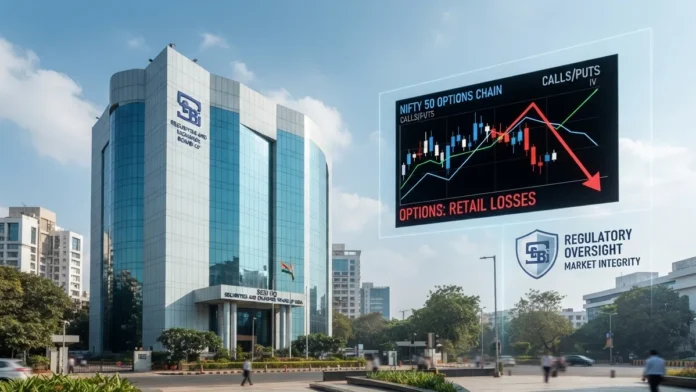
SEBI F&O rules 2026 are back in focus after new regulatory data showed that 87.7% of individual traders in India’s equity derivatives market lost money during FY2025-26, despite a series of measures introduced to cool speculative trading.
Individual traders recorded aggregate net losses of approximately ₹91,685 crore during FY26, according to studies released by the Securities and Exchange Board of India.
The losses were lower than roughly ₹1.12 lakh crore in the previous financial year, but the percentage of traders losing money remained extraordinarily high.
At the same time, SEBI has intensified enforcement around market integrity, recently issuing an interim order against JPMorgan-owned Copthall Mauritius Investment and Mumbai-based Mansi Share and Stock Broking over alleged manipulation during the newly introduced Sensex Closing Auction Session.
The combination has raised an important question for retail investors:
Could India’s F&O market face further tightening?
The answer is that additional measures are possible, but SEBI has not announced a new blanket set of retail-options restrictions at this stage.
87.7% of Individual F&O Traders Lost Money in FY26
SEBI’s latest profitability study paints a stark picture of India’s derivatives market.
Key findings include:
- 87.7% of individual traders incurred net losses
- Aggregate individual losses stood at about ₹91,685 crore
- Active individual traders fell to around 78.6 lakh
- Participation declined by roughly 20% from FY25
- New entrants fell by around 40%
- Average loss per trader was approximately ₹1.17 lakh
- Options accounted for around 92% of aggregate individual losses
The numbers indicate that regulatory measures have cooled participation, but they have not fundamentally changed the probability of a retail trader ending the year with a loss.
SEBI’s official profitability study is available here:
Its separate trading-behavior study is available here:
Retail Traders Lost Less Overall — But That Is Not the Whole Story
At first glance, the fall in aggregate losses from roughly ₹1.12 lakh crore to ₹91,685 crore appears encouraging.
But much of that improvement occurred alongside a sharp decline in the number of people participating.
The number of individual traders fell from about 98.1 lakh in FY25 to 78.6 lakh in FY26.
That means fewer people were trading derivatives.
Meanwhile, the average loss per individual trader rose slightly.
So the data does not suggest that F&O suddenly became safer for those who remained active.
Instead, it suggests regulatory measures reduced participation and aggregate activity while the underlying risk for individual participants remained very high.
Options Caused Most of the Losses
Options remain the central issue.
Approximately 92% of aggregate losses incurred by individuals came from options trading, according to SEBI’s study.
That matters because options can appear deceptively accessible.
A trader can take a position with a relatively small upfront premium while gaining exposure to a much larger market movement.
But time decay, volatility changes, leverage and rapid price movement near expiry can make these instruments extremely difficult for inexperienced traders.
Frequent trading can increase the problem further because transaction costs accumulate whether the trader ultimately makes money or not.
Retail Traders Paid Around ₹25,000 Crore in Transaction Costs
The trading bill itself is enormous.
Individual participants incurred roughly ₹25,000 crore in transaction costs during FY26, according to data from the SEBI study.
These costs can include brokerage-related expenses, exchange charges, securities transaction tax and other trading costs.
For highly active traders, transaction expenses can materially reduce returns even before trading losses are considered.
This is one reason why frequent short-term options trading can produce very different outcomes from what a trader sees when looking only at individual winning trades.
Institutional and Algorithmic Traders Remain Strong
SEBI’s study also highlights the other side of the derivatives market.
Proprietary traders recorded gross trading profits of approximately ₹44,000 crore, while foreign portfolio investors generated around ₹14,000 crore.
Corporate entities and other institutional categories also recorded gains.
One particularly important finding is that the overwhelming majority of gross profits generated by proprietary and foreign portfolio traders came from algorithmic entities.
That does not mean every algorithm wins or every retail participant loses.
But it highlights the environment in which an individual trader competes: sophisticated institutions may use advanced technology, large datasets, automated execution and highly developed risk-management systems.
SEBI Has Already Tightened F&O Rules
The current debate is not beginning from zero.
SEBI has introduced several derivatives-market measures since late 2024 aimed at improving market stability and reducing excessive speculative activity.
These have included:
- Larger minimum contract sizes for index derivatives
- Rationalization of weekly index contracts
- Stronger risk coverage around expiry sessions
- Upfront collection of option premiums from buyers
- Changes to expiry-day margin treatment
- Intraday monitoring of position limits
- Rationalization of monthly index derivative products
The decline in retail participation during FY26 suggests these measures are already influencing behavior.
However, the percentage of loss-making traders remains high enough to keep the issue firmly on the regulator’s agenda.
JPMorgan-Owned Copthall and Mansi Face SEBI Action
The wider derivatives crackdown is also extending into market surveillance and manipulation.
SEBI issued an ex-parte interim order on August 19 involving Copthall Mauritius Investment and Mansi Share and Stock Broking.
The regulator alleged that trading activity during the August 13 Sensex Closing Auction Session, which coincided with derivatives expiry, distorted prices in Sensex constituent stocks.
SEBI alleged that Copthall placed unusually aggressive buy orders, while Mansi placed large sell orders during the auction session.
The regulator said some orders were subsequently cancelled and alleged that the activity benefited options positions linked to the Sensex closing value.
These are allegations contained in an interim regulatory order, not final findings after completion of the investigation.
SEBI ordered the impounding of approximately ₹3.68 crore in alleged wrongful gains and restricted the two entities from accessing the securities market until further orders.
Official SEBI order:
What Is the Closing Auction Session?
The Closing Auction Session, or CAS, was introduced in India on August 3, 2026.
Instead of deriving the official closing price from the average price during the final part of continuous trading, the new mechanism uses a dedicated auction process.
Its objective is to improve price discovery and bring Indian markets closer to practices used in several other major Asian markets.
But thin liquidity during an auction can make unusual orders particularly influential.
That is why SEBI’s rapid action in the August 13 case is important.
The regulator is signaling that the new system will be closely monitored.
Could SEBI Introduce More F&O Curbs?
Possibly—but investors should separate discussion from official policy.
Ideas being debated around the market include tighter collateral requirements, additional controls on frequent weekly options and stronger eligibility or risk checks for individual traders.
However, these should not currently be described as confirmed new SEBI rules.
Any major regulatory change would normally require a circular, consultation paper, formal notification or other official communication from the regulator.
The safest approach for investors is therefore to follow SEBI’s official updates rather than viral social-media claims about “new F&O rules.”
Official SEBI website:
Why SEBI Is Worried About Retail Options Trading
The regulator’s concern is not simply that traders lose money.
Financial markets naturally involve risk.
The larger issue is the scale and persistence of losses among individual participants combined with extremely high trading activity.
If a very large majority of individuals repeatedly lose money while sophisticated institutions capture significant profits, questions emerge around:
- Investor understanding
- Leverage
- Suitability of complex products
- Excessive trading
- Financial literacy
- Platform design
- Risk disclosures
That is why derivatives regulation increasingly resembles a consumer-protection issue as much as a market-structure issue.
Does SEBI Want to Ban Options Trading?
There is no indication that SEBI plans to eliminate the derivatives market.
Futures and options serve legitimate economic purposes.
Institutions use derivatives to hedge portfolios, manage risks and improve price discovery.
The regulatory challenge is to preserve those functions while reducing excessive speculative activity among investors who may not fully understand the risks involved.
That makes tighter guardrails more likely than an outright ban.
What Retail Traders Should Understand Before Trading F&O
The headline figure—87.7% losing money—should be treated as a risk warning rather than a prediction that every trader will lose.
Anyone considering futures or options should understand:
Leverage magnifies both gains and losses.
A relatively small market movement can produce a disproportionately large change in the value of a derivative position.
Options lose time value.
A trader can correctly predict the broad market direction and still lose money because of timing, implied volatility or option decay.
Transaction costs matter.
Frequent trading can make profitability substantially harder.
Expiry sessions can be highly volatile.
Prices can change rapidly around contract expiry.
Professional competitors have structural advantages.
Large institutional and algorithmic traders may have faster execution, advanced technology and sophisticated risk-management systems.
Is F&O Suitable for Long-Term Wealth Creation?
For most investors, derivatives and long-term investing serve very different purposes.
Long-term equity or mutual-fund investing generally focuses on ownership, business growth and compounding over time.
F&O trading is usually much more short-term and can involve significant leverage.
That distinction becomes particularly important when young investors enter derivatives markets expecting the same wealth-building dynamics associated with long-term equity investing.
Also Read – : SEBI Bars 15 Individuals From Stock Market Over Telegram Stock-Tip Case
Market regulators have increasingly focused not only on trading behavior but also on misleading investment advice and social-media-driven speculation.
What Happens Next?
The coming months could be important for India’s derivatives market.
SEBI will be watching whether existing rules continue reducing speculative volumes and whether individual-trader outcomes improve.
The regulator will also monitor the new Closing Auction Session closely after the alleged August 13 manipulation.
If retail losses remain extremely high despite declining participation, pressure for additional safeguards could grow.
For now, however, investors should remember the distinction:
SEBI has already tightened F&O rules, but no new broad retail-options crackdown has been formally announced simply because 87.7% of traders lost money.
The bigger message from the latest data is already powerful enough.
Nearly nine out of every 10 individual derivatives traders ended FY26 in the red.
And for anyone considering options trading, that statistic may be more useful than any promise of quick profits.
This article is for informational and educational purposes only. Futures and options involve substantial risk and are not suitable for every investor. This is not investment advice.