NEW DELHI, INDIA | AUGUST 26, 2026 —
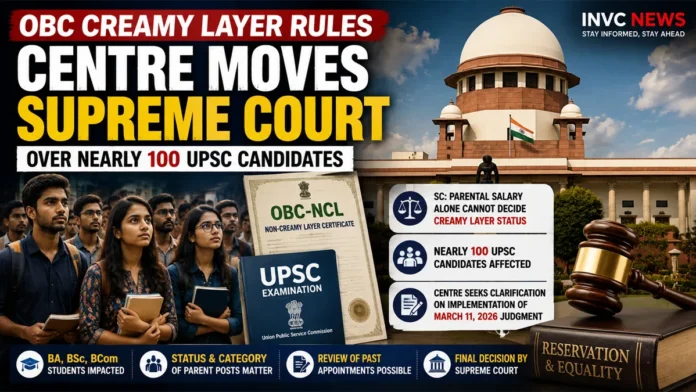
OBC creamy layer rules are back in national focus after the Centre approached the Supreme Court seeking clarification on the implementation of a major judgment affecting nearly 100 Other Backward Classes candidates selected through the Civil Services Examination since 2016.
The dispute centers on a crucial question for OBC reservation: Can a candidate be classified as creamy layer solely because of the salary income of their parents?
In its March 11, 2026 judgment, the Supreme Court said parental income from salary alone cannot be the sole basis for deciding creamy-layer status. The court held that the status and category of the posts held by the candidate’s parents must also be considered.
The Centre has now sought clarification and appropriate directions from the Supreme Court on how that ruling should be applied to candidates whose appointments or service allocations were affected in previous Civil Services Examinations.
What Did the Supreme Court Say on OBC Creamy Layer?
The Supreme Court’s March judgment dealt with candidates claiming reservation under the OBC Non-Creamy Layer, or OBC-NCL, category.
Several candidates had cleared the Civil Services Examination but faced problems during verification because their parents worked in public-sector undertakings, banks or other organizations.
Authorities had considered parental salary while determining whether the candidates fell within the creamy layer.
The Supreme Court ruled that this approach could not be applied mechanically.
According to the judgment, income from salary alone cannot determine whether a person belongs to the OBC creamy layer.
The court said parental occupational status and the category of post held by the parent are essential factors under the existing reservation framework.
Why Has the Centre Returned to the Supreme Court?
The Department of Personnel and Training has now sought clarification regarding the implementation of the ruling for approximately 100 affected OBC candidates.
These candidates were selected in different Civil Services Examinations beginning in 2016 but were denied appointments, allocations or reservation benefits because of creamy-layer determinations.
The Centre’s move is important because implementation could require a review of older cases and potentially affect appointments or service allocation.
The government had reportedly been preparing to implement the judgment before seeking further directions from the Supreme Court.
Could Nearly 100 UPSC Candidates Get Relief?
Potentially, yes—but the outcome will depend on how the Supreme Court responds to the Centre’s request.
The March judgment directed the Department of Personnel and Training to reconsider the claims of affected candidates according to the principles laid down by the court.
Where necessary, the court also contemplated the creation of supernumerary posts so eligible candidates could be accommodated without displacing officers already appointed.
However, this does not automatically mean every candidate will receive an appointment.
Each case will still have to satisfy the applicable OBC Non-Creamy Layer criteria.
Salary Income vs Parental Status: Why the Difference Matters
The distinction is central to the dispute.
Under the reservation framework examined by the Supreme Court, creamy-layer determination is not simply a question of whether a family’s annual income crosses a particular figure.
For some categories, the position or status held by the parents is equally important.
The court observed that treating the children of PSU or private-sector employees differently from similarly placed government employees merely because of salary calculations could result in unequal treatment.
This is particularly significant for families where a parent receives a relatively high salary but does not occupy a senior managerial or equivalent position that would otherwise place the family within the creamy layer.
What Does This Mean for Current OBC Candidates?
Candidates preparing for UPSC or other central-government recruitment examinations should not assume that the March judgment has removed the creamy-layer requirement.
It has not.
OBC candidates seeking reservation benefits must still meet the Non-Creamy Layer eligibility conditions and submit valid documents.
The key change is that creamy-layer determination cannot, according to the Supreme Court’s ruling, be made solely on parental salary without considering the relevant status-based criteria.
Candidates should rely on the applicable recruitment notification and official certificate requirements rather than social-media interpretations of the judgment.
The official Supreme Court judgment can be accessed through the Supreme Court of India website.
Why This Matters for UPSC Aspirants
Reservation-category verification is one of the most important stages after a candidate qualifies in a competitive examination.
Even a candidate who clears the examination can face difficulty if the caste certificate, OBC-NCL status or prescribed documentation does not satisfy the rules applicable to the examination year.
That makes the Supreme Court case highly relevant to Civil Services aspirants as well as candidates appearing for other central recruitment examinations.
INVC NEWS readers tracking central-government opportunities can also see our recent guide to UPSC EPFO APFC Recruitment 2026 for 80 Group A posts.
The recruitment includes vacancies across several reservation categories and is another example of why candidates must verify category eligibility carefully before applying.
Does the ₹8 Lakh Limit Alone Decide OBC Creamy Layer?
This is where confusion often arises.
The familiar income threshold associated with OBC creamy-layer rules should not be interpreted as a universal standalone test in every circumstance.
The Supreme Court emphasized that the applicable government framework distinguishes between different categories of parental employment and status.
Therefore, simply looking at annual salary without checking the parent’s service category can produce an incorrect conclusion.
Candidates facing a real eligibility dispute should rely on the relevant government Office Memoranda, recruitment rules and official legal orders.
What Happens Next?
The Supreme Court will have to consider the Centre’s clarification request and determine how the March 11 judgment should be implemented for the affected candidates.
The outcome will be closely watched because it may establish a clearer administrative process for handling similar OBC-NCL cases in future recruitment.
For the nearly 100 candidates whose appointments have remained affected for years, the case could have immediate career consequences.
For millions of aspirants preparing for UPSC, SSC, banking and other government examinations, however, the larger significance is broader:
OBC creamy-layer status cannot be reduced to a simple salary calculation.
The legal test must follow the full reservation framework, including parental status and employment category where applicable.