WELLINGTON, New Zealand | August 25, 2026 —
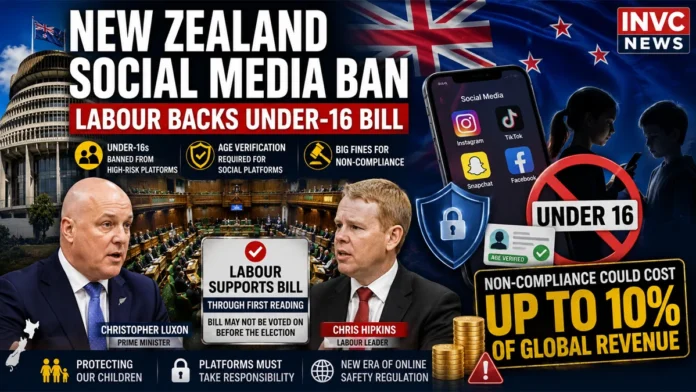
New Zealand social media ban for under-16s has gained major political momentum after the opposition Labour Party agreed to support the government’s Online Safety Bill through its first reading, potentially clearing one of the biggest obstacles facing Prime Minister Christopher Luxon’s plan to restrict children’s access to high-risk social media platforms.
The proposed law would require platforms such as Instagram, TikTok, Snapchat and Facebook to take reasonable steps to prevent children under 16 from holding accounts.
Companies that fail to comply could ultimately face penalties of up to 10% of their global revenue.
But the legislation is not law yet — and despite Labour’s support, the government says there may not be enough parliamentary time to hold even the first vote before New Zealand’s upcoming election.
Labour Gives Luxon’s Social Media Bill a Political Lifeline
Labour leader Chris Hipkins confirmed that his party will support the legislation through its first reading.
That is politically significant because two parties in Luxon’s governing coalition — ACT New Zealand and New Zealand First — oppose the proposal.
Without Labour, the Bill faced serious questions over whether it could advance.
Labour’s support does not mean the party has endorsed every detail.
Hipkins has said the legislation needs improvement and should move to a select committee, where lawmakers, experts and members of the public could examine and potentially amend it.
Labour technology spokesperson Reuben Davidson has also called for stronger emphasis on broader online safety rather than relying solely on age restrictions.
Official Labour statement:
What the New Zealand Social Media Ban Would Do
The legislation is formally called the Online Safety (Minimum Age and Child Safety Risk Assessment) Bill.
Under the proposed framework, designated high-risk social media companies would have to take reasonable steps to determine whether users are at least 16.
Potential age-assurance tools could include:
- Existing account information
- Facial age-estimation technology
- Digital identity services
- Formal identification documents
Simply asking a child to enter a date of birth may not be considered sufficient.
The legal responsibility would fall primarily on the platforms rather than children or their parents.
No Fines for Children or Parents
The government says children, parents and caregivers would not face penalties for violating the age restriction.
Instead, enforcement would focus on technology companies.
That is a crucial distinction.
The proposal is designed to force platforms to build stronger age-verification and child-safety systems rather than criminalizing children who try to access social media.
Platforms Could Face Enormous Fines
The biggest financial element of the Bill is its proposed penalty regime.
Companies failing to meet their obligations could face penalties reaching up to 10% of global revenue.
For the world’s largest technology platforms, that could translate into extremely large financial exposure.
The government specifically identifies high-risk platforms such as:
- TikTok
- Snapchat
However, individual services would ultimately depend on how platforms are designated and regulated under the final framework.
That is why it would be premature to claim that every service operated by Google, Meta or another technology company automatically falls under the age restriction.
Bill Goes Beyond an Under-16 Ban
The proposal is broader than its headline-grabbing age limit.
Platforms used by children would also be required to regularly assess risks they create and explain how those risks are being reduced.
The government also wants emerging technologies, including some AI companion platforms, brought within the wider online-safety regulatory framework.
An independent online-safety regulator within New Zealand’s Department of Internal Affairs would monitor compliance, investigate companies and enforce the rules.
Government details:
https://www.beehive.govt.nz/release/government-moves-ban-u16s-from-social-media
Why Luxon Wants the Ban
Luxon argues that social media is creating significant risks for children.
The government says approximately one in three New Zealand children aged 13 to 17 spends at least five hours a day on social media.
Officials have highlighted concerns involving:
- Harmful content
- Addictive platform design
- Mental health
- Sleep
- Education
- Family life
- Online exploitation
The government’s argument is that parents cannot carry the entire burden of protecting children when global platforms design and operate the technology.
Why ACT and New Zealand First Oppose It
The plan remains politically controversial.
New Zealand First, led by Winston Peters, has opposed the proposal and warned about government overreach.
ACT has also argued that an age ban may be ineffective and could create unintended consequences.
Critics question whether technically skilled teenagers could bypass age-verification measures and whether more intensive identity checks could create privacy concerns.
Those concerns are likely to become central if the Bill eventually reaches a select committee.
Will the Bill Pass Before the Election?
This is now the biggest political question.
Labour’s support may provide enough votes for the Bill to pass its first reading.
But New Zealand’s government has indicated that Parliament has only a limited number of sitting days remaining before the election and that its existing legislative agenda is already crowded.
That creates an unusual situation:
The votes may now exist — but the parliamentary time may not.
Labour wants the government to move the Bill through its first reading before the election so that select-committee work can begin.
The government, however, has indicated the process may have to resume after voters choose the next Parliament.
Australia Has Already Tested the Model
New Zealand is not acting in isolation.
Australia became the first major country to implement a nationwide under-16 social media restriction, and governments around the world are now examining similar policies.
New Zealand says it is studying those international experiences while attempting to create its own regulatory system.
The wider trend signals a major shift in the relationship between governments and social media companies.
For years, online child safety largely depended on parental controls and voluntary platform policies.
Governments are increasingly asking whether the platforms themselves should carry a legal duty to prevent children from accessing certain services.
Why Meta and Other Social Platforms Will Watch Closely
For companies such as Meta, TikTok and Snap, New Zealand is a relatively small market.
The regulatory precedent is much bigger.
If more countries adopt age restrictions backed by penalties calculated against global revenue, platforms could face growing pressure to develop universal age-assurance systems.
That raises major questions involving:
- User privacy
- Facial age estimation
- Digital identity
- Data retention
- Advertising
- Algorithm design
- Children’s access to online communities
INVC NEWS recently reported on another regulatory challenge facing Meta in the United States, where lawmakers are questioning Mark Zuckerberg over AI deepfakes and election safeguards.
Together, these developments show how political pressure on major social platforms is expanding from misinformation and elections to child safety and platform design.
New Zealand Social Media Ban: What Happens Next?
Three developments now matter most.
First, whether the government finds time for a first reading before the election.
Second, whether Labour continues supporting the legislation after the select-committee process and possible amendments.
Third, how the final law defines high-risk platforms and acceptable age-verification methods.
Labour’s decision has unquestionably improved the Bill’s political prospects.
But New Zealand has not banned social media for under-16s yet.
For now, the country has moved from debating whether such a law should exist to debating how it should work — and whether Parliament can act before the election clock runs out.