NEW DELHI, India | August 25, 2026 —
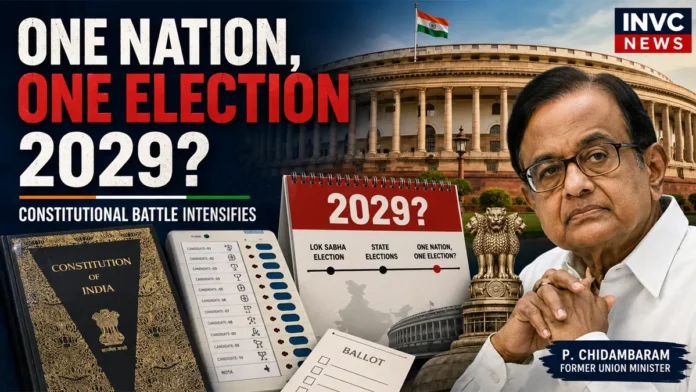
One Nation One Election 2029 has emerged as the latest major constitutional battle between the government and the Opposition, with senior Congress leader P. Chidambaram arguing that simultaneous Lok Sabha and Assembly elections cannot be implemented in 2029 under the legislation currently before Parliament.
Chidambaram, who recently presented his views before the Joint Parliamentary Committee examining the proposal, also said Congress and other Opposition parties would launch a nationwide campaign against the Bills.
His challenge, however, goes beyond party politics.
At the heart of the dispute is a crucial question: even if Parliament approves One Nation, One Election, when could simultaneous elections actually begin?
Why Chidambaram Says 2029 Is Not Possible
Chidambaram’s argument focuses on the wording of the Constitution (129th Amendment) Bill, 2024.
The Bill proposes a new Article 82A.
Under the introduced text, the President may issue a notification bringing the simultaneous-election framework into force on the date of the first sitting of the Lok Sabha after a general election. That date becomes the “appointed date.”
If India’s next scheduled Lok Sabha election takes place in 2029, the appointed date under the current framework would therefore come after that general election.
State Assemblies elected after the appointed date would then have their terms aligned with the expiry of that Lok Sabha.
That is why critics argue that the legislation as currently drafted appears to create the synchronized cycle after 2029 rather than allowing every Assembly election to be held alongside the 2029 Lok Sabha election.
Independent legislative analysis by PRS has illustrated a scenario in which a notification issued after the 2029 general election could result in the first full simultaneous-election cycle around 2034.
JPC Chairman Says 2029 Can Still Be Achieved
Joint Parliamentary Committee chairman P.P. Chaudhary has taken a different position.
He has said simultaneous Lok Sabha and Assembly elections could be possible in 2029 if the necessary constitutional changes are approved and state governments cooperate with the transition.
That means the 2029 debate is not necessarily settled.
The JPC is still examining the Bills and could recommend amendments, transition arrangements or additional safeguards before submitting its final report to Parliament.
The committee has been conducting consultations with legislators, constitutional experts, political parties and other stakeholders across the country.
Its deadline for submitting the report has been extended into the Winter Session of Parliament in 2026.
What Would One Nation, One Election Change?
The proposal aims to restore a system in which Lok Sabha and State Assembly elections are held in the same broad electoral cycle.
India conducted simultaneous parliamentary and Assembly elections during the early decades after independence, but the cycle broke after premature dissolutions of legislatures.
Today, different states vote at different times.
The proposed constitutional amendment seeks to create a common cycle again.
Under the current Bill:
- Lok Sabha and State Assembly elections would eventually be synchronized.
- Assembly terms could be shortened to align with the Lok Sabha cycle.
- If Lok Sabha or an Assembly falls early, the replacement House would serve only the remaining portion of the original five-year cycle.
- The Election Commission could recommend postponing a particular Assembly election in specified circumstances.
These provisions are among the most politically and constitutionally sensitive parts of the proposal.
What Happens if a Government Falls Early?
This is one of the biggest practical challenges.
Suppose a state government loses its majority two years after a simultaneous election.
Under the proposed model, the next election would not necessarily give the new Assembly a fresh five-year term.
Instead, the newly elected Assembly could serve only for the remaining period necessary to keep the national election cycle synchronized.
Critics argue that this could produce legislatures with unusually short terms.
Supporters say some mechanism of this kind is necessary; otherwise, one premature dissolution could again break the synchronized election cycle.
The parliamentary panel has also examined ideas intended to make governments more stable and reduce the risk of frequent premature dissolutions.
Chidambaram Raises Basic Structure Argument
Chidambaram has argued that the proposal affects fundamental principles of India’s parliamentary and federal system.
His objections include the possibility of shortening Assembly terms and changing the relationship between elections, legislative confidence and the normal five-year constitutional cycle.
He has described the Bills as incompatible with key features of parliamentary democracy in a federal country.
That is the Opposition’s constitutional argument.
It does not, however, amount to a judicial ruling that the proposal is unconstitutional.
If the legislation eventually becomes law and is challenged, the Supreme Court could ultimately be asked to consider whether any provision violates the Constitution’s basic structure.
What Supporters of Simultaneous Elections Argue
Supporters present a very different case.
The government-appointed High-Level Committee headed by former President Ram Nath Kovind argued that simultaneous elections could reduce repeated election-related disruption, improve governance predictability and reduce the administrative burden created by frequent polls.
Supporters also point to the repeated application of the Model Code of Conduct, deployment of security personnel and election machinery, and continuing campaign expenditure associated with India’s staggered election calendar.
The government therefore presents One Nation, One Election as a major electoral reform rather than a partisan restructuring of the system.
The Constitutional Numbers Matter
Passing the proposal is itself a major hurdle.
A constitutional amendment requires a special majority in Parliament, not merely a simple majority of members voting.
That means political numbers in both Lok Sabha and Rajya Sabha will be crucial.
Chidambaram has argued that the government does not currently have an easy path to the required majority.
The final political arithmetic will depend on the wording recommended by the JPC, the position taken by NDA allies, regional parties and Opposition groups, and any changes made before the Bills return to Parliament.
Why 2029 Has Become the Political Flashpoint
The real debate is now no longer simply:
Should India hold simultaneous elections?
It has become:
Can the government legally and practically create a synchronized election cycle by 2029?
Under the legislation currently introduced, the appointed-date mechanism provides substantial ammunition to Chidambaram’s argument that a full simultaneous election in 2029 is difficult.
But the Bill is still before a parliamentary committee and its final form is not settled.
That means the political fight could intensify sharply once the JPC submits its report.
INVC NEWS has also been tracking the wider BJP-Congress political battle for India’s younger voters, as both sides build national campaigns around issues likely to shape the road to the next Lok Sabha election.
For One Nation, One Election, the next decisive stage will come in Parliament.
Until then, 2029 remains a political target — not a confirmed simultaneous-election date.