NEW DELHI, India | August 25, 2026 —
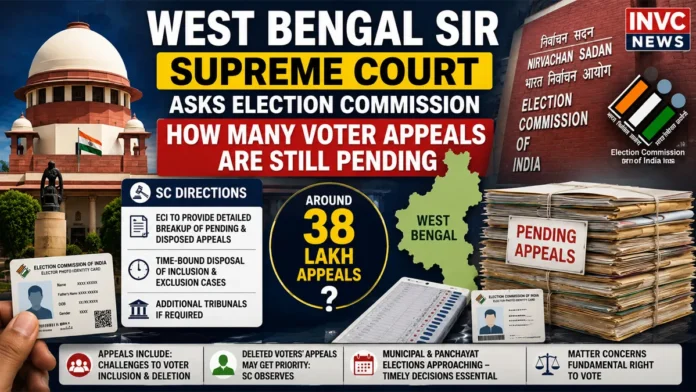
West Bengal SIR returned to the Supreme Court on Tuesday, with the judges directing the Election Commission of India to disclose how many voter-list appeals remain pending after the Special Intensive Revision and how many have already been decided.
The Court said appeals involving inclusion or exclusion from electoral rolls must be handled in a time-bound manner and asked the Election Commission to explain what additional steps — including more appellate tribunals if necessary — may be required to clear the backlog.
The hearing is significant because unresolved appeals can directly affect whether eligible voters find their names on electoral rolls before future elections.
Supreme Court Wants Full Breakup of SIR Appeals
A bench comprising Chief Justice of India Surya Kant, Justice Joymalya Bagchi and Justice V. Mohana asked the Election Commission to provide a detailed breakup of cases before the appellate tribunals.
The Court wants clarity on:
- Total appeals filed
- Appeals already disposed of
- Appeals still pending
- Cases filed by voters whose names were deleted
- Challenges against inclusion of names in electoral rolls
- Cross-appeals
- Number of additional tribunals that may be required
The Election Commission was also asked to explain what measures it has taken to streamline the appeal-disposal mechanism.
Court Told Around 38 Lakh Appeals Are Involved
During the hearing, the Supreme Court was told that approximately 38 lakh appeals were pending before West Bengal’s SIR appellate tribunals.
According to figures cited before the Court from an RTI response, approximately 31 lakh of these appeals challenge the inclusion of individuals on electoral rolls, while around 7 lakh are appeals by people whose names were excluded.
These figures were presented during arguments and the Supreme Court has now asked the Election Commission itself to provide an official and detailed breakup.
That distinction is important.
Until the ECI submits its response, the numbers cited during the hearing should not be treated as the Commission’s final official tally.
Deleted Voters Could Get Priority
One of the key questions before the Court is whether appeals filed by people whose names were deleted should receive priority.
The practical concern is obvious: a person excluded from the electoral roll cannot vote unless the dispute is resolved and the name is restored where legally justified.
The Court emphasized that the process should not remain unresolved indefinitely.
It also indicated that additional tribunals could be considered if the existing mechanism is unable to dispose of cases quickly enough.
Why West Bengal SIR Appeals Matter to Voters
The Special Intensive Revision process examines electoral rolls to determine whether names should remain, be added or be removed under the applicable election rules.
Disputes can arise when:
- A voter’s name is deleted
- A request for inclusion is rejected
- Another person challenges someone’s inclusion
- Documents or eligibility are disputed
For voters, the practical issue is not simply that an appeal exists — it is whether that appeal is decided before the next relevant election.
Petitioners told the Court that municipal and panchayat elections were approaching and argued that prolonged delays could leave affected people unable to exercise their voting rights.
The Supreme Court said its concern would extend beyond only selected constituencies.
What Should a Voter Do if a Name Is Missing?
West Bengal voters should not rely solely on old voter cards or previous electoral-roll entries.
They should verify their current electoral status through the Election Commission’s official services.
Official Election Commission portal:
Voter services:
If a person’s name is missing or electoral details are incorrect, the appropriate inclusion, correction or appeal procedure should be followed through official channels.
Voters involved in an existing SIR appeal should retain acknowledgment numbers and relevant documentation.
Supreme Court Has Been Monitoring West Bengal SIR
The Supreme Court has been dealing with issues arising from the West Bengal SIR process for months.
Earlier proceedings resulted in judicial officers and appellate mechanisms being deployed to deal with the large volume of claims, objections and subsequent appeals.
The Court’s latest intervention moves the focus from conducting the revision itself toward a different question:
How quickly can disputed cases be finally resolved?
Readers can check Supreme Court information at:
What Happens Next?
The Election Commission will now have to place detailed information before the Supreme Court on pending and disposed appeals.
That response could provide a clearer picture of:
How large the actual backlog is, which types of appeals dominate it and whether the existing tribunals are sufficient.
If the Court concludes that the current structure cannot clear cases fast enough, additional tribunals could become part of the solution.
For West Bengal voters, the outcome matters far beyond courtroom procedure.
At its core, the case concerns a fundamental practical question:
Can disputes over a voter’s inclusion or exclusion be resolved before that person loses the opportunity to vote in an election?