NEW DELHI, INDIA | AUGUST 25, 2026 —
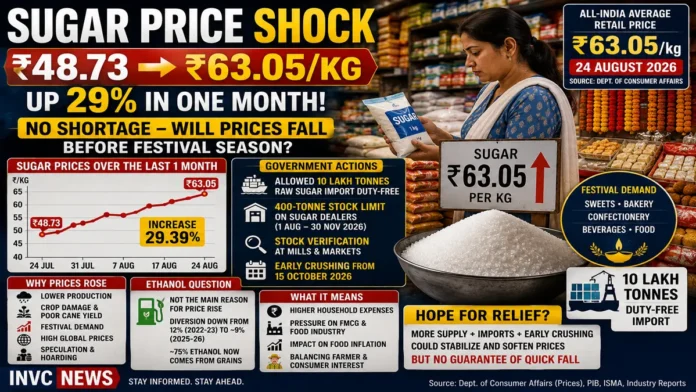
Sugar prices in India 2026 have surged sharply just as the country enters its crucial festival-demand season, with the all-India average retail price climbing to ₹63.05 per kg on August 24, up from ₹48.73 a month earlier.
That represents a 29.39% increase in just one month, according to the Department of Consumer Affairs’ Price Monitoring System.
The sudden spike has raised an obvious question for households, sweet makers, bakeries, restaurants and food companies: Is India running short of sugar — and will prices rise even further before the festive season?
The government and the Indian Sugar & Bio-Energy Manufacturers Association, or ISMA, say there is no outright sugar shortage.
However, lower-than-expected production, weather damage to sugarcane, festival demand, tighter international supplies and speculative buying have created enough pressure to send prices sharply higher.
The government has responded with a series of measures, including allowing 10 lakh tonnes, or 1 million metric tonnes, of raw sugar to be imported duty-free, tightening stock limits and asking mills to begin crushing earlier than usual.
Sugar Price Today: How Much Has It Increased?
The latest government price data illustrates the speed of the rally.
| Period | All-India Average Retail Sugar Price |
|---|---|
| August 24, 2026 | ₹63.05/kg |
| August 17, 2026 | ₹51.68/kg |
| July 24, 2026 | ₹48.73/kg |
| February 24, 2026 | ₹46.42/kg |
| August 24, 2025 | ₹45.87/kg |
| August 24, 2024 | ₹44.88/kg |
In only one week, the national average moved from ₹51.68 to ₹63.05.
Compared with one month earlier, sugar is 29.39% more expensive.
Compared with a year ago, prices are around 37% higher.
That is a significant increase for a staple that is used not only directly in homes but also across India’s enormous packaged-food, beverage, bakery, confectionery and sweets industries.
Why Are Sugar Prices Rising So Fast?
There is no single reason.
The government has identified a combination of pressures behind the latest increase.
Lower Sugar Production
India’s sugar production for the current season is now expected to be around 306 lakh tonnes, below the initial estimate of about 343 lakh tonnes submitted by sugarcane-producing states.
That difference has tightened expectations around available supplies.
Weather Damage to Sugarcane
Sugarcane crops have been affected by problems including Red Rot, Top Borer disease and waterlogging caused by excess rainfall.
Lower cane productivity ultimately affects sugar output.
Festival Demand Is Rising
India is moving into a period that includes major festivals when consumption of sweets, confectionery, bakery products and packaged foods typically rises.
Businesses often purchase additional sugar before peak retail demand arrives.
That can increase short-term pressure on the market.
Speculation and Hoarding
The government has also blamed speculative activity and stock accumulation by parts of the trade for contributing to price increases beyond what underlying supply-demand conditions alone might justify.
Global Sugar Is Getting More Expensive
This is not purely an Indian phenomenon.
International sugar prices rose from roughly $474 per tonne on June 30 to $552 per tonne on August 20, an increase of more than 16%.
The government estimates a global sugar deficit of around 33 lakh tonnes for 2026-27.
That matters because India is now turning to imports precisely when the international market is also relatively tight.
Does India Really Have a Sugar Shortage?
According to both the government and ISMA, no.
India has enough sugar available to meet domestic requirements until the next crushing season starts.
ISMA has also said that there is no need for panic buying and expects prices to ease as additional supplies enter the market and speculative purchases cool.
However, “no shortage” does not mean supply conditions are as comfortable as they were a year ago.
India is expected to begin the next marketing year with lower carry-forward stocks than last year.
Production is also below earlier expectations.
So the better description is:
India does not currently face a physical sugar shortage, but the market has become considerably tighter.
Government Allows 10 Lakh Tonnes of Duty-Free Sugar Imports
The most important intervention is India’s decision to permit 10 lakh tonnes of raw sugar imports without import duty.
This is an unusual step for a country that is normally one of the world’s largest sugar producers.
INVC NEWS previously explained how India opened a 1-million-tonne duty-free raw sugar import window as domestic prices surged ahead of the festival season.
Normally, India’s high import duties make large-scale overseas sugar purchases commercially unattractive.
Removing the duty allows mills and refiners to bring additional raw sugar into the country and sell refined output domestically.
The import measure is intended to increase supply and, just as importantly, reduce expectations that sugar will become even scarcer.
Will Imported Sugar Bring Prices Down Immediately?
Probably not immediately.
There is a physical supply-chain lag.
Raw sugar must be purchased internationally, loaded onto ships, transported to India, unloaded, refined where necessary and moved through domestic distribution networks.
Large shipments from countries such as Brazil can take weeks to arrive.
Therefore, the announcement itself can cool speculative sentiment, but the full supply effect may take longer.
That is why the government is using imports alongside other measures rather than depending on imports alone.
Sugar Dealers Now Face Stock Limits
The government has imposed a 400-tonne stock limit on sugar dealers from August 1 through November 30, 2026.
The purpose is to discourage large inventories from being withheld from the market during a period of rapidly rising prices.
Physical verification of stocks at sugar mills is also being carried out by joint central and state teams.
From September 1, bulk consumers will face additional restrictions on how much sugar inventory they can hold.
The goal is straightforward: move more sugar into normal market circulation rather than allowing unusually large stocks to remain concentrated with traders or institutional buyers.
Early Crushing Could Be the Biggest Relief in October
Another potentially important measure involves the next sugarcane-crushing season.
States and sugar mills have been advised to begin crushing from around October 15.
Normally, October sugar production is only around 3-4 lakh tonnes.
With early crushing, the government expects October output to exceed 10 lakh tonnes.
That additional domestic production could become especially important because October coincides with intense festival-related demand.
If early crushing proceeds smoothly, it could reduce the market’s dependence on imports alone.
Will Sugar Prices Fall Before the Festivals?
Prices could ease, but consumers should not assume an immediate return to ₹48-₹50 per kg.
Several forces are now pulling in opposite directions.
On the positive side, duty-free imports, stock restrictions, physical verification and early crushing should improve supply.
Speculative buying could also cool once traders become confident that more sugar is entering the market.
However, festival demand remains strong.
Global sugar prices are elevated.
Domestic production is below initial expectations.
Weather remains another variable.
The most realistic near-term scenario is therefore price stabilization followed by some easing, rather than a guaranteed collapse back to earlier levels.
What Higher Sugar Prices Mean for Household Budgets
A ₹10-₹15 increase per kilogram may appear manageable for an individual household purchasing only a few kilograms each month.
The broader inflationary effect can be much larger.
Sugar is an input in:
sweets, biscuits, cakes, chocolates, ice cream, soft drinks, juices, bakery products, packaged desserts, confectionery and processed foods.
For manufacturers using hundreds or thousands of tonnes, even a small increase in sugar prices can significantly raise production costs.
Companies then face three choices: absorb those costs, reduce margins or pass part of the increase to consumers.
That is why sugar prices can eventually affect food inflation beyond the sugar packet bought at a grocery store.
INVC NEWS has previously tracked how higher food costs have contributed to renewed pressure on India’s retail inflation and household budgets.
FMCG Companies Could Also Feel the Pressure
Food and consumer-goods manufacturers are already operating in a challenging cost environment.
Fuel, transportation, packaging and other commodity costs can affect margins simultaneously.
INVC NEWS has examined how FMCG companies have been preparing for renewed inflation pressure as higher input and logistics costs threaten prices of everyday consumer goods.
Sugar adds another potential cost pressure for businesses producing beverages, biscuits, confectionery and other sweetened products.
The effect will vary by company depending on existing inventories, hedging arrangements and the proportion of sugar in total production costs.
Is India’s Ethanol Programme Responsible for Expensive Sugar?
This has become one of the most debated questions surrounding the price spike.
The government’s answer is clear:
It says the current rise cannot be attributed primarily to sugar being diverted for ethanol production.
According to the Food and Public Distribution Ministry, the share of sugar diverted toward ethanol has actually declined from around 12% in 2022-23 to approximately 9% in 2025-26.
Moreover, nearly three-fourths of ethanol produced in India now comes from grains, particularly maize.
The government argues that the present sugar-price rise is better explained by lower-than-expected production, crop damage, festival demand, tighter international supplies and speculative activity.
Why Ethanol Still Matters to the Sugar Industry
Although ethanol is not being identified as the principal cause of the current spike, it remains important to India’s sugar economy.
Sugar production can vary significantly from year to year.
During surplus years, excessive inventories can depress mill finances and delay payments to sugarcane farmers.
Ethanol provides mills with another market for agricultural feedstocks and can improve cash flow.
The government says this has contributed to healthier sugar-mill finances and faster payments to farmers.
As of August 20, around 97% of sugarcane dues for the 2025-26 season had been paid.
India is simultaneously expanding its broader alternative-fuel ambitions. INVC NEWS has previously covered India’s push toward legal recognition and greater use of high-ethanol fuels as part of its strategy to reduce dependence on imported petroleum.
The important point is that sugar availability for food and ethanol policy must continue to be balanced carefully.
Why Farmers Also Matter in the Sugar Price Debate
Lower consumer prices are important, but policymakers must also protect sugarcane farmers.
The government has fixed the Fair and Remunerative Price for sugarcane for the 2026-27 season at ₹365 per quintal, based on a 10.25% recovery rate.
Sugar pricing policy therefore involves a complicated balance.
Consumers want affordable sugar.
Farmers need remunerative cane prices.
Mills need sufficient margins to pay farmers on time.
The government also wants ethanol production to reduce fuel-import dependence.
Exports and imports must then be adjusted depending on domestic production.
That is why sugar policy can shift quickly when production expectations change.
What Should Consumers Watch Over the Next Few Weeks?
The first indicator will be whether retail prices stop rising after the government’s interventions.
The second will be the pace of raw sugar import contracts and actual arrivals.
Third, traders will watch whether stock limits release more inventory into the market.
Finally, the start of early crushing around October 15 could provide the largest fresh domestic supply boost.
If these measures work together, prices could gradually soften.
If festival demand remains exceptionally strong or weather disrupts the next crop, relief could take longer.
Sugar Price FAQ
What is the average sugar price in India now?
Department of Consumer Affairs data shows an all-India average retail price of ₹63.05 per kg on August 24, 2026.
How much have sugar prices increased in one month?
The national average increased from ₹48.73 on July 24 to ₹63.05 on August 24, an increase of 29.39%.
Is there a sugar shortage in India?
The government and industry body ISMA say India currently has sufficient sugar for domestic consumption and there is no outright shortage.
Why is sugar expensive?
Lower-than-expected production, weather damage, festival demand, global supply tightness and speculative buying are among the factors identified by the government.
Is ethanol causing the sugar price rise?
The government says the current increase should not be attributed primarily to ethanol. Sugar diversion for ethanol has declined as a share of production, while grain-based ethanol has expanded.
Has India allowed sugar imports?
Yes. The government has permitted 10 lakh tonnes, or 1 million tonnes, of raw sugar to be imported duty-free to increase domestic availability.
Will sugar become cheaper before Diwali?
Prices could stabilize and ease as imports, stock-control measures and early domestic crushing improve availability. However, there is no guarantee that prices will quickly return to July levels.
Bottom Line
India’s sugar market is experiencing an unusually sharp price shock.
The all-India average retail price has risen 29.39% in a month to ₹63.05 per kg, creating pressure just as festival demand begins to build.
Yet this is not currently being described as a nationwide physical shortage.
The government is attempting to cool the market through 10 lakh tonnes of duty-free imports, stock limits, anti-hoarding inspections and early sugarcane crushing.
For households, the next few weeks will determine whether those measures translate into lower retail prices.
For the broader economy, the stakes are larger.
Sugar sits at the intersection of household inflation, food manufacturing, farmers, global commodity markets and India’s rapidly expanding ethanol economy.
That makes the current price spike much more than a question of how much a kilogram of sugar costs at the neighborhood store.