WELLINGTON, NEW ZEALAND | AUGUST 25, 2026 —
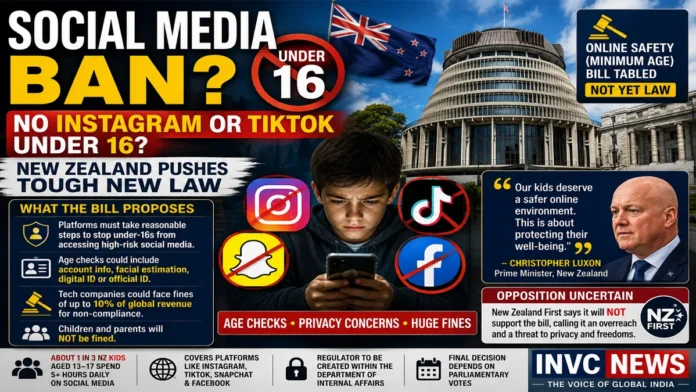
New Zealand social media ban plans could prevent children under 16 from accessing high-risk platforms such as Instagram, TikTok, Snapchat and Facebook under a sweeping Online Safety Bill that would force technology companies to verify users’ ages or potentially face enormous financial penalties.
Prime Minister Christopher Luxon’s government announced the Online Safety (Minimum Age and Child Safety Risk Assessment) Bill on August 24, arguing that social media companies must accept greater responsibility for protecting children from harmful content, addictive platform features and other online risks.
However, the proposal is not yet law, and New Zealanders under 16 have not suddenly been banned from Instagram, TikTok or other platforms.
The legislation still faces a difficult political path through Parliament.
New Zealand First, one of the parties in the governing coalition, has publicly said it will not support the measure, raising immediate questions over whether the bill can secure enough votes to become law.
What Would New Zealand’s Under-16 Social Media Ban Do?
The proposed law would place the responsibility primarily on technology companies rather than children or parents.
Platforms considered high-risk would have to take reasonable steps to establish that users are at least 16 years old.
The government specifically identified platforms such as:
- TikTok
- Snapchat
The legislation would not simply ask users to tick a box confirming their age.
Instead, companies could be required to adopt stronger verification methods.
How Could Instagram and TikTok Check Your Age?
This is likely to become one of the biggest points of debate.
According to the New Zealand government’s announcement, platforms could use several methods to determine whether someone is over 16.
Those could include:
Existing account information
Platforms could examine information already associated with an account.
Facial age estimation
Technology could estimate a person’s likely age from facial characteristics.
Digital identity services
Approved digital-ID systems could be used to verify that someone meets the required age threshold.
Formal identification
Platforms could potentially use official identity documentation as part of verification.
Importantly, facial age estimation is not necessarily the same thing as traditional facial recognition, which attempts to identify a specific person.
Even so, the prospect of stronger age checks will inevitably raise privacy questions.
That connects with the wider debate over how technology systems infer information about users. INVC NEWS has previously examined how AI systems and digital platforms can infer personal information from user behavior and interactions.
Could Tech Companies Face Massive Fines?
Yes.
One of the most striking elements of the bill is the proposed penalty.
Technology companies that fail to meet their obligations could face fines of up to:
10% of global revenue
That potentially makes the proposal far more serious than a symbolic age-limit rule.
For the world’s largest technology companies, 10% of global revenue could translate into billions of dollars.
The intention is clearly to make compliance a board-level issue rather than a minor regulatory expense.
The precise circumstances under which the maximum penalty could be imposed would depend on the final legislation and enforcement framework.
Children and Parents Would Not Be Fined
The proposed law does not seek to punish children for attempting to access social media.
Parents and caregivers would also not face penalties.
Instead, the legal obligations would fall on platform operators.
Education Minister Erica Stanford said the approach is designed to place responsibility on technology companies while allowing parents, schools and communities to continue playing a role in children’s online safety.
New Online Safety Regulator Could Be Created
The bill would also establish an online safety regulator within New Zealand’s Department of Internal Affairs.
That regulator would be responsible for:
- Monitoring compliance
- Investigating platforms
- Enforcing legal requirements
- Assessing how companies manage risks to children
The proposal therefore goes significantly beyond a simple age ban.
Platforms used by children could also be required to regularly assess the risks their services create and explain what they are doing to reduce those risks.
AI Companion Platforms Are Also in the Firing Line
Another particularly interesting element is the treatment of emerging technology.
The New Zealand government says the regulatory framework would also bring AI companion platforms within its scope.
That could make the bill relevant not only to traditional social networks but also to a rapidly growing category of artificial-intelligence products designed to simulate relationships, companionship or ongoing personal interaction.
This is significant because policymakers around the world are increasingly debating whether existing child-safety laws are capable of dealing with AI services that did not exist when most online-protection rules were written.
Why Is Christopher Luxon Pushing the Ban?
Luxon argues that children’s social-media use has become a significant social problem.
The government says about one in three New Zealand children aged 13 to 17 spends at least five hours a day on social media.
Luxon has linked excessive social-media exposure to concerns involving:
- Harmful content
- Addictive technology
- Sleep
- Education
- Family relationships
- Youth well-being
Supporters of stronger regulation argue that children should not be expected to manage sophisticated recommendation algorithms, infinite scrolling and attention-optimization systems on their own.
They say platforms themselves should bear greater responsibility.
But Is the New Zealand Social Media Ban Guaranteed to Pass?
No.
This is where the political story becomes just as important as the technology story.
New Zealand First has invoked the coalition’s “agree to disagree” provisions and explicitly said it will not support the legislation.
The party argues that enforcing such a restriction could lead to intrusive digital-ID requirements or attempts to limit technologies such as VPNs.
It also argues that parents, rather than government, should retain primary responsibility for children’s social-media access.
The criticism means describing the proposal as an already decided government ban would be misleading.
The accurate position is:
New Zealand is proposing legislation that could ban under-16s from designated social-media platforms, but parliamentary approval remains uncertain.
Australia Has Already Gone Further
New Zealand’s debate is unfolding after Australia moved ahead with its own under-16 social-media restrictions.
That experiment is being watched closely because it could provide evidence about several unresolved questions:
- Can teenagers bypass age restrictions?
- Can VPNs defeat the system?
- Do age checks compromise adult privacy?
- Do teenagers migrate to unregulated platforms?
- Do restrictions materially reduce harmful social-media use?
Luxon’s government argues that early Australian experience suggests age restrictions can change behavior.
Opponents dispute whether Australia’s model has been sufficiently effective to justify copying it.
That debate is likely to become central as New Zealand considers its own approach.
Could VPNs Make the Ban Ineffective?
Possibly, and opponents have focused heavily on this problem.
Technically sophisticated teenagers may attempt to bypass restrictions through:
- VPNs
- False birth dates
- Borrowed accounts
- Adult credentials
- Alternative platforms
But attempting to block circumvention creates a second problem.
The stronger age-verification becomes, the greater the potential privacy implications for adults who are legally entitled to use the platforms.
That tension — child safety versus privacy and open internet access — could become one of the defining arguments around the bill.
Social Media Companies Are Facing More Political Pressure Worldwide
The New Zealand proposal is part of a much broader shift.
Governments are increasingly asking whether large digital platforms should carry legal responsibility for risks involving children, misinformation, artificial intelligence and harmful content.
The pressure on Meta in particular extends well beyond children’s accounts.
INVC NEWS recently reported how US lawmakers are demanding answers from Mark Zuckerberg over Meta’s handling of AI deepfakes, misinformation and election security.
The common theme is platform accountability.
For years, governments largely allowed major social networks to develop their own moderation and safety systems.
That era increasingly appears to be ending.
What Happens to Instagram and TikTok If the Bill Passes?
If the legislation eventually becomes law in its proposed form, designated platforms would have to develop systems capable of establishing whether New Zealand users meet the minimum age requirement.
That could mean substantial technical changes.
Platforms may need to combine several signals rather than depend on one identity check.
Companies could also need to demonstrate to the regulator how their verification systems work and how they protect users’ personal information.
For teenagers, the practical result could be significantly harder access to mainstream social networks.
Could Adults Also Be Asked to Verify Their Age?
Potentially, yes.
Any system designed to establish whether someone is under 16 must also determine that an adult is over 16.
That creates one of the central practical challenges.
A platform cannot reliably exclude children without performing some type of age assessment on a wider population of users.
The eventual technical rules will therefore matter enormously.
Privacy protections could become almost as important as the minimum-age requirement itself.
Why This Story Matters Beyond New Zealand
New Zealand has a population of only about five million people, but the policy debate carries much wider significance.
If Australia and New Zealand both adopt strict youth-access rules, similar measures could gain momentum elsewhere.
Technology companies generally prefer global products rather than maintaining radically different systems for dozens of countries.
As a result, regulations introduced in relatively small markets can sometimes influence how platforms design products globally.
The bigger question is no longer simply whether children should spend less time on social media.
It is:
Who should be responsible for making that happen — parents, governments or the technology companies themselves?
Bottom Line
The New Zealand social media ban is not currently an active nationwide prohibition.
Prime Minister Christopher Luxon’s government has introduced a proposal that would require high-risk social-media platforms to take reasonable steps to keep children under 16 off their services.
Platforms could use account information, facial age estimation, digital IDs and formal identification to verify age.
Companies that fail to comply could eventually face penalties reaching 10% of global revenue, while children and parents would not be fined.
But the political battle is far from over.
With New Zealand First refusing to support the legislation and broader parliamentary approval uncertain, whether New Zealand ultimately follows Australia with a legally enforceable under-16 social-media regime remains an open question.