MUMBAI, INDIA | AUGUST 25, 2026 —
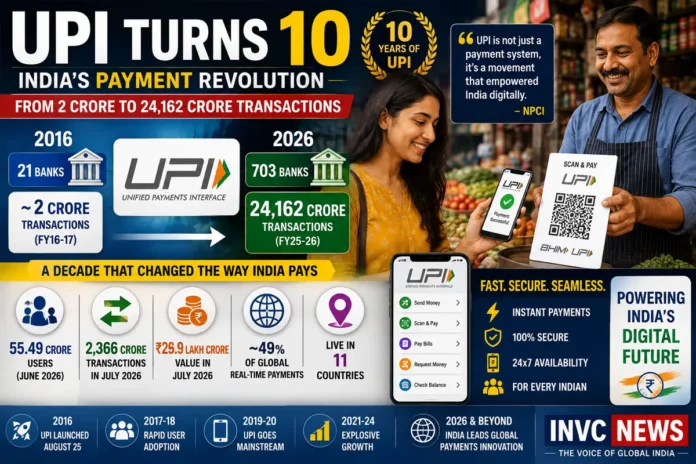
UPI Turns 10 today, marking a decade since India’s Unified Payments Interface went live for customers with just 21 banks on August 25, 2016 — a moment that would eventually transform the way hundreds of millions of Indians pay, shop, transfer money and run businesses.
What began as an ambitious experiment in interoperable bank-to-bank mobile payments has grown into the world’s largest real-time payment system by transaction volume.
In FY2016-17, UPI handled roughly 2 crore transactions.
By FY2025-26, that number had exploded to approximately 24,161.69 crore transactions, with a total value of about ₹314 lakh crore.
That represents an almost 12,000-fold increase in transaction volume in a decade.
And UPI is still growing.
In July 2026 alone, the platform processed around 2,366 crore transactions worth ₹29.9 lakh crore, highlighting how deeply instant digital payments have become embedded in everyday life in India.
UPI at 10: The Numbers Tell an Extraordinary Story
Here is how dramatically the platform has expanded:
| UPI Metric | Latest Scale |
|---|---|
| Annual transactions FY2025-26 | 24,161.69 crore |
| Annual transaction value FY2025-26 | ₹314 lakh crore |
| Users onboarded by June 2026 | 55.49 crore |
| Banks live on UPI by March 2026 | 703 |
| Banks at public launch in 2016 | 21 |
| July 2026 transactions | 2,366 crore |
| July 2026 transaction value | ₹29.9 lakh crore |
| Share of global real-time payments | Around 49% |
| Foreign countries where UPI is live | 11 |
The scale is remarkable because UPI is no longer simply a way to send money to friends.
It has become basic financial infrastructure for Indian consumers, street vendors, restaurants, e-commerce companies, taxi drivers, supermarkets, utility providers and businesses.
What Happened on August 25, 2016?
UPI’s journey actually began several months before its customer launch.
The platform was soft-launched on April 11, 2016, under the leadership of the National Payments Corporation of India, with then RBI Governor Raghuram Rajan announcing the pilot.
For several months, the system was tested largely with employee-customers to identify technical issues and improve transaction success rates.
Then came August 25, 2016.
NPCI announced that UPI was going live for customers with 21 banks.
Nineteen banks were preparing UPI-enabled mobile apps for customers, while IDBI Bank and RBL Bank were initially participating as issuer banks.
At the time, sending money through a mobile phone instantly and interoperably across multiple banks was a fundamentally different proposition from the payment experience most Indians knew.
Ten years later, scanning a QR code to pay ₹20 for tea barely feels remarkable.
That normalcy may be UPI’s greatest achievement.
From 2 Crore Transactions to More Than 24,000 Crore
UPI’s first financial year gives some perspective on the scale of the transformation.
FY2016-17 recorded around 2 crore transactions worth only about ₹0.07 lakh crore.
By FY2025-26:
Transaction volume: approximately 24,162 crore
Transaction value: approximately ₹314 lakh crore
The annual transaction volume increased around 30% year over year in FY2025-26, while transaction value increased more than 20%.
This growth has continued into the current financial year.
INVC NEWS earlier tracked the surge when UPI recorded 22.35 billion transactions in April 2026, reinforcing the fact that monthly transaction volumes above 2,000 crore are becoming part of the platform’s new normal.
55.49 Crore Users Are Now Connected to UPI
Another measure of UPI’s scale is its user base.
NPCI data provided to the government showed that approximately 55.49 crore users had been onboarded to UPI by June 2026.
The banking network has expanded dramatically as well.
UPI began with 21 participating banks at its public launch.
By March 2026, around 703 banks were live on the platform.
That includes public-sector banks, private banks, small finance banks, payments banks and cooperative banks.
This interoperability is one of UPI’s defining characteristics.
A customer does not need to use the same bank or payment app as the person or merchant receiving the money.
The QR Code Changed Small Retail in India
Perhaps nowhere is UPI’s transformation more visible than at India’s smallest businesses.
Vegetable sellers, tea stalls, auto-rickshaw drivers, neighborhood stores and roadside vendors can accept digital payments without installing traditional card-processing terminals.
A printed QR code can be enough.
That dramatically lowered the barrier to accepting digital payments.
Person-to-merchant, or P2M, transactions now represent a major share of UPI usage.
Government data shows that merchant transactions account for roughly 63% of transaction volume in the analyzed period.
Even more revealing is the ticket size.
Around 86% of P2M transactions were below ₹500, illustrating how UPI has become deeply integrated into small everyday purchases.
A ₹30 snack, ₹80 taxi ride or ₹150 grocery purchase is exactly the kind of transaction that once overwhelmingly depended on cash.
Why UPI Became So Successful
UPI solved several payment problems at the same time.
Instant Transfers
Money can move between participating bank accounts in real time.
24/7 Availability
Transactions are not restricted to normal banking hours.
Interoperability
A customer using one UPI app can pay another user or merchant operating through a different participating bank or app.
Simple Identity
UPI reduced dependence on repeatedly entering bank-account numbers and IFSC codes for normal transfers.
QR Payments
Merchants can accept payments without expensive card terminals.
Low Friction
For consumers, routine UPI payments have generally remained free.
These features made digital payments accessible far beyond people who routinely used credit cards or sophisticated online banking.
Are UPI Payments Still Free in 2026?
This has become one of the biggest UPI search queries this year.
The answer for consumers remains straightforward:
UPI users are not being charged for making normal UPI payments.
The government clarified in August that consumers will not face UPI transaction charges and that person-to-person payments will continue to remain free.
There has been considerable debate around the future economics of digital payments and the possibility of Merchant Discount Rate, or MDR, for certain categories of merchant transactions.
However, that should not be confused with a blanket consumer fee.
INVC NEWS has a detailed explainer on whether UPI payments above ₹2,000 will face charges and what India’s updated digital-payments law actually means.
That distinction is especially important because misleading messages about new UPI charges frequently circulate online.
If UPI Is Free, How Do Google Pay and PhonePe Make Money?
The extraordinary scale of UPI creates another obvious question:
If a customer can send money without paying a transaction fee, how do major payment apps generate revenue?
UPI payment apps increasingly operate as gateways to broader financial and commercial ecosystems.
Potential revenue sources include merchant services, payment devices, financial-product distribution, advertising, lending partnerships, insurance and other value-added services.
For readers interested in the business behind free digital payments, INVC NEWS has previously explained how Google Pay and PhonePe can build multibillion-rupee businesses even when normal UPI payments remain free.
That business model is likely to become increasingly important as policymakers balance affordability for users with the long-term economics of maintaining large payment infrastructure.
UPI Now Handles Nearly Half of Global Real-Time Payments
UPI’s significance is no longer limited to India.
India’s payment system accounts for approximately 49% of global real-time payment transaction volume, according to figures referenced by the government.
The International Monetary Fund has recognized UPI as the world’s largest retail fast-payment system by transaction volume.
That gives India an unusual position in global fintech.
For decades, many major consumer financial technologies entered India after becoming established elsewhere.
UPI reversed part of that pattern.
International policymakers and payment companies are now studying Indian digital public infrastructure.
UPI Is Expanding Beyond India
UPI is also gradually becoming international.
As of August 2026, the government says UPI is live in 11 foreign countries.
Its international presence is intended to make payments easier for Indian travelers and, in some markets, improve payment connectivity between countries.
UPI-related arrangements have expanded into markets including Singapore, the UAE, France, Bhutan, Nepal, Sri Lanka and Mauritius, among others.
Cross-border interoperability could become one of the biggest growth areas for UPI’s second decade.
That fits into a broader Asian trend toward interconnected digital-payment systems.
INVC NEWS recently examined how cross-border payments and digital interoperability could create new opportunities between India and ASEAN economies.
UPI Is Part of a Much Bigger Digital India Story
UPI did not grow in isolation.
Its rise coincided with India’s broader expansion of digital public infrastructure, smartphones, affordable mobile data, bank-account access and online public services.
Other platforms such as Aadhaar, DigiLocker and UMANG have become part of the country’s increasingly interconnected digital ecosystem.
INVC NEWS previously covered 11 years of Digital India and the expansion of digital public services across the country.
UPI is arguably the most visible everyday expression of that transformation because people interact with it multiple times a day.
UPI’s Next Big Challenge: Fraud and Security
Scale also creates risk.
As digital payments grow, fraudsters increasingly attempt to exploit users through:
- Fake QR codes
- Fraudulent collect requests
- Screen-sharing scams
- Fake customer-support numbers
- Phishing links
- Remote-access applications
- Impersonation scams
- Fake cashback offers
- Social-engineering attacks
Importantly, many such frauds do not require attackers to technically “hack UPI.”
Instead, criminals try to convince users to authorize transactions themselves.
Government, RBI and NPCI measures have included enhanced app-security requirements, risk-based transaction limits and fraud-monitoring systems.
Consumers still remain a critical part of the security chain.
Never Enter a UPI PIN to Receive Money
One rule deserves particular emphasis.
You normally do not need to enter your UPI PIN simply to receive money.
A UPI PIN authorizes money leaving an account.
If someone claims they need your PIN, OTP or screen-sharing access to send you money, that should be treated as a major warning sign.
Consumers should also verify the recipient’s name before approving any payment.
UPI Has Changed India’s Relationship With Cash
India has not become a cashless economy, nor is physical currency disappearing.
But consumer behavior has changed dramatically.
Before widespread UPI adoption, even digitally connected consumers often carried cash for small purchases because merchants lacked card machines.
Today, a smartphone and QR code can complete many of those transactions in seconds.
UPI did not simply digitize an existing card payment.
It expanded electronic payments into categories of commerce where card infrastructure had often never existed.
That is a fundamentally different kind of transformation.
What Could UPI Look Like in the Next 10 Years?
The next phase is likely to be different from the first.
UPI already has enormous domestic scale.
Future growth could increasingly come from:
International Expansion
More countries could accept UPI or connect domestic instant-payment networks with India’s system.
New Payment Experiences
Voice, biometric and feature-phone payment technologies could broaden accessibility.
Credit on UPI
Banks and financial institutions could increasingly integrate eligible credit products into UPI-based payments.
UPI Lite
Small-value transactions could become even faster and easier.
Merchant Services
Payment apps could build broader business tools around UPI acceptance.
Fraud Prevention
Artificial intelligence and real-time risk analysis could become increasingly important as transaction volumes rise.
UPI at 10: From Experiment to Everyday Infrastructure
Ten years ago, UPI went live with 21 banks and a simple proposition: allow people to send and receive money instantly through interoperable mobile applications.
Today, it processes tens of billions of transactions each month.
More than 55 crore users have been onboarded.
Hundreds of banks participate.
Small merchants use it for transactions worth just a few rupees.
And India’s real-time payment infrastructure now accounts for nearly half of global real-time transaction volume.
The most striking part of UPI’s first decade may therefore not be the 24,162 crore annual transactions.
It is that for millions of Indians, scanning a QR code and seeing “payment successful” has become so ordinary that the technology behind it is barely noticed anymore.
That is what happens when a technological innovation stops feeling like technology and starts becoming infrastructure.