NEW DELHI, India | August 24, 2026
India sodium-ion battery technology is moving significantly closer to commercial deployment, potentially opening a new chapter in the country’s electric vehicle, renewable-energy storage and advanced manufacturing ambitions.
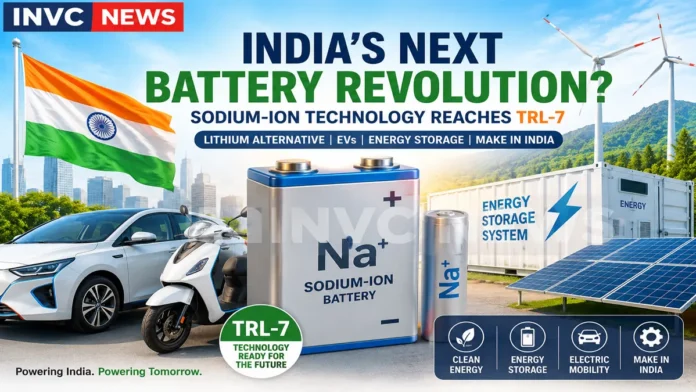
Renewable Energy Secretary Santosh Kumar Sarangi has said researchers working on sodium-ion batteries in India have reached Technology Readiness Level 7 and above, an important stage indicating that prototype systems have progressed beyond laboratory development and have been demonstrated in an operational environment.
According to Sarangi, technologies reaching this level could potentially move from pilot projects to commercial production within roughly two to three years.
The development is important because India currently depends heavily on lithium-based battery technologies for electric vehicles, electronics and large-scale energy storage. Sodium-ion batteries could eventually provide an additional option, particularly in applications where cost, material availability and supply-chain resilience matter more than maximum energy density.
What Does TRL-7 Mean for Sodium-Ion Batteries?
Technology Readiness Level, or TRL, is commonly used to measure how close an emerging technology is to real-world deployment.
At the early stages, researchers generally test materials, individual components and laboratory prototypes.
By TRL-7, however, a prototype has reached the point where it can be demonstrated in an operational or near-operational environment.
That does not mean sodium-ion batteries are immediately ready to replace lithium-ion batteries across India.
It does mean that some Indian research efforts are moving much closer to the crucial commercialization phase.
The next challenge will involve scaling production, improving manufacturing consistency, achieving competitive costs, establishing supply chains and demonstrating long-term reliability.
Why Sodium-Ion Batteries Matter for India
Sodium is considerably more abundant than lithium and can potentially be sourced through more geographically diversified supply chains.
That gives sodium-ion technology an important strategic advantage for countries seeking to reduce their exposure to concentrated critical-mineral supply chains.
Indian government-backed research has previously identified sodium-ion batteries as a promising option for grid-scale energy storage, inverter and UPS systems, solar applications and certain forms of electric mobility.
A successful domestic sodium-ion ecosystem could therefore support both India’s clean-energy transition and its wider push to strengthen domestic advanced manufacturing.
The development comes as India’s electric vehicle market is already expanding rapidly.
INVC previously reported that India’s electric passenger vehicle registrations surged nearly 90% in Q1 FY27, highlighting how quickly demand for battery-powered transportation is growing.
If EV adoption continues accelerating, demand for battery cells, battery packs, charging infrastructure and raw materials is likely to rise sharply as well.
Could Sodium-Ion Replace Lithium-Ion Batteries?
Not immediately.
Lithium-ion remains the dominant rechargeable battery chemistry for electric vehicles because it combines relatively high energy density, established manufacturing capacity and decades of commercial development.
Sodium-ion batteries currently face limitations, particularly when manufacturers need maximum energy storage within minimum weight and space.
That matters considerably in passenger cars, where heavier batteries can reduce driving efficiency and range.
However, sodium-ion batteries could become highly competitive in applications where weight is less critical.
These could include:
- Grid-scale renewable-energy storage
- Stationary battery systems
- Solar energy storage
- Telecom backup systems
- Low-speed electric vehicles
- Two-wheelers and three-wheelers
- Commercial or industrial energy storage
That means the future battery market may not necessarily become a simple competition between lithium and sodium.
Instead, different battery chemistries could serve different applications.
India Needs Massive Energy Storage Capacity
The sodium-ion milestone also comes at a time when India is preparing for enormous growth in energy-storage requirements.
Sarangi said Central Electricity Authority estimates indicate India could require approximately 411 GWh of storage capacity by 2031-32.
He also said around 156 GWh of battery energy storage systems are already under tendering, implementation or related development processes.
That scale creates room for several technologies rather than a single dominant chemistry.
Lithium-ion batteries are expected to remain important, but sodium-ion batteries, pumped-storage projects and vanadium flow batteries could all play complementary roles.
For readers following India’s broader renewable-energy transition, INVC’s coverage of new solar-panel rules and renewable-energy-related regulatory changes provides additional context on how India’s clean-energy ecosystem is evolving.
Why Energy Storage Is Critical for Solar and Wind Power
Solar and wind generation are inherently variable.
Solar plants generate heavily during daylight hours, while electricity demand frequently peaks later in the evening.
Wind generation can also fluctuate substantially according to weather conditions.
Battery energy storage systems allow electricity generated during periods of high renewable output to be stored and released later when demand rises.
That means India’s renewable-energy expansion increasingly depends not only on building additional solar and wind projects but also on creating sufficient storage capacity.
Without adequate storage, integrating very large quantities of renewable power into the electricity grid becomes considerably more difficult.
Sodium-Ion Could Strengthen Make in India
The biggest long-term opportunity may therefore be manufacturing.
If Indian companies successfully commercialize sodium-ion technology, the country could build another domestic battery supply chain alongside existing lithium-ion investments.
That could create opportunities across:
Battery cells: Domestic production of sodium-ion cells.
Cathode and anode materials: Manufacturing advanced battery materials within India.
Battery management systems: Electronics and software controlling charging, safety and performance.
Energy-storage systems: Large containerized batteries supporting electricity grids and renewable projects.
Electric mobility: Battery packs designed for two-wheelers, three-wheelers and potentially passenger EVs.
Battery recycling: Recovery and reuse of materials as the battery market expands.
India is already pushing aggressively into high-value manufacturing across electronics, automobiles and clean technology.
A domestic sodium-ion industry would fit naturally within that strategy.
EV Market Could Become a Major Testing Ground
Electric mobility could eventually become one of the most closely watched applications.
India’s electric scooter and three-wheeler markets are especially suitable for experimentation because buyers are highly sensitive to vehicle price.
INVC’s 2026 electric scooter comparison shows how battery range, affordability and charging remain central considerations for Indian consumers.
At the same time, Delhi-NCR is preparing tighter clean-mobility rules, including a transition toward electric three-wheelers for new registrations.
If sodium-ion cells eventually become commercially competitive, India’s enormous two- and three-wheeler market could provide manufacturers with a major deployment opportunity.
Battery Competition Is Already Intensifying Worldwide
Sodium-ion is only one of several next-generation technologies seeking a place beyond conventional lithium-ion batteries.
Solid-state batteries are another major contender.
Automakers are investing heavily in solid-state battery research because the technology could potentially deliver greater energy density, faster charging and improved safety.
Toyota, for example, is targeting commercialization of next-generation batteries later this decade. INVC has previously detailed Toyota’s solid-state battery roadmap targeting up to 1,200 km of potential range.
Plug-in hybrid technology is also evolving rapidly. BYD’s DM-i hybrid technology introduced in India illustrates how automakers are exploring multiple routes toward electrified mobility rather than relying on a single battery solution.
Government Research Is Already Supporting Sodium-Ion Development
India’s sodium-ion push is not starting from scratch.
The Ministry of New and Renewable Energy has previously published an assessment examining the global sodium-ion battery landscape and its potential in India.
Government-backed scientific institutions have also been working on sodium-ion cells and battery materials.
In December 2025, the International Advanced Research Centre for Powder Metallurgy and New Materials entered into an agreement with an Indian company for industrial performance validation of sodium-ion pouch cells, with commercialization among the objectives.
Research teams have also been developing cathode and hard-carbon technologies intended to improve sodium-ion battery performance.
These projects suggest India is attempting to build capability across several parts of the battery technology chain rather than depending entirely on imported finished systems.
Vanadium Flow Batteries Could Become Another Alternative
Sodium-ion is not the only alternative battery chemistry attracting attention.
Sarangi also highlighted progress in vanadium flow batteries, particularly for stationary energy-storage applications.
NTPC Green Energy has placed an order involving around 100 MW of vanadium flow battery capacity, according to the secretary.
Flow batteries can be particularly attractive for long-duration stationary storage because their energy-storage capacity can be expanded differently from conventional lithium-ion systems.
Domestic manufacturing and greater deployment could eventually reduce their costs.
What Sodium-Ion Batteries Could Mean for Consumers
Consumers should not expect sodium-ion-powered cars to suddenly dominate Indian showrooms.
Commercialization is still developing.
However, the technology could ultimately influence consumers indirectly even before it appears in large numbers of passenger vehicles.
Cheaper stationary batteries could make renewable-energy systems more affordable.
Lower-cost energy storage could strengthen electricity grids and improve renewable-power reliability.
Sodium-ion battery packs could also reduce costs in selected electric two-wheelers, three-wheelers or commercial vehicles.
Most importantly, greater competition among battery chemistries could reduce dependence on a single technology and potentially put downward pressure on battery costs over time.
The Bigger Story: India Wants Battery Independence
India’s sodium-ion progress should therefore be viewed as more than another laboratory achievement.
Batteries are increasingly becoming strategic industrial infrastructure.
They determine the economics of electric vehicles, renewable energy, grid stability, consumer electronics and even national energy security.
Countries capable of controlling battery research, materials, manufacturing and recycling will have a major advantage as transportation and power systems become increasingly electrified.
Reaching TRL-7 does not guarantee that every Indian sodium-ion battery project will become commercially successful.
Manufacturers still need to prove cost competitiveness, durability, scale and performance.
But the milestone moves sodium-ion technology closer to the point where those questions can increasingly be answered through real commercial deployment rather than laboratory testing.
If Indian manufacturers can successfully cross that final gap, India sodium-ion battery technology could emerge as an important lithium alternative for energy storage and selected electric-vehicle applications—while giving Make in India another strategically important manufacturing opportunity.