TAIPEI / BEIJING | AUGUST 24, 2026
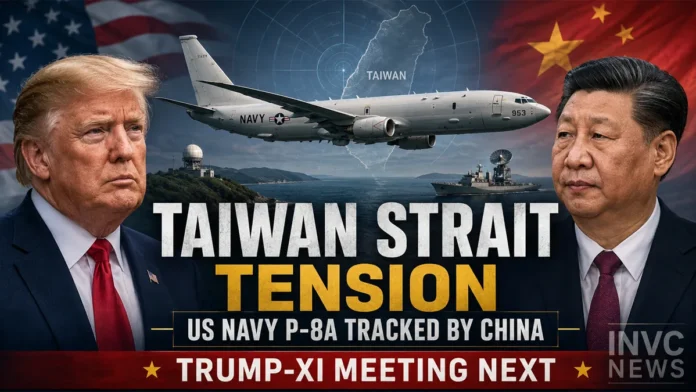
The US Navy Taiwan Strait 2026 confrontation has returned to the global spotlight after a P-8A Poseidon maritime patrol aircraft flew through international airspace over the sensitive waterway while Chinese forces tracked the aircraft throughout its transit.
The U.S. Navy’s 7th Fleet said the Friday mission demonstrated Washington’s commitment to a “free and open Indo-Pacific” and that American forces would continue to operate wherever international law allows.
China, however, monitored the aircraft during its passage and reiterated its opposition to U.S. military activity around Taiwan.
The timing has made the flight particularly significant.
Chinese President Xi Jinping is expected to visit the United States next month for a meeting with President Donald Trump as Washington and Beijing attempt to stabilize a relationship strained by Taiwan, trade, technology restrictions and military competition.
Meanwhile, Taiwan has proposed an 18% increase in defense spending for 2027, taking its broader defense budget above NT$1 trillion for the first time.
Together, the developments have put the Taiwan Strait back at the center of one of the world’s most consequential geopolitical rivalries.
What Happened During the US Navy Taiwan Strait 2026 Transit?
A U.S. Navy P-8A Poseidon patrol and reconnaissance aircraft flew through the Taiwan Strait on Friday.
The U.S. 7th Fleet said the aircraft operated in international airspace.
Washington described the mission as an exercise of navigational rights and freedoms under international law.
China’s military tracked and monitored the aircraft throughout the transit.
Chinese state-linked reporting said the situation remained under control.
The flight did not result in a publicly reported confrontation between the aircraft and Chinese forces.
However, even routine American military movements through the Taiwan Strait attract close attention because Beijing considers Taiwan part of China and strongly opposes what it views as foreign military interference.
What Is a P-8A Poseidon?
The Boeing P-8A Poseidon is one of the U.S. Navy’s most important maritime patrol and surveillance aircraft.
It is designed for missions including:
- Maritime surveillance
- Anti-submarine warfare
- Anti-surface warfare
- Intelligence gathering
- Reconnaissance
- Monitoring naval movements
- Search-and-rescue support
Because of those capabilities, the appearance of a P-8A in a strategically contested waterway carries greater military significance than an ordinary civilian overflight.
However, Washington has characterized such Taiwan Strait missions as lawful and routine operations rather than preparations for conflict.
Why Does China Object to US Military Operations in the Taiwan Strait?
China considers democratically governed Taiwan part of its territory and has not renounced the use of force to bring the island under Beijing’s control.
Taiwan rejects Beijing’s sovereignty claim.
The two sides also differ over the legal and political status of the Taiwan Strait.
Washington and Taipei maintain that international navigational freedoms apply through the waterway.
Beijing argues that it has sovereignty, sovereign rights and jurisdiction over waters and airspace connected with the strait under its interpretation of international law.
These conflicting positions mean that even a single naval or air transit can become a geopolitical signal.
Why the Trump-Xi Meeting Matters Now
The P-8A transit comes ahead of an expected meeting between Donald Trump and Xi Jinping next month.
That makes the military movement more politically sensitive.
Washington and Beijing are trying to manage a relationship shaped by several major disputes:
- Taiwan
- Tariffs and trade
- Advanced semiconductor technology
- Artificial intelligence
- Export controls
- Rare earth supplies
- South China Sea tensions
- Military competition across the Indo-Pacific
The Taiwan question remains among the most dangerous of those disputes.
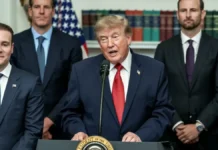
INVC has been tracking the diplomatic relationship closely. Earlier coverage of Donald Trump’s China visit and high-stakes talks with Xi Jinping highlighted how trade, technology and strategic security have increasingly become interconnected in US-China negotiations.
The upcoming meeting could therefore become much more than another discussion about tariffs.
Taiwan may emerge as one of its most sensitive subjects.
Is the Trump-Xi Meeting Officially Finalized?
Xi is expected to visit the United States next month and meet Trump, but the precise details of the summit should be treated carefully until the governments release the final schedule.
That distinction matters because high-level diplomatic engagements can change due to geopolitical events.
Washington and Beijing nevertheless have strong incentives to keep top-level communication open.
Neither government benefits economically from an uncontrolled crisis between the world’s two largest economies.
At the same time, neither side wants to appear weak on issues it considers central to national security.
Taiwan sits directly inside that dilemma.
Taiwan Proposes Record 2027 Defense Spending
The military tension is rising just as Taiwan prepares a major expansion of defense spending.
Taipei has proposed raising overall defense expenditure by 18% in 2027.
The spending would reach approximately NT$1.1225 trillion, equivalent to roughly $31.4 billion.
That would push defense expenditure above 3% of Taiwan’s GDP.
The proposed budget includes investment in areas such as:
- Drones
- Missiles
- Maritime security
- Military modernization
- Indigenous defense programs
- Coast Guard capabilities
- Improved battlefield resilience
Taiwan’s government argues that higher spending is needed because Chinese military and political pressure has intensified.
Lai Ching-te Says Peace Requires Strength
Taiwan President Lai Ching-te reinforced that message on August 23 while visiting Kinmen, a Taiwan-controlled island located close to the Chinese mainland.
The visit marked the anniversary of the 1958 Taiwan Strait conflict.
Lai said Taiwan must strengthen its defense in order to protect peace and sovereignty.
He also called for political support for increased military spending.
The symbolism was significant.
Kinmen lies extremely close to China and has historically been one of the most sensitive frontline locations in cross-strait relations.
Chinese and Taiwanese forces fought heavily around the islands during the 1958 crisis.
Today, military tensions are very different, but the historical memory remains politically powerful.
China’s Military Pressure Around Taiwan
China routinely conducts military operations in waters and airspace around Taiwan.
These include:
- Fighter aircraft missions
- Naval patrols
- Coast Guard operations
- Large-scale military exercises
- Surveillance activity
- Operations around offshore islands
Beijing describes many of these actions as necessary measures to defend sovereignty and oppose Taiwanese separatism and foreign interference.
Taipei sees them as military pressure and gray-zone coercion.
The United States continues to maintain a military presence across the wider Indo-Pacific.
INVC recently reported how the Pentagon has insisted that the United States is not retreating from Asia while calling for stronger regional defense capabilities.
The Taiwan Strait transit reinforces that message.
Could Trump Take a Different Approach to Taiwan?
This is another question closely watched in Taipei.
Trump has frequently pursued a transactional foreign-policy approach, pressing partners to spend more on their own security.
Taiwan has responded by substantially increasing defense expenditure.
However, U.S.-China economic relations also matter greatly to the Trump administration.
That creates a complicated balancing act.
Washington wants to deter any forced change to the status quo around Taiwan while simultaneously negotiating with Beijing on tariffs, technology, investment and other economic issues.
The result could be a combination of military deterrence and diplomatic engagement.
The latest P-8A transit illustrates that dual approach.
American military operations continue even as preparations move forward for another Trump-Xi meeting.
US-China Trade War Adds Another Layer of Tension
Military competition is only one part of the relationship.
The United States and China remain locked in a broader economic rivalry.
Tariffs, advanced chips, AI, strategic minerals and industrial supply chains all remain potential flashpoints.
INVC’s detailed analysis of the US-China trade war and the fragile Trump-Xi tariff truce shows how quickly economic tensions between Washington and Beijing can escalate.
Taiwan makes the economic rivalry even more complicated because of the island’s central role in advanced semiconductor manufacturing.
A serious military crisis could therefore produce effects far beyond the defence sector.
Technology companies, automobile manufacturers, electronics firms and global supply chains could all be exposed.
Why Taiwan Matters to the Global Semiconductor Industry
Taiwan is a crucial hub for global semiconductor manufacturing.
Advanced chips produced there are used in products ranging from smartphones and data centers to automobiles and artificial-intelligence systems.
That means instability around Taiwan is not simply an East Asian security concern.
A major disruption could create significant pressure on:
- Electronics production
- AI infrastructure
- Smartphones
- Cloud computing
- Automobiles
- Industrial equipment
- Defence technology
This connection between military security and technology supply chains is one reason developments in the Taiwan Strait are followed closely by investors and governments around the world.
Could a Taiwan Strait Crisis Hit Global Shipping?
Yes.
The waters around Taiwan form part of major commercial shipping routes connecting Northeast Asia with the rest of the world.
A military crisis, blockade or prolonged exercise could force shipping companies to reconsider routes, insurance and risk exposure.
Potential consequences could include:
- Higher freight costs
- Shipping delays
- Increased insurance premiums
- Supply-chain disruption
- Energy-market volatility
- Electronics shortages
However, the latest P-8A transit itself has not produced such disruption.
These are risk scenarios associated with a much larger escalation.
Why India Should Watch the Taiwan Strait
India is not a party to the Taiwan sovereignty dispute, but stability in the Indo-Pacific has direct economic and strategic importance for New Delhi.
Several factors matter.
Semiconductor Security
India is investing heavily in domestic semiconductor manufacturing.
Any major disruption to East Asian chip supply chains could affect Indian electronics, automobiles, telecom equipment and technology companies.
Maritime Trade
A large portion of India’s trade with East Asia depends on stable Indo-Pacific shipping routes.
Strategic Competition
India, the United States, Japan and Australia cooperate through the Quad on a range of Indo-Pacific issues.
A sharp increase in US-China confrontation would affect the broader regional security environment in which India operates.
Supply-Chain Diversification
Companies seeking to reduce geopolitical risk are increasingly considering alternative manufacturing locations.
India could benefit from some diversification, although building sophisticated supply chains requires sustained investment and infrastructure.
Could China and the US Actually Go to War Over Taiwan?
A conflict is not inevitable.
Both Washington and Beijing have powerful reasons to avoid direct war.
A military confrontation between nuclear-armed powers would carry enormous economic and security risks.
However, analysts worry about escalation through miscalculation.
The danger can arise from:
- Military aircraft operating close to each other
- Naval encounters
- Large Chinese exercises
- U.S. military transits
- Arms sales
- Political visits
- A blockade or quarantine scenario
- Misinterpreted military signals
This is why communication between senior U.S. and Chinese officials remains critical even when political relations deteriorate.
What Could Trump and Xi Discuss?
If the expected meeting goes ahead, several issues are likely to dominate.
Taiwan
Washington will seek stability and oppose coercive changes to the status quo.
Beijing is likely to insist that Taiwan remains a core Chinese interest.
Trade and Tariffs
Both countries have strong economic reasons to prevent another uncontrolled tariff escalation.
Technology Restrictions
Controls involving semiconductors, artificial intelligence and advanced manufacturing remain major sources of friction.
Military Communications
Maintaining communication between military commands can reduce the risk of accidental escalation.
Regional Security
The South China Sea, North Korea and wider Indo-Pacific military deployments could also feature in discussions.
Taiwan’s Defense Budget Still Faces Political Scrutiny
Taiwan’s proposed 2027 defense budget is not automatically guaranteed in its current form.
The government faces an opposition-dominated legislature.
Opposition parties have said they support national defense but also want detailed scrutiny of military spending.
Earlier budget proposals have faced delays and reductions.
That means the political battle over Taiwan’s military buildup will continue inside the island as well as across the strait.
What Happens Next in the Taiwan Strait?
Several developments deserve close attention.
First, Chinese military activity. Any sharp increase in fighter aircraft, warships or exercises around Taiwan could signal a response to the U.S. transit.
Second, the Trump-Xi summit. Confirmation of the meeting and its agenda will show whether Taiwan becomes a central negotiating issue.
Third, Taiwan’s defense budget. Legislative approval will determine how much of Taipei’s planned military expansion actually moves forward.
Fourth, U.S. military activity. Additional naval or aerial transits could reinforce Washington’s commitment to maintaining an operational presence in the strait.
Fifth, Beijing-Taipei rhetoric. Statements from both governments can provide early clues about whether tensions are cooling or escalating.
US Navy Taiwan Strait 2026: The Bottom Line
The US Navy Taiwan Strait 2026 P-8A Poseidon flight did not trigger a military confrontation, but its timing gives the mission considerable geopolitical significance.
China tracked the aircraft.
Washington defended the transit as lawful.
Taiwan is preparing record defense spending.
President Lai is publicly arguing that stronger defenses are necessary to preserve peace.
And Xi Jinping is expected to meet Donald Trump next month as the world’s two largest powers try to manage an increasingly complicated strategic rivalry.
That combination makes the Taiwan Strait one of the most important geopolitical issues to watch in the weeks ahead.
The central question is no longer simply whether another U.S. aircraft or warship will cross the strait.
It is whether Washington and Beijing can maintain military deterrence, economic competition and political dialogue at the same time — without allowing one incident to turn strategic rivalry into a much larger crisis.