AMRITSAR, INDIA | AUGUST 24, 2026
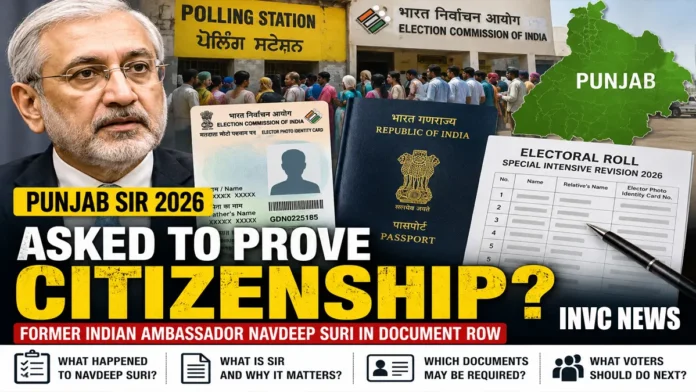
Punjab SIR 2026 has triggered a fresh political and voter-rights debate after former Indian diplomat Navdeep Suri said election officials asked him to produce documents, including his passport, when his current voter details could not be mapped to Punjab’s 2003 electoral roll.
Suri, who served as India’s ambassador to the United Arab Emirates and Egypt and as high commissioner to Australia, said he had submitted his voter ID and Aadhaar details during the Special Intensive Revision, or SIR, process.
However, he later learned that his details could not be matched with the older electoral records being used in the verification exercise.
The episode has attracted national attention because it raises a much broader question: What happens when an ordinary voter’s current details do not match a voter list prepared more than two decades ago?
It has also turned into a political controversy, with senior Congress leader P. Chidambaram questioning the Election Commission’s handling of the SIR process.
What Happened to Navdeep Suri During Punjab SIR 2026?
Suri publicly described his experience on August 23.
According to his account, he approached his Booth Level Officer, or BLO, and provided his voter ID and Aadhaar card as part of the ongoing verification process.
Initially, he said, he was told that everything appeared to be in order.
Later, however, he received information that some of his details did not match Punjab’s 2003 SIR electoral records.
When Suri contacted the BLO again, he was asked to collect a notice and return with documents establishing his eligibility.
Suri explained that he was not in India in 2003 because he was posted at the Indian High Commission in London.
After explaining his overseas posting, he said officials asked him to produce his passport.
Suri has been asked to appear before the concerned authorities in Amritsar on August 28, 2026.
Why Did Navdeep Suri’s 2003 Voter Record Not Match?
The issue appears to be one of historical electoral-roll mapping.
Punjab’s SIR exercise involves comparing current voter information with older intensive-revision records.
Suri said he was serving abroad in 2003 and therefore did not participate in that revision.
He later shifted his electoral registration to Amritsar and updated his voter-related records.
According to the explanation from Punjab election authorities, Suri’s current voter entry could not automatically be mapped to the 2003 roll because he was outside India at that time.
His documents will therefore be examined during the verification process.
That distinction is important.
A record mismatch does not automatically establish that a voter is ineligible or that the person is not an Indian citizen.
Does an SIR Notice Mean Your Citizenship Has Been Cancelled?
No.
Receiving an SIR notice or being asked to provide citizenship-related documents does not mean a person has automatically lost Indian citizenship.
The Supreme Court clarified this important distinction in its May 27, 2026 judgment concerning the legality of the Special Intensive Revision of electoral rolls.
The Court upheld the Election Commission’s power to conduct SIR and said the Commission can carry out a limited inquiry into citizenship when deciding whether a person is eligible to be included in an electoral roll.
However, the Election Commission cannot make a final legal determination cancelling a person’s citizenship.
Formal adjudication of citizenship remains within the jurisdiction of the competent authority under citizenship law.
Therefore, voters receiving notices should treat them seriously, but they should not assume that a notice itself amounts to a declaration that they are no longer Indian citizens.
What Is Punjab SIR 2026?
SIR stands for Special Intensive Revision.
It is a detailed revision of electoral rolls conducted under the Election Commission’s constitutional and statutory powers.
Unlike a routine update, an intensive revision can involve extensive verification of existing voter records.
The process may include:
- House-to-house visits by Booth Level Officers
- Collection and verification of enumeration forms
- Comparison with previous electoral rolls
- Identification of deceased voters
- Detection of duplicate entries
- Identification of voters who have permanently shifted
- Verification of untraceable voters
- Issuance of notices where additional clarification is required
- Publication of a draft electoral roll
- Filing of claims and objections
- Correction or inclusion of eligible voters before the final roll
Punjab is not the only state where voters have received verification notices.
INVC previously reported that the Election Commission issued notices to 19.04 lakh voters during the Uttarakhand SIR 2026 verification process after discrepancies were identified in electoral records.
That earlier exercise shows why voters should respond to verification notices instead of ignoring them.
Punjab Draft Voter List: Why August and September Matter
Punjab’s draft electoral roll under SIR 2026 was published on August 13 for all 117 Assembly constituencies.
The publication of the draft list opened an important correction window.
Voters can file claims and objections until September 12, 2026 under the revised schedule.
This means anyone whose name is missing, whose personal information is incorrect, or whose entry requires verification still has an opportunity to act.
The notice and disposal process will continue after the draft publication, while the final electoral roll is expected under the revised timetable in October.
For voters, the important message is simple: the draft roll is not the end of the process.
More Than 20 Lakh Entries Were Left Out of Punjab’s Draft Roll
The scale of the exercise makes the Punjab SIR especially significant.
Before publication of the draft roll, around 20.66 lakh voter entries were identified in categories that included people reported as permanently shifted, deceased, untraceable or duplicated, as well as electors who had not completed the required enumeration process.
The figures included approximately:
- 9.44 lakh voters listed as permanently shifted
- 5.74 lakh identified as deceased
- 4.12 lakh categorized as absent or untraceable
- 1.19 lakh identified as duplicate entries
Because these numbers are substantial, the claims-and-objections phase becomes particularly important.
A voter missing from the draft list should not immediately assume permanent deletion. Eligible voters can use the prescribed process to seek inclusion or correction.
Which Documents May Be Needed During SIR Verification?
There is no single document requirement that applies identically to every voter.
The documents requested can depend on the nature of the discrepancy, the voter’s age, birthplace, family records and previous electoral history.
Depending on the individual case and applicable Election Commission instructions, supporting documents may include records such as:
- Indian passport
- Birth certificate
- Matriculation or recognized educational certificate
- Government-issued employee identity records
- Pension Payment Order
- Permanent residence certificate
- Family register issued by a competent authority
- Government land or house allotment records
- Other documents permitted under the applicable SIR instructions
In Suri’s case, he said a passport was sought after he explained that he had been posted overseas in 2003.
Are Aadhaar and Voter ID Enough for Punjab SIR?
This is one of the most important questions for voters.
Aadhaar can help establish identity, but Aadhaar itself is not proof of Indian citizenship.
Similarly, possession of an Elector Photo Identity Card, or EPIC, does not necessarily prevent election officials from seeking additional information during an electoral-roll revision if an entry cannot be verified against the applicable records.
Therefore, voters should follow the requirements stated in their individual notices rather than assume one document will resolve every case.
If the notice is unclear, the voter should contact the concerned BLO, Electoral Registration Officer or District Election Office.
How to Check Your Name in the Punjab Voter List
Punjab voters should verify their status now rather than waiting until the next election.
The Election Commission provides online voter services through its official Voters’ Service Portal.
The portal includes facilities connected with SIR 2026, including searching historical electoral-roll records.
Step 1: Search Your Current Electoral Details
Check your current registration using your EPIC number or personal details.
Step 2: Search the Previous SIR Electoral Roll
The Election Commission also provides a facility to search names in the previous intensive-revision electoral roll.
Older records may contain different spellings, so voters should try reasonable spelling variations if the first search does not produce a match.
Step 3: Check Every Personal Detail
Verify:
- Full name
- Age or date of birth
- Address
- Assembly constituency
- Polling station
- EPIC number
- Name of parent, spouse or relative
A small difference in historical records can sometimes result in additional verification.
What to Do If Your Name Is Missing From Punjab’s Draft Voter List
If your name is missing, do not assume you have permanently lost your right to vote.
Eligible voters can use the appropriate Election Commission forms.
Form 6 is used for inclusion of a name in the electoral roll.
Form 6A applies to eligible overseas Indian electors.
Form 7 is used for objections or deletion-related requests in prescribed circumstances.
Form 8 can be used for correction of entries or shifting of residence within the applicable framework.
Voters should check the latest instructions before filing because the correct form depends on the specific issue.
Received an SIR Notice? Do These Five Things
First, do not ignore the notice.
Check the reason mentioned and note the hearing date, location and documents requested.
Second, collect genuine supporting documents relevant to your case.
Third, carry originals if instructed and keep photocopies or digital scans for your records.
Fourth, retain acknowledgements, application numbers and proof of every submission.
Finally, contact the BLO or Electoral Registration Officer if any part of the notice is unclear.
Providing false declarations or forged documents can lead to legal consequences, making accuracy especially important.
The same verification issue has already emerged in other states. INVC’s report on Election Commission notices issued during Uttarakhand’s SIR explains how voters facing discrepancies were asked to appear with supporting documents.
Supreme Court Ruling Sets an Important Boundary
The Supreme Court’s May ruling provides important legal context for the current controversy.
The Court held that citizenship is a condition for registration as an elector and that the Election Commission can make a limited inquiry for electoral purposes.
However, it distinguished that inquiry from a final determination under the Citizenship Act.
If the Election Commission concludes that a citizenship question requires formal adjudication, the matter must be dealt with by the competent authority under the law.
In other words, removal from an electoral roll on a citizenship-related issue does not, by itself, amount to a final legal declaration that someone is not an Indian citizen.
That distinction is particularly important amid heated political rhetoric surrounding SIR.
Chidambaram Targets Election Commission After Navdeep Suri Case
The controversy intensified on August 24 when Congress leader P. Chidambaram cited Suri’s experience while criticizing the Election Commission.
Chidambaram claimed that the SIR exercise could ultimately leave a significant number of citizens without voting rights and used the phrase “non-voting citizens” while attacking the process.
He also projected that the number could reach around 10 crore people.
That figure is Chidambaram’s political claim and projection, not an official Election Commission finding.
Still, his intervention has transformed Suri’s individual case into a broader national political debate over electoral-roll verification and possible voter exclusion.
India has witnessed earlier clashes between political parties and election authorities over voter-roll integrity. INVC has also covered the wider Election Commission and Rahul Gandhi voter-list controversy, showing how questions over electoral data have increasingly become part of national political campaigning.
Why Navdeep Suri’s Case Matters Beyond One Former Ambassador
Suri’s situation is unusual because he spent decades formally representing India overseas.
Yet the wider significance lies elsewhere.
Millions of ordinary Indians move between cities, states and countries for employment, education or family reasons.
Some may have changed their permanent address several times since 2003.
Others may have been too young to vote when an older SIR was conducted.
Names may also appear differently across old records because of spelling variations, marriage, transliteration or administrative changes.
Therefore, a system dependent partly on historical voter-roll matching inevitably requires an effective mechanism for genuine voters to correct mismatches.
That is why accessible notices, clear document requirements and a workable claims process matter.
What Happens Next in Navdeep Suri’s Case?
Suri is expected to appear before election authorities in Amritsar on August 28.
Officials are expected to examine his passport and other supporting information before deciding how his electoral entry should be treated.
His case is likely to remain politically significant because it provides a highly visible example of the challenges that can arise during historical voter-record matching.
At the same time, the larger Punjab SIR 2026 exercise is continuing across the state.
For ordinary voters, the most important deadline is not the political argument surrounding the controversy.
It is the opportunity to verify their own electoral status and use the claims-and-objections process where required.
Punjab SIR 2026: What Every Voter Should Remember
A voter ID card should not be treated as a reason to ignore the current electoral-roll revision.
Punjab residents should check whether their names appear correctly in the draft roll, verify their personal details and respond promptly to any official notice.
Anyone whose details do not match older records should provide genuine supporting documents and preserve proof of submission.
Most importantly, receiving a notice does not automatically mean that a voter has been declared a non-citizen.
With Punjab heading toward its next Assembly election cycle, the accuracy and inclusiveness of the final electoral roll will remain under intense administrative, legal and political scrutiny.
Navdeep Suri’s case has ensured that Punjab SIR 2026 is no longer merely an election-management exercise. It is now a national debate about voter verification, documentation and how India balances electoral-roll accuracy with protection against wrongful exclusion.