TAIPEI, TAIWAN | AUGUST 23, 2026 —
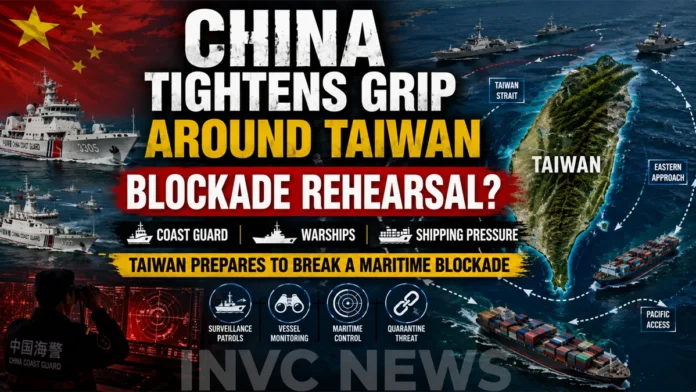
China Taiwan maritime pressure is moving into a potentially more consequential phase as Beijing expands coast guard and government-vessel operations around the self-governed island, particularly across waters to Taiwan’s east that have traditionally received less attention than the Taiwan Strait.
Taiwan’s Ministry of National Defense said Sunday morning that seven People’s Liberation Army Navy vessels and seven Chinese government vessels were detected operating around Taiwan during the 24-hour period ending at 6 a.m. on August 23. No PLA aircraft were detected during that reporting window.
The maritime activity comes against a much broader backdrop.
Since June, Chinese coast guard and maritime authorities have established a more persistent presence east of Taiwan, describing their operations as legitimate law enforcement designed to protect China’s sovereignty and maritime rights.
Taipei rejects Beijing’s jurisdictional claims and accuses China of using civilian-looking law-enforcement operations to gradually change the status quo without crossing the threshold into outright war.
Now, maritime-security researchers are warning that the pattern could have implications far beyond routine patrols.
The concern is that China may be testing tools that could eventually be used to quarantine or blockade Taiwan.
Why China’s New Operations East of Taiwan Matter
Most discussion about a potential Taiwan conflict traditionally focuses on the Taiwan Strait, the roughly 180-kilometer-wide body of water separating Taiwan from mainland China.
But Taiwan’s eastern maritime approaches are strategically important as well.
They connect the island directly with the broader Pacific and could become critical routes for commercial shipping, energy supplies or outside support during a crisis.
China’s growing ability to maintain coast guard, survey and naval activity on both sides of Taiwan therefore has major strategic implications.
Instead of applying pressure only from the west, Beijing could increasingly demonstrate an ability to operate around the island.
That is one reason the recent activity has attracted close attention in Taipei, Tokyo, Manila and Washington.
China Coast Guard Says Its Patrols Are Lawful
Beijing describes the operations very differently.
The China Coast Guard said its ship formations have been conducting what it calls routine law-enforcement patrols east of Taiwan.
In July, the coast guard said the Xiushan task group replaced another formation and would continue patrols, vessel verification, fishery protection and rescue operations.
It also said the patrols would be strengthened in waters China considers to be under its jurisdiction.
China’s Taiwan Affairs Office has argued that Beijing possesses exclusive economic zone and continental-shelf rights in relevant waters east of Taiwan and has accused Japan and the Philippines of infringing Chinese maritime interests.
Taiwan rejects those claims.
The disagreement is not merely semantic.
If Beijing can normalize the idea that Chinese authorities possess law-enforcement powers over commercial vessels operating around Taiwan, it could create the basis for more intrusive actions during a future political crisis.
Chinese Authorities Questioned 198 Commercial Vessels
One of the most striking episodes took place during a Chinese maritime operation in June.
According to China’s own official account, maritime authorities carried out an operation covering approximately 1,030 nautical miles and inspected 198 passing vessels.
The operation also included hydrographic-survey activity.
Beijing said the mission was designed to exercise maritime administrative jurisdiction and strengthen offshore law-enforcement capabilities.
The Asia Maritime Transparency Initiative, or AMTI, at the Center for Strategic and International Studies has raised concerns about those operations.
Its August 19 analysis said Chinese law-enforcement vessels demanded information from passing commercial ships, including ports of call and crew details.
AMTI argues that the scale and character of the operations could represent an attempt to establish a more permanent Chinese presence east of Taiwan.
Is China Rehearsing a Taiwan Quarantine?
This is where the strategic debate becomes particularly important.
A quarantine would not necessarily look like a traditional naval blockade.
China could theoretically rely heavily on coast guard and other law-enforcement agencies rather than immediately deploying the PLA Navy to stop every vessel.
Authorities could announce new shipping regulations, demand advance declarations from ships entering Taiwanese ports or attempt to inspect particular vessels.
Beijing could present such measures as domestic law enforcement rather than military action.
Taiwan and its partners could view exactly the same actions as coercive interference with international shipping.
AMTI said China’s sustained patrols and monitoring of commercial vessels could potentially function as a rehearsal for a future quarantine by allowing Beijing to test regional reactions while gradually normalizing its presence.
That possibility is particularly worrying because it would create difficult questions for the United States and regional governments.
Quarantine vs Blockade: What Is the Difference?
The distinction matters enormously.
A military blockade would generally involve openly using military power to prevent ships or aircraft from reaching Taiwan.
Such an action could quickly create a major international military crisis.
A quarantine-style strategy, by contrast, could be more ambiguous.
China could claim that its coast guard was merely enforcing Chinese regulations, inspecting ships or protecting maritime safety.
That ambiguity could make an international response more complicated.
Would another country send naval vessels to protect a commercial ship?
Would companies continue sailing if insurance costs surged?
Would shipping firms comply with Chinese inspection requests simply to avoid confrontation?
Those are precisely the types of dilemmas a gray-zone maritime strategy could create without immediately starting a conventional war.
Taiwan Is Already Practicing How to Break a Blockade
Taiwan is clearly taking the threat seriously.
During its Han Kuang 42 military exercises, Taiwan’s navy and coast guard conducted a joint anti-blockade escort drill.
The exercise simulated a merchant vessel transporting critical supplies.
Taiwanese naval and coast guard forces practiced escorting the vessel through a protected corridor and guiding it toward an important port.
Taiwan’s Ministry of National Defense said the exercise was designed to strengthen interagency coordination and the island’s ability to keep maritime supply routes open during a quarantine or blockade scenario.
The exercise demonstrates that Taiwanese planners no longer view blockade scenarios as purely theoretical.
Beijing’s Pressure Extends Beyond Taiwan Strait
Chinese maritime operations are also becoming more visible elsewhere.
Taiwan’s Coast Guard reported on August 19 that four Chinese coast guard vessels entered restricted waters near Kinmen, prompting Taiwanese patrol vessels to monitor and expel them.
Taiwanese authorities also reported Chinese coast guard activity near Pratas Island, another strategically important location controlled by Taipei.
The pattern points toward a broader Chinese approach in which coast guard forces operate around multiple areas administered by Taiwan.
This gives Beijing a mechanism for applying sustained pressure without necessarily relying on dramatic large-scale military exercises every time.
Japan and Philippines Become Part of the Story
The latest maritime activity is not only about Taiwan.
China began expanding operations east of the island after Japan and the Philippines announced plans to negotiate their overlapping maritime boundaries in the Philippine Sea.
Beijing strongly opposed those talks.
China argues that the negotiations affect maritime areas in which it claims rights and therefore cannot legitimately proceed without Beijing.
Japan and the Philippines have simultaneously been deepening their defense cooperation.
That means waters east of Taiwan are becoming part of a much larger strategic triangle involving China, Japan and the Philippines.
AMTI says Chinese law-enforcement activity between June and August has been heavily concentrated in areas where maritime claims overlap.
Why Taiwan’s East Coast Is Strategically Sensitive
Taiwan’s geography makes its east coast especially important.
The island’s western side faces mainland China.
Its eastern side opens toward the Pacific.
In a major conflict, maritime routes east of Taiwan could become important for maintaining commercial access and potentially receiving outside support.
A sustained Chinese law-enforcement presence there therefore carries strategic meaning beyond routine coast guard activity.
It could demonstrate Beijing’s ability to operate across approaches that Taiwan might otherwise hope would remain relatively open during a crisis.
Gray-Zone Pressure May Be More Likely Than Immediate Invasion
Much public discussion about Taiwan focuses on whether China will launch a full-scale amphibious invasion.
But there are many steps Beijing could theoretically take below that level.
Those could include:
- Coast guard patrols
- Shipping inspections
- Maritime exclusion zones
- Customs or declaration requirements
- Large-scale military exercises
- Cyber disruption
- Air and sea pressure
- Selective interference with commercial vessels
These measures could be used individually or together.
A quarantine would potentially allow Beijing to increase pressure gradually and observe how Taiwan, Washington and regional governments respond.
Commercial Shipping Could Become the Key Pressure Point
Taiwan’s economy depends heavily on international trade.
It imports large quantities of energy and raw materials while exporting advanced electronics and semiconductors.
Any serious disruption to maritime commerce could therefore create economic pressure rapidly.
The consequences would extend far beyond Taiwan.
The island plays an enormous role in global semiconductor supply chains.
Disruption to Taiwanese shipping or manufacturing could affect electronics, automobiles, artificial intelligence infrastructure and technology companies worldwide.
That is why a Taiwan maritime crisis would not remain merely a regional security story.
It could quickly become a global economic crisis.
Semiconductor Supply Chains Raise the Stakes
Taiwan is home to some of the world’s most important advanced semiconductor manufacturing capacity.
Those chips are used in:
- Smartphones
- Data centers
- AI processors
- Cars
- Consumer electronics
- Defense equipment
- Industrial machinery
Even a limited interruption to Taiwan’s commercial shipping could create uncertainty throughout global technology supply chains.
A prolonged blockade or quarantine would be far more serious.
This economic reality is one reason maritime coercion around Taiwan attracts attention from governments and businesses far beyond East Asia.
Taiwan Strengthens Coast Guard–Military Coordination
Taiwan has increasingly emphasized cooperation between its navy and coast guard.
That matters because a potential quarantine could begin with Chinese law-enforcement vessels rather than warships.
Taipei would therefore need to decide when a maritime confrontation remains a coast guard issue and when military forces should become involved.
The Han Kuang anti-blockade exercise specifically tested coordination between these agencies.
That kind of joint preparation reflects the ambiguity Taiwan expects to face during a gray-zone crisis.
China Could Gain From Normalizing Its Presence
For Beijing, persistence itself may create strategic value.
If Chinese coast guard vessels operate east of Taiwan only during major crises, their presence appears exceptional.
If they operate there routinely for months or years, their presence gradually becomes less unusual.
That can change perceptions of the status quo.
AMTI argues that Beijing may be attempting precisely that — establishing a semi-permanent law-enforcement presence across waters where such activity was previously rare.
The strategy resembles patterns seen in other disputed maritime areas where repeated Chinese patrols have gradually become routine.
Military Activity Around Taiwan Remains Persistent
The maritime pressure is occurring alongside the PLA’s regular military presence around Taiwan.
Taiwan routinely reports Chinese naval ships and aircraft operating nearby.
For the 24 hours ending Sunday morning, however, the Ministry of National Defense reported seven PLA Navy vessels and seven Chinese official vessels but no PLA aircraft.
The absence of aircraft during that particular period does not represent an end to military pressure.
Instead, it highlights something strategically significant:
China can apply pressure around Taiwan using multiple instruments, and those instruments do not always need to operate simultaneously.
Could Maritime Pressure Trigger a Larger Crisis?
The greatest danger may be miscalculation.
If a Chinese coast guard vessel attempts to inspect a commercial ship and Taiwan intervenes, vessels from both sides could come into close contact.
If one side believes the other has crossed a legal or security red line, escalation could happen quickly.
The presence of military forces nearby adds another layer of risk.
A coast guard confrontation could potentially become a military confrontation if either side believes national security is threatened.
Why the United States Is Watching Closely
Washington has long opposed unilateral attempts to change the status quo across the Taiwan Strait.
A quarantine scenario would present the United States with an especially difficult challenge because it could fall into the gray area between peacetime law enforcement and open military blockade.
The strategic question would be whether allowing Chinese inspections or shipping restrictions to continue would effectively concede Beijing’s claimed jurisdiction.
But directly challenging those measures could carry serious escalation risks.
That makes quarantine-style tactics potentially more complicated than a conventional blockade.
China Taiwan Maritime Pressure: What to Watch Next
Several developments could reveal whether Beijing is establishing a permanent new pattern.
Coast guard deployment: Whether Chinese vessels continue sustained patrols east of Taiwan.
Commercial shipping: Whether vessels face further questioning, inspection or interference.
Survey operations: Whether Chinese research ships conduct repeated surveys around strategically sensitive areas.
Taiwan response: How aggressively Taiwan’s coast guard challenges Chinese vessels.
Japan-Philippines cooperation: Whether maritime-boundary talks and defense cooperation continue.
PLA involvement: Whether future coast guard patrols become increasingly coordinated with military deployments.
International response: Whether the United States, Japan or European governments publicly challenge Chinese jurisdictional claims.
Taiwan Faces a Different Kind of China Challenge
The most important element of the current China Taiwan maritime pressure is that Beijing does not need to launch an invasion to dramatically alter the security environment around Taiwan.
A growing coast guard presence can challenge jurisdiction.
Survey vessels can gather information.
Commercial ships can be questioned.
Patrols can become routine.
And exercises can test how Taiwan and its partners respond.
Each action alone may fall below the threshold of war.
Taken together, however, they could gradually change the operating environment around the island.
That is why the latest operations east of Taiwan deserve attention.
The strategic question is no longer simply whether China is preparing for a military attack.
It is whether Beijing is developing a broader toolkit that could allow it to pressure, isolate or partially quarantine Taiwan without immediately firing the first shot.
And if that approach becomes normalized, a future Taiwan crisis could begin not with an invasion fleet — but with a coast guard vessel ordering a commercial ship to stop.