MOSCOW, RUSSIA | AUGUST 23, 2026 —
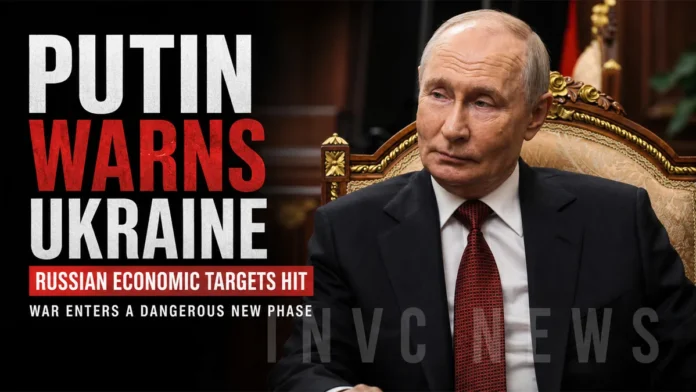
Putin warns Ukraine that Moscow could retaliate against what he described as Kyiv’s most sensitive economic sectors after a wave of Ukrainian drone strikes hit Russian oil, logistics and commercial infrastructure, raising the risk of a deeper economic war far beyond the front lines.
Russian President Vladimir Putin said Ukraine had opened a “Pandora’s box” by expanding attacks on Russian economic targets, including oil refineries and warehouses.
His warning comes as both Russia and Ukraine increasingly target infrastructure designed to sustain each other’s economies and war efforts.
Ukraine has intensified long-range drone attacks on Russian oil facilities, ports and logistics hubs.
Russia, meanwhile, has continued attacks on Ukrainian cities, energy systems, industrial sites and Black Sea grain infrastructure.
The escalation is creating a new and increasingly dangerous layer of the conflict: economic infrastructure itself is becoming a battlefield.
Putin Says Ukraine Has Opened ‘Pandora’s Box’
Putin said Kyiv should expect a response after strikes against Russian economic infrastructure.
He argued that Ukraine had deliberately sought to damage the Russian economy and warned that Moscow could now target sectors considered particularly important to Ukraine.
The statement is significant because it suggests Russia could widen its focus beyond traditional military objectives.
Economic targets such as export infrastructure, logistics hubs, warehouses, energy facilities and agricultural systems could face increasing pressure.
The warning also comes after Ukraine stepped up its campaign against Russian oil-processing and logistics assets.
Kyiv says such targets contribute to Russia’s ability to finance and sustain the war.
Ukraine Expands Long-Range Drone Campaign
Ukraine’s ability to strike deep inside Russia has grown significantly.
Recent attacks have targeted facilities far from the Ukrainian border, forcing Moscow to devote additional resources to protecting industrial infrastructure, oil installations and commercial logistics networks.
In one of the most striking examples earlier this month, Ukraine said it had hit an energy and petrochemical facility in Tobolsk, western Siberia, more than 2,500 kilometers from Ukrainian territory.
Also Read: Ukraine Says Its Deep-Strike Reach Now Extends More Than 2,500 Kilometers Into Russia
The expanding range of Ukrainian drones is changing calculations inside Russia.
Facilities that were once considered safely beyond the reach of conventional Ukrainian weapons are now increasingly vulnerable.
Ozon Warehouse and Oil Refinery Hit
The latest Ukrainian drone campaign included attacks across several Russian regions and Russian-controlled areas.
A logistics center belonging to Russian online retailer Ozon in the Samara region halted operations following a drone strike.
Ukraine also said it targeted an oil refinery in Novokuibyshevsk.
Russian officials reported deaths and injuries in multiple regions during the attacks.
Moscow said its air defenses intercepted hundreds of Ukrainian drones overnight.
The scale of the attack underlines how central drones have become to the conflict.
Both sides can now strike infrastructure hundreds or even thousands of kilometers from conventional battle lines without deploying manned aircraft.
Civilian Casualties Rise on Both Sides
The escalation has also brought a growing civilian toll.
Russian officials reported at least 10 deaths from Ukrainian drone attacks across Russia and Russian-controlled territories.
In Ukraine, the situation has been even more severe following a series of major Russian strikes.
A Russian drone attack on a shopping center in Kryvyi Rih killed at least 16 people and wounded more than 130, according to Ukrainian authorities.
Children were among those injured.
Ukrainian President Volodymyr Zelenskiy accused Russia of deliberately striking the location and said Ukraine would respond.
Russia has repeatedly said that its military targets facilities connected with Ukraine’s war effort.
Ukraine and its Western allies have accused Moscow of conducting attacks that have caused extensive civilian casualties.
Kyiv Attack Adds to Pressure on Ukraine’s Air Defenses
The latest violence follows another deadly Russian strike on Kyiv.
Earlier this week, Russian ballistic missile and drone attacks killed 17 people in the Ukrainian capital and surrounding areas.
The attack again highlighted one of Ukraine’s biggest military vulnerabilities: its limited supply of advanced air-defense interceptors.
Ukraine has become increasingly dependent on sophisticated Western systems to counter ballistic missiles.
Among them, the U.S.-made Patriot system remains especially important because of its capability against high-speed ballistic threats.
Zelenskiy has repeatedly warned that shortages of interceptor missiles are leaving Ukrainian cities exposed.
France Promises Faster Air-Defense Deliveries
Ukraine’s growing air-defense problem has triggered fresh commitments from European allies.
French President Emmanuel Macron has agreed to accelerate deliveries of French military equipment and interceptor missiles to Ukraine.
The decision followed a lengthy conversation with Zelenskiy focused heavily on Ukraine’s shortage of air defenses.
Macron has also indicated that France will work with other allies that hold stocks of Patriot interceptors.
Ukraine is additionally waiting for the newer SAMP/T-NG air-defense system, developed by France and Italy.
The system is expected to provide another layer of protection against ballistic missile threats.
Why Patriot Missiles Matter So Much
Ukraine faces a difficult defensive equation.
Russia can launch drones in large numbers, forcing Ukrainian air defenses to expend missiles and ammunition.
At the same time, ballistic missiles travel faster and are much harder to intercept.
That means Ukraine must preserve its most advanced interceptors for the most dangerous threats.
When Patriot missile stocks run low, major cities and infrastructure become more vulnerable.
This is why Zelenskiy has increasingly connected peace diplomacy with air defense.
His argument is that Russia will have less incentive to compromise if it believes Ukraine remains vulnerable to sustained air attacks.
Black Sea Grain Trade Becomes Another Battlefield
Economic warfare is also spreading across the Black Sea.
Russia and Ukraine are increasingly targeting ports, vessels and grain infrastructure associated with each other’s export systems.
The consequences are already reaching global food markets.
Wheat prices have risen sharply as importers worry about delayed shipments.
Countries in Asia, the Middle East and Africa rely heavily on grain exported through the Black Sea.
Major importers such as Egypt and Indonesia are particularly exposed to prolonged disruption.
Global Wheat Prices Feel the Impact
Benchmark wheat futures have risen more than 17% since early July amid growing concern over Black Sea supply.
Recent attacks have forced some grain terminals to stop operations and caused shipping companies to reconsider entering Russian and Ukrainian ports.
Cargoes have been delayed or cancelled.
Importers are now exploring more expensive alternatives from Australia, North America and Argentina.
That means the Russia-Ukraine conflict is again creating food-security risks far beyond Europe.
Putin Says Russia Can Replace Ukrainian Grain
Putin has dismissed concerns that attacks on Ukrainian agricultural exports will lead to a global shortage.
He argues that Russia has enough export capacity to compensate for reduced Ukrainian supplies.
However, the market impact is more complicated.
Even when grain exists elsewhere, disrupted shipping routes, higher insurance costs and longer transport distances can push prices higher.
The key issue is therefore not only global production.
It is whether grain can reach buyers reliably and affordably.
The Black Sea Safety System Has Broken Down
The Black Sea once operated under a Turkish-brokered arrangement designed to protect grain shipments.
Russia withdrew from that agreement in 2023.
More recently, both sides had largely avoided directly disrupting some commercial grain flows.
That informal restraint now appears to be weakening.
Attacks on ports and vessels have increased significantly.
If the escalation continues, commercial shipping could face even greater insurance costs and operational risks.
Russian Oil Infrastructure Is Also Under Pressure
Ukraine’s strategy is increasingly aimed at reducing Russia’s ability to earn revenue from energy exports.
Oil refineries, storage facilities and ports have become high-value targets.
Recent attacks have disrupted operations at Russia’s Black Sea port of Novorossiysk, one of the country’s most important oil-export hubs.
Russian western-port oil exports reportedly fell below planned levels during the first half of August.
Even temporary disruption matters because energy exports remain central to Russia’s economy and government revenues.
Why Ukraine Targets Economic Infrastructure
Ukraine says economic strikes are intended to weaken Russia’s ability to finance and sustain military operations.
From Kyiv’s perspective, attacking an oil refinery can have multiple effects.
It can reduce fuel availability.
It can force Russia to spend money on repairs.
It can divert air-defense systems away from the battlefield.
And it can potentially reduce export revenues.
The strategy also gives Ukraine a way to impose costs deep inside Russia without launching conventional ground operations.
Russia Could Expand Its Own Economic Target List
Putin’s warning suggests Moscow may respond with a broader campaign against Ukrainian economic sectors.
Potential targets could include logistics infrastructure, export routes, industrial facilities and energy systems.
Russia has already attacked many such targets during the war.
The significance of Putin’s latest statement is that economic retaliation is now being framed more explicitly as a response to Ukraine’s deep-strike campaign.
That raises fears of a cycle in which each side attacks a broader range of civilian-economic infrastructure.
Grain, Oil and Warehouses Are Becoming Strategic Targets
The conflict increasingly shows how modern warfare extends far beyond military bases.
Warehouses matter because they support logistics.
Refineries matter because they supply fuel and generate revenue.
Ports matter because they connect national economies with global markets.
Grain infrastructure matters because agricultural exports generate income and support food supply chains.
The line between economic infrastructure and wartime logistics is therefore becoming increasingly contested.
That makes escalation particularly dangerous for civilians and international markets.
Peace Talks Remain Stalled
Despite the growing violence, Putin says Russia remains open to negotiations.
However, he insists that any talks must reflect what he calls the current realities on the ground.
Ukraine has rejected Russian territorial demands and continues to insist that a settlement must protect its sovereignty and security.
Western governments have also been involved in efforts to revive negotiations.
But little evidence currently suggests that the fundamental positions of Moscow and Kyiv are moving significantly closer.
Putin Rejects What He Calls ‘Exotic’ Proposals
The Russian president has criticized proposals delivered through intermediaries that he considers unrealistic.
His position remains that negotiations must reflect Russia’s territorial and military gains.
Ukraine sees that approach as an attempt to turn battlefield occupation into permanent political concessions.
This disagreement remains one of the biggest barriers to a peace agreement.
Until there is movement on territory and security guarantees, diplomacy is likely to remain extremely difficult.
Zelenskiy and Macron Discuss New Diplomatic Options
Zelenskiy and Macron also discussed the status of peace efforts during their latest call.
The Ukrainian president said the two leaders had agreed on steps that could create additional diplomatic opportunities.
Macron, British Prime Minister Andy Burnham and German Chancellor Friedrich Merz are expected to co-chair another meeting of the Coalition of the Willing in Kyiv.
The group is intended to strengthen support for Ukraine while also coordinating diplomatic strategy.
War Approaches Four-and-a-Half-Year Mark
Russia launched its full-scale invasion of Ukraine in February 2022.
More than four years later, neither side has achieved a decisive outcome.
Russia continues to hold substantial Ukrainian territory.
Ukraine continues to resist and has developed increasingly sophisticated long-range strike capabilities.
The war has therefore evolved from large armored offensives into a broader contest involving drones, missiles, electronic warfare, industrial capacity and economic endurance.
Drone Warfare Is Changing the Conflict
Perhaps the biggest transformation has been the role of unmanned systems.
Low-cost drones can now threaten infrastructure worth millions or billions of dollars.
They can strike far beyond the front.
They can overwhelm air-defense networks through sheer numbers.
And they can force governments to defend enormous geographical areas.
This creates a new strategic problem for both Moscow and Kyiv.
No country can economically protect every refinery, warehouse, power station, port and city with high-end missile defenses.
Europe Faces Growing Pressure to Supply More Weapons
European governments increasingly recognize that Ukraine’s air-defense shortage could determine the direction of the conflict.
France’s latest commitment is part of a broader effort to provide cheaper and more sustainable defenses against Russian missile attacks.
The challenge is production.
Modern interceptor missiles take time and money to manufacture.
Ukraine can consume them far faster than Western companies can sometimes replace them.
That means increasing European production has become almost as important as transferring existing stockpiles.
Economic War Could Have Global Consequences
The conflict’s next phase could create economic consequences far beyond Russia and Ukraine.
If attacks reduce Russian oil exports, energy prices could rise.
If Black Sea grain exports remain disrupted, food prices could increase.
If ports become too dangerous, shipping insurance costs could jump.
And if more industrial infrastructure is targeted, reconstruction costs will continue climbing.
This is why Putin’s “Pandora’s box” warning matters beyond the immediate military confrontation.
It points toward a broader form of warfare in which economic systems themselves become targets.
What Happens Next?
Several developments will determine whether the escalation deepens.
Russian retaliation: Moscow’s next major attack could show what Putin means by targeting Ukraine’s “most sensitive economic sectors.”
Ukrainian deep strikes: Kyiv is likely to continue attacking Russian energy and logistics infrastructure.
Air-defense supplies: Faster French deliveries and additional Patriot interceptors could significantly affect Ukraine’s ability to protect major cities.
Black Sea shipping: More attacks on ports or vessels could push grain prices higher.
Peace diplomacy: Any new diplomatic initiative will need to address fundamental territorial and security disputes.
Russia-Ukraine War Enters a More Dangerous Economic Phase
The most important change in the Russia-Ukraine war is no longer simply where the front line moves.
The battlefield is expanding into national economies.
Ukraine is striking refineries and logistics hubs deep inside Russia.
Russia is attacking Ukrainian cities, ports, energy infrastructure and grain-export facilities.
Both sides are trying to reduce the other’s ability to sustain the war.
That creates an increasingly dangerous cycle.
Military retaliation can damage economic infrastructure.
Economic attacks can trigger broader military retaliation.
And disruption to oil and grain exports can spread the consequences of the war across international markets.
Putin’s warning that Ukraine has opened a “Pandora’s box” therefore captures the central risk facing the conflict now.
The question is whether the box can still be closed — or whether Russia and Ukraine are entering a phase in which economic warfare becomes as important as the fighting on the battlefield itself.