
New Delhi, India | August 22, 2026
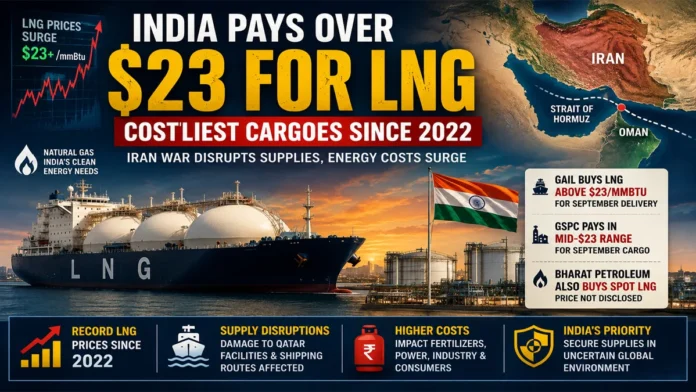
India LNG prices have surged to their highest levels in years as state-backed energy companies scramble for supplies on the spot market amid disruptions caused by the Iran conflict and restrictions affecting shipping through the Strait of Hormuz.
GAIL India recently paid more than $23 per million British thermal units (mmBtu) for a liquefied natural gas cargo scheduled for September delivery, according to people familiar with the transaction.
Gujarat State Petroleum Corp. separately paid in the mid-$23 per mmBtu range for a September cargo.
The purchases rank among India’s most expensive LNG imports since 2022 and underscore how geopolitical disruptions in West Asia are beginning to reshape the country’s gas procurement strategy.
Why India Is Paying More for LNG
India normally secures substantial LNG supplies through long-term contracts, particularly from Qatar.
However, the regional conflict has disrupted normal supply flows. Qatar’s major LNG export infrastructure was damaged during Iranian attacks in March, while commercial shipping through the strategically critical Strait of Hormuz remains heavily constrained.
That has forced Indian state-backed buyers to turn more aggressively toward the international spot market.
At the same time, India is competing with European buyers, where gas prices have climbed to a five-month high amid concerns about available supplies.
Also Read: India-Oman CEPA Takes Effect: Duty-Free Access and Energy Security Get Major Boost
Fertilizer Sector Adds Urgency to India’s LNG Purchases
The government’s need to maintain supplies for fertilizer producers is adding urgency to gas procurement.
Natural gas is a crucial feedstock for fertilizer production, particularly urea. A shortage or prolonged disruption in gas availability could therefore have implications beyond the energy sector.
This helps explain why state-backed companies are willing to secure cargoes even at unusually elevated spot-market prices.
The immediate priority is supply security.
However, sustained LNG prices above $23/mmBtu would significantly increase procurement costs compared with more normal market conditions.
Bharat Petroleum Also Turns to Spot Market
GAIL and Gujarat State Petroleum Corp. are not the only Indian buyers seeking additional supplies.
Bharat Petroleum Corp. also agreed to purchase an LNG cargo on the spot market this week, according to people familiar with the transactions.
The price of BPCL’s cargo has not been confirmed.
Together, the purchases demonstrate how Indian energy companies are diversifying procurement as traditional supply channels face disruption.
Strait of Hormuz Becomes Critical for India
The Strait of Hormuz remains one of the world’s most important energy corridors.
Any prolonged disruption can affect crude oil as well as LNG flows, creating price pressure far beyond the Middle East.
For India, the vulnerability is particularly important because the country relies heavily on imported energy.
The current LNG situation therefore highlights a broader strategic challenge: ensuring affordable energy supplies when geopolitical conflict disrupts established trade routes.
Also Read: Iran-America War Sends Crude Oil Higher: Will Petrol-Diesel Get Costlier in India?
Could Expensive LNG Affect Indian Consumers?
There should be caution here.
A $23-plus spot LNG purchase does not automatically mean household gas prices will immediately rise.
India’s gas market includes domestic production, long-term imported LNG contracts and spot purchases, while prices paid by different categories of consumers depend on supply arrangements and government policies.
However, persistently expensive spot LNG can raise costs for companies and industries that rely heavily on imported natural gas.
Fertilizers, city gas distribution, refining, petrochemicals, industrial manufacturing and power generation are among sectors where gas availability and pricing can matter.
The economic impact will therefore depend largely on how long the supply disruption lasts and how much additional LNG India needs to purchase at elevated spot prices.
India’s Energy Security Faces Another Test
The latest purchases demonstrate how quickly geopolitical developments can translate into higher procurement costs for an energy-importing economy.
India has sought to diversify its energy suppliers and expand domestic natural gas infrastructure, while also maintaining long-term supply agreements.
Nevertheless, major disruptions in the Gulf can still expose Indian buyers to volatile international markets.
The immediate focus will now be on the Strait of Hormuz, restoration of Qatari LNG supplies and global spot prices.
If disruptions ease, LNG prices could moderate.
If they persist, Indian buyers may have to continue competing for expensive cargoes to protect domestic supply.
For now, GAIL’s purchase above $23/mmBtu provides a striking measure of how dramatically the Iran conflict has altered the international LNG market—and the price India is having to pay for energy security.










Comments are closed.