Mumbai, August 19, 2026
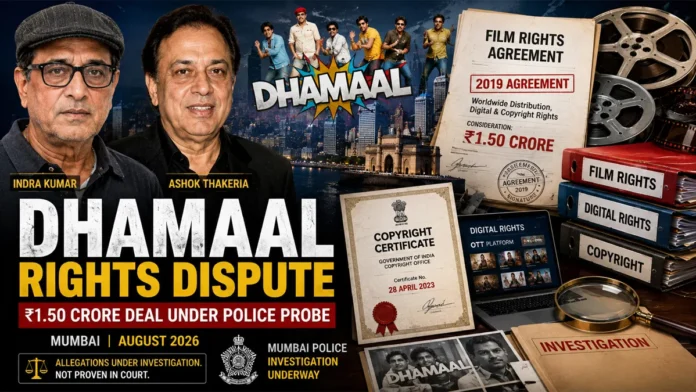
Dhamaal Copyright Fraud Case allegations have triggered a police investigation in Mumbai after a film distribution company accused veteran filmmaker Indra Kumar and producer Ashok Thakeria of cheating it in an alleged ₹1.50 crore deal involving worldwide distribution, digital and copyright rights to the popular Bollywood comedy Dhamaal .
According to the complaint, Amboli Police registered a case on August 17, 2026, following allegations made by Vikas Baldevraj Sahni, owner of Andheri West-based film distribution company Grand Master.
The complaint alleges that rights to Dhamaal , starring Sanjay Dutt, Arshad Warsi, Riteish Deshmukh and Jaaved Jaaferi, were sold to Grand Master in 2019 despite certain digital rights allegedly having already been transferred to another entertainment company years earlier.
The allegations are under investigation. Registration of a police case does not establish guilt, and the claims will have to be tested through evidence and the legal process.
What Is the Dhamaal Rights Dispute?
At the heart of the dispute is an agreement allegedly executed between Grand Master and Maruti International on October 15, 2019.
According to Sahni’s complaint, Grand Master agreed to pay approximately ₹1.50 crore for what it understood to be permanent worldwide distribution and copyright-related rights to Dhamaal.
The complainant claims that assurances were given at the time that the rights being transferred had not already been sold to another third party.
Sahni alleges that his company entered the transaction on the basis of those representations and subsequently treated itself as the lawful holder of the rights covered by the agreement.
Complaint Claims Digital Rights Had Already Been Sold
The dispute intensified after Grand Master allegedly discovered that certain lifetime OTT and digital rights connected with Dhamaal had previously been transferred to Shemaroo Entertainment Limited in 2015.
The complainant alleges that this earlier arrangement was not disclosed when the 2019 agreement with Grand Master was executed.
That allegation is central to the cheating and forgery complaint because investigators will need to establish precisely which rights were included in each contract and whether the rights sold under the respective agreements overlapped.
Film-rights agreements can separately cover theatrical distribution, satellite television, digital streaming, music, overseas exploitation and other forms of commercial use, making the wording of the contracts particularly important.
Maruti International Deal Under Police Scanner
Maruti International has long been associated with Indra Kumar and Ashok Thakeria and with the Dhamaal film franchise.
According to the police complaint described in the case material, Grand Master alleges that representations made during its transaction with Maruti International caused it significant financial loss.
Investigators are expected to examine the original 2019 agreement, payment records and correspondence between the parties to determine exactly what was promised and what rights were contractually transferred.
The police may also compare those documents with agreements involving other rights holders.
Allegation Over Subsequent Shemaroo Agreement
The complaint further alleges that, after the dispute emerged, another agreement or amended arrangement involving Shemaroo was produced in 2020.
Sahni has alleged that this documentation was used in an attempt to undermine or restrict Grand Master’s claimed rights.
The allegation of document fabrication or forgery remains to be established by investigators.
Police will likely have to examine the dates on the documents, their execution, signatures, payment records and communications among the parties to determine whether any document was improperly created, altered or relied upon.
Grand Master Claims Copyright Ownership
Another significant element of the complaint concerns a copyright registration that Grand Master says supports its ownership claim.
According to Sahni, documentation was submitted to India’s Copyright Office and a registration was issued on April 28, 2023, recognizing Grand Master’s claimed interest in Dhamaal.
The precise scope and legal effect of that registration could become an important issue in the investigation and any subsequent civil or criminal proceedings.
Copyright registration can provide documentary evidence relating to a claim, but disputes over contractual ownership and competing assignments can still require examination of the underlying agreements and applicable law.
India’s Copyright Office maintains registration and application records as part of the country’s statutory copyright framework.
Original Film Negatives Also Part of Ownership Claim
Sahni has also cited an alleged communication concerning the physical original negatives of the film.
According to the complaint, the filmmakers issued a letter to a film laboratory in January 2020 stating that rights or control over the original sound and picture negatives were being transferred to Grand Master.
The complainant maintains that these materials continue to remain legally associated with his company.
Investigators will have to determine the precise legal significance of the letter and whether ownership or custody of original negatives corresponds with the commercial and copyright rights being disputed.
Why the Difference Between Physical Negatives and Copyright Matters
Ownership of physical film material and ownership of copyright are not necessarily identical.
A company may possess a physical negative, print or master while particular exploitation rights are governed by separate contractual agreements.
Similarly, digital, satellite, overseas and theatrical rights may be licensed or assigned independently.
For that reason, the police investigation is expected to focus heavily on the wording and chronology of the various agreements rather than any single document in isolation.
Grand Master Claims Other Digital Deals Collapsed
The complainant alleges that the rights dispute caused Grand Master to lose other commercial opportunities.
According to Sahni, his company was negotiating or pursuing arrangements with major digital platforms when competing claims over Dhamaal emerged.
He alleges that some of those business opportunities were subsequently cancelled, resulting in losses beyond the original ₹1.50 crore transaction.
The exact amount of any consequential financial loss has not been independently established and would require documentary evidence.
Legal Notice Sent in January 2023
The complaint also states that a legal notice was sent on January 2, 2023 seeking resolution of the dispute.
According to Sahni, no satisfactory settlement followed, eventually leading him to approach the police.
The case has now moved from a contractual dispute into a criminal investigation involving allegations of cheating and document-related wrongdoing.
Investigators are examining materials submitted by the complainant as they assess whether the facts disclose criminal conduct or primarily constitute a commercial rights dispute.
Police to Examine Chain of Film Rights
One of the most important tasks before investigators will be reconstructing the complete chain of title for Dhamaal.
That could include:
- agreements executed by the film’s producers;
- contracts with Grand Master;
- earlier agreements involving Shemaroo;
- amendments or supplementary agreements;
- payment and banking records;
- copyright registration documents;
- laboratory correspondence relating to film negatives; and
- emails or other communications between the parties.
Establishing the exact rights held by each party at different points in time will be crucial to determining whether any rights were sold more than once.
Why Chain of Title Is Critical in Film Business
Film rights can generate revenue for decades after a movie’s theatrical release.
A producer may separately exploit theatrical, television, digital, overseas, remake, adaptation and other rights.
A clear chain of title records how those rights were originally created and subsequently assigned or licensed.
When competing companies claim rights to the same film, investigators and courts often need to examine every relevant agreement chronologically.
That process could become central to the Dhamaal dispute.
Dhamaal Remains One of Bollywood’s Popular Comedy Franchises
The original Dhamaal became a widely recognized Hindi comedy and later developed into a successful franchise.
Indra Kumar has continued to be closely associated with the series as director, while Ashok Thakeria has been involved as a producer.
Their association with the franchise continued through subsequent installments.
That commercial value makes ownership of catalog and digital rights potentially significant long after the original film’s theatrical run.
Allegations Not Yet Proven
The case remains at the investigation stage.
The allegations made by Grand Master and Vikas Sahni have not been established as proven findings against Indra Kumar, Ashok Thakeria or Maruti International.
The filmmakers and any other parties named in the investigation are entitled to respond to the allegations and present their documents and version of events.
Any determination of criminal liability would ultimately depend on the evidence and judicial proceedings.
What Happens Next?
Mumbai Police are expected to scrutinize the documents supplied with the complaint and may seek additional records from the companies involved.
Investigators could examine agreements dating back several years to establish when individual rights to Dhamaal were transferred and whether any of those assignments conflicted with later contracts.
Statements from the complainant, filmmakers, company representatives and other parties connected with the rights transactions may also be recorded.
If necessary, police could seek expert examination of disputed documents or digital communications.
For now, the Dhamaal 4 Copyright Fraud Case centers on a fundamental question: whether Grand Master was sold rights for ₹1.50 crore that had allegedly already been assigned, in whole or in part, to another company.
The answer will depend on the documentary chain of title and the findings of the ongoing Mumbai Police investigation.