NEW DELHI, August 14, 2026
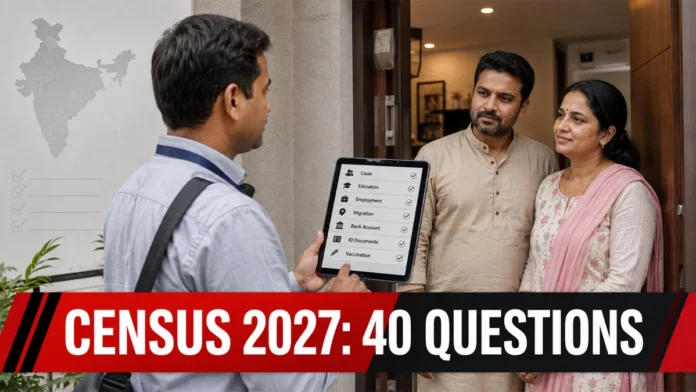
Census 2027 questions will range from a person’s caste, religion and educational qualifications to employment, migration, bank accounts and the place where they received a Covid-19 vaccine, according to a newly notified 40-point questionnaire.
The population-enumeration schedule also covers mobile numbers and identification details such as Aadhaar, voter ID and Indian passport numbers, where available. Respondents will additionally be asked whether they possess a driving license.
The questionnaire was notified by the Office of the Registrar General and Census Commissioner of India under Section 8(1) of the Census Act, 1948. It authorizes census officials to collect the specified information from people residing within their assigned areas through the Census 2027 Household Schedule.
The population count will begin September 1 in Ladakh and designated snowbound areas of Jammu and Kashmir, Himachal Pradesh and Uttarakhand. Door-to-door enumeration in these regions will continue through September 30, while an online self-enumeration option will be available from August 17 to 31.
Population enumeration across the rest of India is scheduled for 2027.
Caste enumeration becomes a defining feature
Census 2027 will conduct comprehensive caste enumeration of all individuals for the first time in a post-independence national Census. Previous censuses systematically recorded Scheduled Caste and Scheduled Tribe status but did not enumerate every caste.
The Cabinet Committee on Political Affairs, chaired by Prime Minister Narendra Modi, approved the inclusion of caste enumeration on April 30, 2025. The caste data will be collected electronically during the second phase of the Census.
No predefined list of individual castes is expected to be presented to respondents. Instead, people are likely to state their caste, with enumerators recording the response provided.
The government’s official Census 2027 backgrounder describes the exercise as India’s first fully digital Census and confirms that caste data will be captured during population enumeration.
Complete list of 40 Census 2027 questions
The notified Household Schedule covers the following subjects:
- Name: What is the person’s name?
- Relationship to household head: How is the person related to the head of the household?
- Sex: What is the person’s sex?
- Date of birth and age: What is the person’s date of birth and age in completed years?
- Marital status: What is the person’s current marital status?
- Age at marriage: How old was the person, in completed years, when they married?
- Spouse’s name: What is the name of the person’s spouse?
- Nationality: What nationality does the person declare?
- Religion: What is the person’s religion?
- SC, ST and caste: Does the person belong to a Scheduled Caste or Scheduled Tribe, and what is their caste?
- Father’s particulars: What are the relevant details about the person’s father?
- Mother’s particulars: What are the relevant details about the person’s mother?
- Disability: Does the person have a disability?
- Languages: What is the person’s mother tongue, and what other languages do they know?
- Literacy: What is the person’s literacy and digital-literacy status?
- Educational attendance: Is the person attending an educational institution?
- Educational qualification: What is the highest educational level attained, including the stream or discipline?
- Work during the previous year: Did the person work at any point during the last year?
- Economic activity: What is the person’s category of economic activity?
- Occupation: What is the person’s occupation?
- Industry or service: What is the nature of the industry, trade or service connected with the person’s work?
- Worker classification: To which class of worker does the person belong?
- Non-economic activity: In what non-economic activity is a marginal, semi-marginal or non-worker engaged?
- Availability for work: Is a marginal, semi-marginal or non-worker seeking or available for work?
- Travel to work: How does the person travel to their workplace?
- Birthplace: Where was the person born?
- Previous residence: Where did the person live immediately before moving to the current location?
- Reason for migration: Why did the person migrate?
- Duration of residence: How long has the person lived in the current village or town since the last migration?
- Permanent address: What is the person’s permanent residential address?
- Surviving children: For women who are married, widowed, divorced or separated, how many children are currently alive?
- Children ever born alive: How many children has an eligible woman given birth to alive?
- Births during the previous year: How many children were born alive to a currently married woman during the last year?
- Covid-19 vaccination: Where did the person receive a Covid-19 vaccination?
- Bank accounts: How many bank accounts does the person have?
- Mobile number: What is the person’s mobile number, if available?
- Aadhaar number: What is the person’s Aadhaar number, if available?
- Voter ID: What is the person’s voter identification number, if available?
- Passport number: What is the person’s passport number if they hold an Indian passport?
- Driving license: Does the person have a driving license?
Education, digital literacy and employment data
The Census 2027 questions will examine both conventional literacy and digital literacy. Respondents will be asked whether they attend an educational institution, the highest educational level they have completed and their chosen academic stream or discipline.
Employment-related questions will establish whether a person worked at any time during the previous year. Enumerators will record the respondent’s occupation, worker category and the nature of the industry, trade or service in which they are engaged.
Marginal workers, semi-marginal workers and people classified as non-workers will be asked about their non-economic activities. The schedule will also determine whether they are looking for work or are available to work.
Information about travel to the workplace will help provide a broader picture of commuting patterns and access to employment.
Migration and permanent-address information
Migration will form another major part of population enumeration. Respondents will provide their birthplace, last place of residence and reason for moving to their current village or town.
They will also be asked how long they have lived at the present location since their last migration and to provide their permanent residential address.
The information is intended to help measure domestic migration, population movement, urbanization and changing settlement patterns.
Questions concerning women and children
Women who are currently married, widowed, divorced or separated will be asked about the number of their children who are still living and the total number of children they have given birth to alive.
Currently married women will also be asked how many children they delivered alive during the preceding year.
These questions form part of the Census exercise’s demographic and fertility-related data collection.
Aadhaar, mobile and passport information listed as conditional
The schedule includes mobile, Aadhaar and voter ID numbers only “if available.” Passport details apply only to Indian passport holders, while the driving-license question concerns whether the document is available.
The questionnaire separately seeks the total number of bank accounts held by a person and the place where the respondent received a Covid-19 vaccination.
The notification identifies the information census officers are authorized to seek. It does not mean that every item applies identically to every respondent; several questions are expressly conditional or restricted to particular categories.
India’s first digital Census
Census 2027 is being prepared as India’s first Census conducted through digital means. Enumerators will use mobile-based systems for data collection, while respondents will have the option of completing self-enumeration online before door-to-door counting begins.
The government has approved an expenditure of approximately ₹11,718.24 crore for the exercise. Around three million census functionaries—including enumerators, supervisors, trainers and administrative officers—are expected to participate.
The nationwide exercise has two principal stages: House Listing and Housing Census, followed by Population Enumeration. The first stage records buildings, households, housing conditions, assets and basic amenities. The second stage collects individual demographic, social, educational, cultural and economic information.
The regular 2021 Census could not proceed as scheduled after field operations were postponed because of the Covid-19 pandemic. The official government announcement sets March 1, 2027, as the reference date for most of India and October 1, 2026, for the designated snowbound regions.