
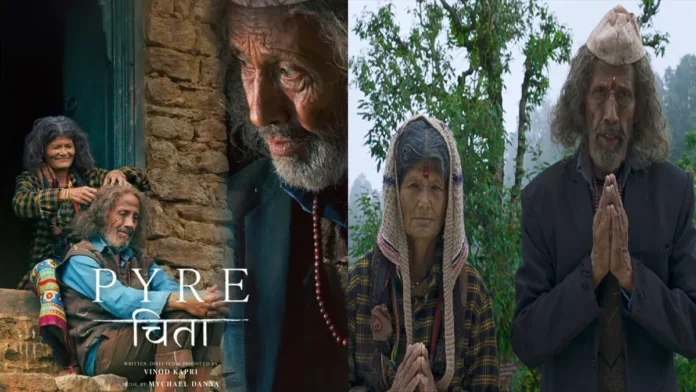
NEW DELHI, INDIA | October 30, 2026: What does growing old mean when the village you have called home for decades is slowly emptying out, your children have moved away and even reaching a hospital becomes a difficult journey? And what happens when the person who has shared your life for more than six decades is the only companion left in a world that seems to have forgotten you?
Director Vinod Kapri explores these deeply human questions in Pyre, a moving Hindi film set in the remote mountains of Uttarakhand. After earning international recognition and winning several awards at film festivals, the film has finally arrived in Indian cinemas on October 30, 2026.
Starring Padam Singh Kapri and Hira Devi in the lead roles, Pyre is not a conventional romantic drama. It is a quiet, deeply emotional story about an elderly couple, their fading village, their absent son and the fragile hope that keeps them going.
The film’s greatest achievement is its ability to make ordinary moments feel extraordinary. A conversation between husband and wife, a walk through the mountains, a letter from a son who has been away for decades or the simple presence of someone willing to help — every small detail carries emotional weight.
The Story: A Lifetime Together, Waiting for Someone to Return
Set in a remote village in Uttarakhand’s Kumaon region, Pyre follows Padam and Tulsi, an elderly couple who have spent most of their lives together in the mountains.
Padam, played by Padam Singh Kapri, is an ageing shepherd, while Hira Devi portrays his wife, Tulsi. Their days revolve around familiar routines, looking after their goats, managing household responsibilities and dealing with the health problems that come with old age.
Their village, however, is no longer the lively community it once was. Younger residents have left for cities in search of jobs and better opportunities. Houses are gradually being abandoned, neighbours are disappearing and the couple are increasingly isolated.
Their only son, who left for Mumbai nearly three decades earlier, has not returned. His absence has become a permanent part of their lives, but the hope of seeing him again refuses to disappear.
Then a letter arrives, bringing news that the son may finally come home. For Padam and Tulsi, this small development becomes a reason to look forward to life again. Their excitement, however, also exposes how deeply they have missed him.
As the story unfolds, the couple face deteriorating health, difficult journeys for medical treatment and the growing uncertainty of living in a village with very few people left.
The film gradually moves beyond the question of whether their son will return. It becomes a larger reflection on ageing, family responsibility, migration and the human need for companionship.
Padam Singh and Hira Devi: Performances That Feel Like Real Life
The most remarkable aspect of Pyre is its lead performances.
Padam Singh Kapri and Hira Devi are not conventional film stars. Their natural presence gives the characters an authenticity that is difficult to manufacture. Rather than appearing to perform a scripted version of old age, they make the audience feel as though it is observing two real people living through their everyday struggles.
Padam Singh brings a beautiful simplicity to Bubu’s character. His mannerisms, conversations and quiet anxieties make the character believable. There is humour in his exchanges with Tulsi, but there is also an unmistakable sadness beneath his ordinary routines.
Hira Devi is equally impressive as Tulsi. Her character is physically vulnerable but emotionally strong. She argues with her husband, worries about their circumstances and continues to find meaning in the smallest moments of daily life.
Their relationship is one of the film’s biggest strengths. They do not express love through grand speeches or dramatic romantic gestures. Their affection emerges through everyday disagreements, concern for one another, shared memories and the comfort of simply being together.
The two characters feel like people who have lived a lifetime side by side. That is precisely what makes their performances so affecting.
The supporting cast, including Subhash Chandra, Shubham Chaudhary and Sadab Khan, helps establish the changing social environment around the couple.
Vinod Kapri’s Direction: Finding Drama in the Ordinary
Vinod Kapri deserves credit for choosing a story that does not depend on conventional cinematic excitement.
There are no unnecessary plot twists, exaggerated confrontations or manufactured emotional speeches. Kapri allows the story to develop at the pace of the lives it portrays.
This approach may not appeal to viewers accustomed to fast-moving commercial cinema. However, it suits the film’s subject. Life in a remote mountain village is shaped by routine, changing weather, physical hardship and long stretches of silence. The director understands that these everyday details can reveal more about a person’s life than an elaborate dramatic sequence.
Kapri also avoids turning the elderly couple into objects of sympathy. They have disagreements, habits, humour and individual personalities. Their lives are difficult, but they are not defined only by suffering.
The film’s emotional strength comes from its observation of people rather than its attempt to manipulate the audience.
The Mountains Are Beautiful, But Life Is Not Easy
The Kumaon landscape is one of the film’s most striking elements. The mountains, winding paths, small settlements and changing weather create a visually rich world.
But Pyre does not present village life as an uncomplicated paradise. Behind the beauty of the hills lies a difficult reality.
Healthcare is not easily accessible. Even a medical visit can become an exhausting journey. Basic transport is a challenge, and the departure of younger generations has left older residents with fewer people to depend on.
The film draws attention to a larger problem affecting many mountain communities: migration.
When younger people leave their villages for employment and better opportunities, elderly parents are often left behind. The houses remain, the memories remain, but the people who once made those communities lively gradually disappear.
For Padam and Tulsi, this is not an abstract social issue. It is the reality of their everyday existence.
Their isolation becomes increasingly painful as the film progresses. The mountains that once represented home and belonging also become a reminder of how difficult life can be when support systems disappear.
Cinematography and Music: The Beauty of Silence
Cinematographer Manas Bhattacharyya captures the Himalayan landscape with remarkable sensitivity. The camera does not simply use the mountains as attractive backgrounds. It connects the physical environment to the emotional condition of the characters.
Wide shots emphasise the vastness of the landscape, while the couple’s modest home highlights their isolation. The contrast between the grandeur of nature and the vulnerability of human life gives the film much of its visual power.
The sound design and music also complement the film’s understated storytelling. Rather than forcing an emotional response through constant background music, the film allows the natural atmosphere and everyday sounds to contribute to its mood.
The result is a cinematic experience that feels intimate, patient and deeply connected to its setting.
What Works and What Doesn’t?
What works:
- Padam Singh Kapri and Hira Devi deliver remarkably natural performances.
- The relationship between the elderly couple feels genuine and deeply moving.
- Vinod Kapri’s restrained direction gives the story emotional authenticity.
- The Kumaon landscape and cinematography are visually impressive.
- The film addresses migration, ageing and loneliness without becoming preachy.
- Its treatment of companionship gives the story a universal emotional appeal.
What doesn’t work as well:
- The slow pace may test the patience of mainstream audiences.
- Some sequences feel repetitive as the couple’s daily routine unfolds.
- The restrained storytelling may not appeal to viewers expecting conventional dramatic entertainment.
- The emotional atmosphere can feel heavy, particularly in the later portions.
Is Pyre Worth Watching?
Yes, particularly if you appreciate meaningful cinema that focuses on human relationships and social realities.
Pyre is not designed for viewers looking for action, comedy or a fast-moving commercial story. It requires patience and an interest in observing the small details of ordinary lives.
But if you are willing to spend time with its characters, the film offers something valuable. It reminds us that companionship is not simply about having someone around. It is about sharing memories, surviving difficult days, arguing over small things and knowing that someone is there when life becomes uncertain.
The film also leaves viewers thinking about the elderly people who remain in villages after their children move away. Their needs are often simple: healthcare, support, dignity and the reassurance that they have not been forgotten.
INVC NEWS Verdict
Pyre is a deeply human film that finds extraordinary emotion in an apparently ordinary life. Vinod Kapri tells the story of an elderly couple with patience and sensitivity, while Padam Singh Kapri and Hira Devi bring an authenticity that becomes the film’s greatest strength.
Its slow narrative will not work for everyone, and a few portions could have been tighter. Yet the emotional honesty, striking mountain visuals and powerful portrayal of companionship make the film worth experiencing.
This is not merely a story about old age. It is about the people who wait, the families that leave, the homes that grow silent and the importance of having someone beside you when the world becomes smaller.
Final Verdict: A sensitive, beautifully observed Himalayan drama that stays with you long after the final scene. It may move slowly, but its emotions run deep.
Pyre: Movie Details
- Film: Pyre
- Release Date in India: October 30, 2026
- Director and Writer: Vinod Kapri
- Lead Cast: Padam Singh Kapri and Hira Devi
- Supporting Cast: Subhash Chandra, Shubham Chaudhary and Sadab Khan
- Language: Hindi, with Kumaoni dialect
- Genre: Drama / Romance
- Runtime: Approximately 1 hour 55 minutes
- Setting: Kumaon region, Uttarakhand
- Cinematography: Manas Bhattacharyya
- Music: Mychael Danna and Amritha Vaz
INVC NEWS Star Rating
⭐⭐⭐⭐☆ 4/5 Stars
| Review Category | Rating |
|---|---|
| Story and Concept | 4.5/5 |
| Performances | 4.5/5 |
| Direction | 4/5 |
| Cinematography | 4.5/5 |
| Music and Sound | 4/5 |
| Overall Impact | 4/5 |
Final Rating: 4 out of 5 stars.
Who should watch it? Viewers who appreciate meaningful cinema, emotional storytelling, realistic performances and films that explore the lives of ordinary people.
Who may not enjoy it? Those looking for fast-paced entertainment, frequent dramatic twists or conventional commercial cinema.