
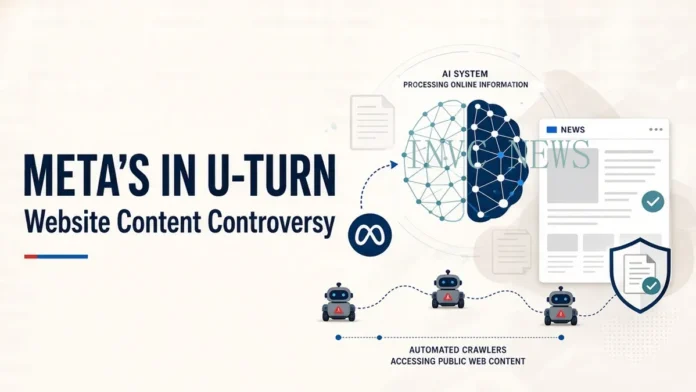
New Delhi, October 18, 2026: Meta has removed a controversial provision from its upcoming commercial terms after its wording triggered concerns that the company could use content from websites linked to business accounts to train its artificial intelligence models. The clause had raised questions among legal experts and news publishers about copyright, licensing fees and the extent to which technology companies can collect material from third-party websites.
Meta says the revision clarifies that its website-crawling terms apply to advertising and business products and does not change how its web crawlers operate. However, the controversy has highlighted a broader concern for publishers: how can they protect original reporting, analysis and other website content as AI companies expand their use of online information?
The revised terms are scheduled to take effect on October 30, 2026. The dispute concerns what the earlier wording appeared to authorise; it does not establish that Meta used the proposed provision to scrape news websites for AI training.
What Did Meta’s Controversial Clause Say?
The controversy began after Meta updated its commercial terms for businesses using its platforms and related tools. The earlier wording authorised automated software, including web crawlers and bots, to access and collect content from domains, web pages and URLs associated with businesses and their products or services.
The disputed provision went further by stating that Meta could use content from those websites to develop, improve, research and train its products and services.
That language attracted attention because a business using Meta’s services may link to a website containing much more than product listings or advertising information. A news publisher, for example, could operate a Facebook or Instagram business account while linking to a website containing original reporting, interviews, photographs and investigative articles.
Legal experts warned that the broad wording could be interpreted as giving Meta permission to collect and use material from such websites for AI training, potentially without separate licensing agreements or payments to publishers.
Meta subsequently removed the specific language referring to training from the disputed provision.
Why Were News Publishers Concerned?
For news organisations, original journalism is both intellectual property and a major source of digital revenue. Publishers invest in reporters, editors, photographers, research and fact-checking to produce content that attracts readers and advertisers.
If AI systems use that material to generate answers directly on social platforms, publishers worry that users may have less reason to visit the original websites. Such a shift could affect referral traffic, advertising income and the commercial value of original reporting.
The concern extends beyond news articles. Websites may contain specialist research, business information, photographs, product descriptions and other material created through substantial investment.
Publishers therefore want clearer rules governing when AI companies can collect their content, what they can do with it, and whether permission or payment is required.
The central question is not simply whether a webpage can be accessed publicly. It is whether that access also grants permission to reuse its contents for a different commercial purpose.
What Did Legal Experts Flag?
Digital and information law experts, including Cornell University professor James Grimmelmann, raised concerns about the breadth of the proposed terms. Reporting by Nieman Journalism Lab highlighted the possibility that the language could be used to argue that Meta had permission to scrape website content and train its AI products on it.
The wording also drew attention to robots.txt, a file website operators use to communicate instructions to automated crawlers about which parts of a site they should or should not access.
Publishers and technical teams use crawling controls to manage automated access, although robots.txt is not, by itself, a copyright licence or a universal technical barrier against bots.
The concern was whether the proposed contractual language could create uncertainty about the relationship between website owners’ crawling instructions and the permissions granted under Meta’s commercial terms.
These were concerns about the potential interpretation and reach of the provision, not a judicial finding that Meta had violated copyright law or bypassed a website’s restrictions.
Meta’s Response: What the Company Clarified
After the controversy emerged, Meta maintained that the wording had been misunderstood. The company said the consolidated crawling terms applied to advertising and business products and that the revision was intended to clarify their scope.
Meta communications executive Andy Stone also said the company had not changed how it uses web crawlers.
The subsequent removal of the explicit reference to training addressed one of the most contentious elements of the language. However, Meta’s explanation should not be confused with a blanket announcement that all web crawling has stopped or that all website content is excluded from every AI-related use.
The revision concerns a particular provision in the commercial terms. It does not, on its own, settle every question about copyright, licensing, crawler access or the use of publicly available material in AI systems.
Does Removing the Clause Mean Meta Can No Longer Use Website Content for AI?
Not necessarily. The removal narrows the disputed wording, but the legal and practical position depends on the applicable terms, the type of content involved, the method of collection and any other permissions or restrictions that apply.
Three distinctions matter:
- Website crawling: Automated systems can visit and collect information from webpages, subject to applicable technical controls, terms and laws.
- AI training: Using collected material to train or improve a model is a separate question from merely accessing a webpage.
- Copyright and licensing: Public availability does not automatically resolve whether a particular reuse is legally permitted or requires a licence.
The revised clause also does not establish that every use of website content requires payment. Copyright rules and licensing obligations depend on the relevant facts and legal framework.
For publishers, the practical priority is to understand what permissions they grant through platform agreements and how their website-level controls interact with those agreements.
Meta Is Not the Only Technology Company Facing This Debate
The wider AI industry faces growing scrutiny over how models obtain training data and whether creators receive adequate recognition or compensation.
In October 2026, more than 40 publishers, including The New York Times, Agence France-Presse and The Economist, joined the Standards for Publisher Usage Rights (SPUR) coalition, according to Reuters. The initiative seeks common standards and technical systems to help publishers monitor and manage the use of their content by AI companies.
The controversy also recalls the debate surrounding WeTransfer’s terms of service in July 2025. The file-sharing company faced criticism over wording that appeared to suggest user-uploaded files could be used to improve machine-learning models. Following the backlash, it revised its terms and removed references to machine learning and AI.
These episodes reflect an unresolved challenge: AI developers want access to useful information, while publishers and creators want transparency, control and clarity over the commercial use of their work.
What Should News Websites Do Now?
The Meta episode offers a reminder that publishers should not rely solely on the assumption that content published on their websites will be used only to attract human readers.
News organisations and website owners can review several areas:
- Commercial terms: Check the permissions granted through business accounts, advertising services and other platform agreements.
- Crawler controls: Review robots.txt and other available technical controls, while recognising their limitations.
- Licensing and copyright: Maintain clear records of content ownership, licences and any agreements governing third-party use.
- Traffic monitoring: Track referral traffic and investigate material changes in visits from search engines and social platforms.
- Policy updates: Monitor changes to AI and data-use terms that may affect original reporting, images and other editorial material.
These steps do not guarantee that content will never be collected or reused. They can, however, help publishers understand their exposure and make better-informed decisions about permissions and distribution.
The Bigger Picture
Meta’s decision to remove the explicit AI-training language came after a brief but significant controversy over the scope of its planned commercial terms. The company says its web-crawling practices have not changed, while critics had warned that the earlier wording could be interpreted far more broadly than its stated business purpose.
For news publishers, the issue goes to the heart of the digital media economy: if AI systems can deliver information without sending users to the original source, how will the organisations producing that information sustain their work?
The removal of the clause addresses one immediate point of concern, but it does not resolve the wider debate over consent, copyright, licensing and the economic value of journalism in the AI era.
The bottom line: Meta has removed the disputed reference to AI training from its upcoming commercial terms after publishers and legal experts raised concerns. The company says its crawler practices remain unchanged. The next question is whether clearer rules, stronger technical controls and workable licensing arrangements can give publishers greater certainty over how their content is accessed and used.