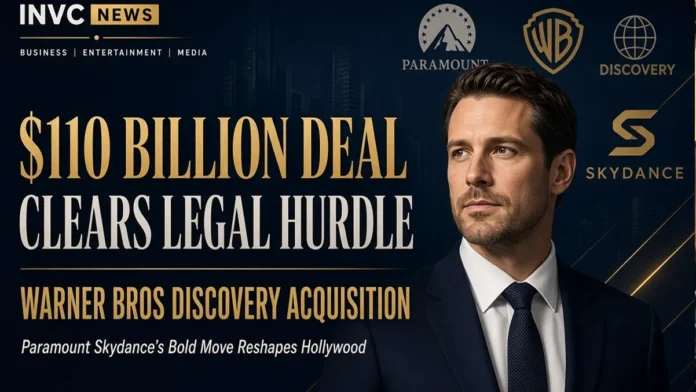
LOS ANGELES, United States | September 23, 2026 —
Hollywood once looked at David Ellison and saw a billionaire’s son with money to burn.
Twenty years later, the industry may have to look up.
At 43, Ellison is now on the verge of controlling an entertainment empire stretching from Paramount Pictures and CBS to Warner Bros., HBO, CNN and the DC Universe, after Paramount Skydance cleared the biggest remaining legal obstacle to its takeover of Warner Bros. Discovery.
The numbers alone are enormous.
Paramount’s official merger agreement values Warner Bros. Discovery at approximately $81 billion in equity value and $110 billion in enterprise value.
Some industry reports have rounded the transaction to about $111 billion.
But the bigger story is power.
If the transaction closes as expected, Ellison will sit at the center of an extraordinary collection of movie studios, television networks, streaming platforms and global entertainment franchises.
And suddenly, the man Hollywood once dismissed as “the kid” looks considerably less like an outsider.
From Hollywood Punchline to Hollywood Power Center
Ellison arrived in Hollywood in 2006 at just 23.
His father, Larry Ellison, co-founded Oracle and became one of the world’s wealthiest technology executives.
That family fortune initially made David an easy target for industry skepticism.
Some executives saw him as another wealthy newcomer who wanted to play producer.
That perception did not disappear quickly.
But Ellison kept investing.
He built Skydance into a serious production company and attached it to major franchises including Mission: Impossible, Top Gun and Star Trek.
Then the ambition became much bigger.
In 2025, Ellison completed the roughly $8 billion acquisition of Paramount, bringing one of Hollywood’s oldest studios under his control.
Barely more than a year later, he moved for Warner Bros. Discovery.
That changed the conversation completely.
The $110 Billion Move That Changes Hollywood
Paramount Skydance agreed to acquire Warner Bros. Discovery for $31 per share in cash.
According to Paramount’s official transaction announcement, the deal values WBD at approximately $110 billion including debt.
The combination would bring two historic Hollywood studios under one corporate roof.
Paramount brings assets including Paramount Pictures, CBS, Nickelodeon, MTV, Paramount+ and franchises such as Mission: Impossible and Top Gun.
Warner Bros. Discovery brings Warner Bros. Pictures, HBO, HBO Max, CNN, Discovery, TNT and some of entertainment’s most valuable intellectual property.
That includes Batman, Superman, Wonder Woman, Harry Potter and Game of Thrones.
Put those libraries together and Ellison would control characters and franchises that span generations of global popular culture.
That is where the “Superman” comparison begins to make sense.
Why Hollywood Is Calling Him Its New ‘Superman’
The description did not originate with Ellison himself.
Veteran film financier and former studio executive Joseph M. Singer told the New York Times that Ellison was about to become Hollywood’s equivalent of “Superman, Caesar and Midas combined.”
Singer’s remark was not simply praise.
He also expressed concern about concentrating so much influence in one company.
That distinction matters.
Ellison’s rise has impressed some industry figures, while critics of the merger warn that fewer major media owners could affect competition, jobs, pricing and creative opportunities.
In other words, Hollywood is not unanimously celebrating.
But very few people appear to be ignoring him anymore.
The Final Major Legal Roadblock Has Fallen
The merger spent months facing resistance.
A coalition of 12 US states challenged the transaction on antitrust grounds, while the Writers Guild of America pursued a separate legal challenge.
Those cases threatened to delay or block the deal.
This week changed the equation.
Paramount reached settlements with the states and the Writers Guild, removing what Reuters described as the transaction’s final major hurdles.
The agreements include several conditions designed to address competition and industry concerns.
Paramount committed to increase US production spending by at least $300 million annually.
It also agreed to release 30 theatrical films annually during the first two years after the merger and 32 films annually during the following three years.
Failure to meet those targets could trigger significant financial penalties.
The company also agreed to maintain certain safeguards around news operations.
Important: The Deal Has Not Formally Closed Yet
This is where headlines can easily get ahead of the facts.
Ellison has cleared the biggest remaining obstacle, but Paramount Skydance has not yet fully completed the Warner Bros. Discovery acquisition as of September 23.
In a message to Paramount employees, Ellison said he expected the transaction to close in approximately two weeks.
That means he is poised to take control, rather than already sitting in complete legal control of every Warner Bros. Discovery asset.
The distinction may sound technical.
For a transaction of this size, it is crucial.
Once the final closing steps are completed, the integration of two enormous media groups can begin.
And that may prove harder than winning the deal itself.
HBO, CNN, CBS, Warner Bros. — One Enormous Corporate Universe
If the combination closes, few modern entertainment executives will oversee such a broad portfolio.
The company would span theatrical movies, premium television, streaming, broadcast television, cable networks, sports rights and news.
It would also operate both Paramount+ and HBO Max, while controlling major film production operations at Paramount and Warner Bros.
The scale creates obvious possibilities.
A bigger catalogue can strengthen streaming services.
Shared technology could reduce costs.
Global distribution can become more efficient.
Franchises can travel across films, television, games and consumer products.
However, scale also creates headaches.
The companies expect approximately $6 billion in synergies, a corporate term that usually means eliminating duplicated costs and combining operations.
Employees across Hollywood will therefore watch the integration closely.
There Is an $80 Billion Debt Problem Waiting Too
Building an empire is one thing.
Paying for it is another.
Reuters has reported that the combined company is expected to carry approximately $80 billion in debt.
That makes Ellison’s next mission far less glamorous than a studio premiere.
He must combine two giant organizations, find billions of dollars in efficiencies, protect major franchises, compete against Netflix and YouTube, manage declining traditional cable businesses and still produce films and television shows audiences actually want to watch.
That may be the real test of his reputation.
Deal-making can create power.
Only performance can keep it.
The Son of Larry Ellison Is Building His Own Identity
David Ellison will always carry one unavoidable label: Larry Ellison’s son.
His father’s wealth and financial backing helped make Skydance’s expansion possible.
The Warner Bros. Discovery transaction itself is backed by huge amounts of capital connected to the Ellison family and RedBird Capital.
Still, David Ellison is no longer merely financing movies.
He is building a structure that could reshape who controls Hollywood’s most important studios and stories.
That represents a profound shift from where he started.
The young producer Hollywood once underestimated is preparing to oversee both the mountain from Paramount’s logo and the shield of Warner Bros.
And somewhere inside that empire will sit Superman himself.
The irony is difficult to miss.
Ellison Has Won the Deal Battle — Now Comes the Hard Part
The Warner Bros. Discovery acquisition may become the defining transaction of Ellison’s career.
But closing will not mark the end of the story.
It will mark the beginning.
He must prove that combining two legendary entertainment companies creates something stronger instead of simply something larger.
He must convince creators that scale will not suffocate creativity.
He must reassure employees worried about consolidation.
He must keep audiences paying for streaming services while persuading them to continue visiting cinemas.
And he must make an enormous debt load manageable.
Hollywood has already changed its opinion of David Ellison once.
The industry first saw a rich kid.
Then it saw a producer.
Then a studio owner.
Now, at 43, it is preparing to see something much bigger:
one of the most influential entertainment executives of his generation.