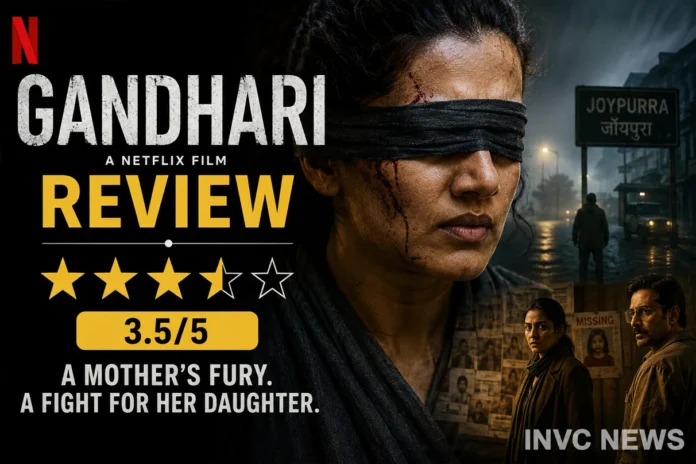
MUMBAI, India | September 3, 2026 —
Gandhari Review begins with an idea that sounds familiar — a parent pushed into violence after a child disappears — but Netflix’s new Hindi action thriller adds a far more intriguing complication. Its protagonist, Bani, does not simply lose her daughter. She also loses her eyesight.
From that moment, Gandhari stops being only a kidnapping thriller and turns into a story about adaptation, maternal fury, fear and the limits of what one person can endure when the system around her offers too few answers.
Taapsee Pannu carries that burden as Bani, a woman whose search for her abducted daughter pulls her into the disturbing world hidden beneath the fictional town of Joypurra.
Written and produced by Kanika Dhillon and directed by Devashish Makhija, Gandhari brings together two very different cinematic instincts.
Dhillon frequently writes characters driven by volatile emotion, morally complicated relationships and impulses that refuse to stay neatly contained.
Makhija, meanwhile, has built his reputation around darker, socially rooted stories in films such as Bhonsle and Joram.
That combination gives Gandhari its most interesting quality: it wants to function as an accessible Netflix thriller without becoming completely detached from the uglier world surrounding its heroine.
And at the center of everything stands Taapsee Pannu.
INVC NEWS Rating: ★★★½☆ — 3.5/5
Gandhari Review: What Is the Story About?
Bani is a mother living through the nightmare every parent fears.
Her young daughter disappears after being abducted.
The search takes Bani into Joypurra, a fictional town where fear, silence and the mysterious world of Behrupiyas form part of the atmosphere surrounding the investigation.
As Bani pushes deeper, the disappearance begins to expose something much darker.
The case leads toward a child-trafficking network, forcing Bani to confront people and circumstances far beyond anything she expected.
Then the story takes away the one thing a conventional action hero relies on most: sight.
Bani loses her eyesight.
Instead of ending her search, that loss transforms it.
She learns to navigate danger differently and turns sound, touch, memory and instinct into survival tools as she continues hunting for the people responsible.
That is the hook that separates Gandhari from a routine revenge film.
Taapsee Pannu Is the Reason Gandhari Demands Attention
Taapsee Pannu has spent years building a filmography around women who do not behave according to convenient expectations.
Whether the setting is a courtroom, a relationship, a sports arena or a thriller, her screen persona often carries an interesting tension: vulnerability on the surface and extraordinary stubbornness underneath.
Bani fits naturally into that territory.
But Gandhari pushes it physically.
The role asks Pannu to portray a woman who does not begin as an indestructible action machine.
She becomes dangerous because circumstances leave her no acceptable alternative.
That distinction matters.
A convincing revenge protagonist needs more than anger.
The audience needs to understand what that anger costs.
The film’s mother-daughter foundation supplies the emotional fuel, while Bani’s blindness adds physical uncertainty to every confrontation.
Pannu’s biggest strength has always been her ability to make determination look slightly messy rather than superheroically perfect.
That quality suits Gandhari.
The Blindness Angle Gives the Thriller Its Identity
The most interesting creative decision in Gandhari is not the kidnapping.
Indian cinema has told countless abduction and revenge stories.
It is Bani’s loss of eyesight that changes the equation.
Kanika Dhillon and Taapsee Pannu have described blindness not merely as an obstacle but as something Bani gradually learns to navigate rather than allowing it to define her.
That prevents the character from becoming an object of pity.
Instead, her changed relationship with the physical world becomes part of the thriller.
The idea also carries symbolic weight.
The title immediately invokes Gandhari from the Mahabharata, the queen who chose to cover her eyes after marrying the blind Dhritarashtra.
This contemporary Gandhari reverses that image.
Instead of withdrawing from the battlefield, Bani enters it.
The mythological reference therefore works best as thematic architecture rather than literal adaptation.
This Gandhari does not accept helplessness.
She fights.
Joypurra Gives the Story a World Beyond the Heroine
Another smart choice is the fictional setting of Joypurra.
A generic city could have reduced the film to another urban kidnapping thriller.
Joypurra allows the filmmakers to construct their own social ecosystem.
The presence of Behrupiyas — traditional performers associated with disguise and transformation — also gives the setting a cultural identity that naturally complements a mystery built around appearances, hidden identities and people who may not be what they seem.
That layer potentially gives Gandhari something many streaming thrillers lack: a sense of place.
Atmosphere matters in this genre.
The viewer should feel that Bani has entered a world whose rules she does not fully understand.
Joypurra provides that possibility.
Devashish Makhija Is an Interesting Choice for a Netflix Action Film
Devashish Makhija is not the obvious director for a glossy mainstream revenge vehicle.
That is precisely why his involvement makes Gandhari interesting.
His earlier work has shown an attraction to violence not as spectacle alone, but as something that grows out of social structures, desperation and power.
A straightforward action filmmaker might have treated Bani’s journey primarily as a succession of fights.
Makhija’s presence suggests a darker ambition.
The violence needs emotional consequence.
The surroundings need to feel dangerous even before anyone throws a punch.
That tonal seriousness helps distinguish Gandhari from disposable action content.
Kanika Dhillon and Taapsee Pannu Know Each Other’s Rhythm
Gandhari marks another collaboration between Kanika Dhillon and Taapsee Pannu after projects including Manmarziyaan, Haseen Dillruba, Rashmi Rocket, Dunki and Phir Aayi Hasseen Dillruba.
Creative familiarity can become a weakness if collaborators keep repeating the same tricks.
Here, however, the shift into survival-action territory gives the partnership a new playground.
Dhillon understands the kind of contradictions Pannu handles well.
Her characters can make questionable decisions without immediately losing audience sympathy.
Bani needs exactly that freedom.
A desperate mother hunting for a kidnapped child cannot operate according to the calm logic of someone sitting safely outside the crisis.
Her decisions need to feel emotional, impulsive and sometimes dangerous.
That is where the Dhillon-Pannu partnership makes sense.
The Supporting Cast Gives Gandhari Serious Weight
The supporting cast significantly increases the film’s credibility.
Ishwak Singh joins Pannu in a central role, while Mita Vashisht, Swastika Mukherjee, Chhaya Kadam, Jatin Sarna, Prashant Narayanan, Chandan Roy and Vishwanath Chatterjee populate the wider story.
That is a remarkably strong group of character actors for a streaming thriller.
A film like Gandhari depends heavily on the world surrounding its protagonist.
If every supporting character exists only to give Bani information or create another obstacle, the story becomes mechanical.
Actors such as Vashisht, Mukherjee, Kadam and Narayanan bring enough screen history and personality to suggest lives beyond simple plot functions.
Where Gandhari’s Biggest Risk Lies
The premise also creates the film’s greatest danger.
A mother losing her child is an inherently powerful emotional trigger.
Child trafficking makes the subject even heavier.
Blindness adds another layer of vulnerability.
Mythological symbolism adds yet another.
An action-thriller structure sits on top of all of them.
That is a lot for one movie to carry.
The danger is emotional overload.
If every development tries to become more painful than the last, genuine emotion can start feeling engineered.
Similarly, Bani must remain believable once the film shifts deeper into action.
The more invincible she becomes, the weaker the story’s central vulnerability becomes.
Gandhari works as a concept precisely because Bani is forced to fight despite enormous limitations.
Turning her into a conventional unstoppable action hero would undermine that strength.
The film’s success therefore depends on maintaining the tension between capability and fragility.
Gandhari Is More Than a Female-Led Action Film
Calling Gandhari simply a “female action movie” reduces what makes it interesting.
Male-led action films rarely receive labels such as “male action movie.”
The meaningful question is whether the character has compelling stakes.
Bani does.
Her gender informs the story because motherhood forms its emotional foundation, but the underlying fear is universal.
Someone has taken her child.
The institutions around her cannot give her what she needs.
She decides to act.
That basic engine requires no demographic qualifier.
The best thing Gandhari can do for female-led action cinema is not announce its importance.
It can simply work as a thriller.
The Mahabharata Connection Adds Long-Term Value
The title gives the film an unusually durable interpretive layer.
In the Mahabharata, Gandhari’s blindness becomes one of her defining characteristics.
Netflix’s Bani encounters blindness differently.
She does not use it to retreat from conflict.
She learns how to fight through it.
That inversion opens the film to readings beyond the surface-level kidnapping plot.
It asks what happens when sacrifice stops being passive.
What happens when motherhood produces rage instead of endurance?
What happens when a woman associated symbolically with blindness decides that she sees the truth more clearly than the people around her?
Those questions give Gandhari the kind of thematic material that can keep audiences discussing it after the immediate release cycle ends.
Is Gandhari Worth Watching?
Yes — particularly for viewers who enjoy dark Hindi thrillers driven by character rather than spectacle alone.
Taapsee Pannu fans will find familiar qualities in Bani: resilience, anger, stubbornness and a refusal to remain passive.
Viewers who liked the darker edges of Haseen Dillruba, Joram, Naam Shabana or other grounded Hindi thrillers should find Gandhari especially interesting.
Those looking purely for glossy, large-scale action may find the film’s emotional and social dimensions heavier than expected.
This is not designed as escapist hero worship.
Its strongest selling point is personal stakes.
Gandhari Review: Final Verdict
Gandhari has the ingredients of a thriller that can remain relevant after its release-week buzz disappears.
The kidnapping gives it urgency.
Joypurra gives it atmosphere.
The child-trafficking backdrop gives the story social darkness.
Bani’s blindness gives the action an unusual physical dimension.
The Mahabharata connection gives the title thematic depth.
And Taapsee Pannu gives the entire project its most important weapon: credibility as a woman who can move between fear, grief and defiance without requiring the audience to see her as traditionally heroic.
Not every ingredient is automatically a strength.
The story carries enough emotional weight that restraint becomes essential. The mythology should deepen the film rather than explain it, and the action must never overwhelm Bani’s vulnerability.
But Gandhari earns attention because it tries to make maternal rage more than a revenge-movie shortcut.
It treats motherhood as an instinct that can transform grief into resistance.
And that gives Taapsee Pannu another character designed not merely to survive danger, but to walk directly into it.
INVC NEWS Rating: ★★★½☆ — 3.5/5
Verdict: Worth Watching
Best For: Taapsee Pannu fans – dark thriller audiences – mystery lovers – female-led action fans – viewers interested in grounded Indian crime stories
Gandhari Quick Review
Movie: Gandhari
Release Date: September 3, 2026
Streaming Platform: Netflix
Language: Hindi
Genre: Action – Mystery – Thriller – Drama
Director: Devashish Makhija
Writer: Kanika Dhillon
Producer: Kanika Dhillon
Lead Cast: Taapsee Pannu – Ishwak Singh – Mita Vashisht – Swastika Mukherjee – Chhaya Kadam – Jatin Sarna
Character: Taapsee Pannu as Bani
Certification: U/A 16+ in India
INVC NEWS Rating: ★★★½☆ — 3.5/5
Recommendation: Worth Watching
Gandhari Review FAQ
What is Gandhari about?
Gandhari follows Bani, a mother whose daughter is abducted. Her search takes her into a dangerous network in the fictional town of Joypurra. After losing her eyesight, she continues hunting for the people responsible.
Who plays the lead role in Gandhari?
Taapsee Pannu plays Bani, the central character.
Where can I watch Gandhari?
Gandhari streams on Netflix.
When was Gandhari released?
Netflix released Gandhari on September 3, 2026.
Who directed Gandhari?
Devashish Makhija directed the film.
Who wrote Gandhari?
Kanika Dhillon wrote and produced Gandhari.
Is Gandhari connected to the Mahabharata?
The film is not a direct Mahabharata adaptation. Its title and central theme reinterpret the symbolism associated with Gandhari, particularly blindness and motherhood, in a contemporary thriller.
Is Gandhari worth watching?
Viewers who enjoy dark, character-driven action thrillers and Taapsee Pannu’s performance style should find enough here to justify a watch.
What is the INVC NEWS rating for Gandhari?
★★★½☆ — 3.5 out of 5 stars.