By Team INVC | INVC NEWS
Published: September 2, 2026 |11 : 10 AM IST
VANDENBERG SPACE FORCE BASE, United States | September 2, 2026 —
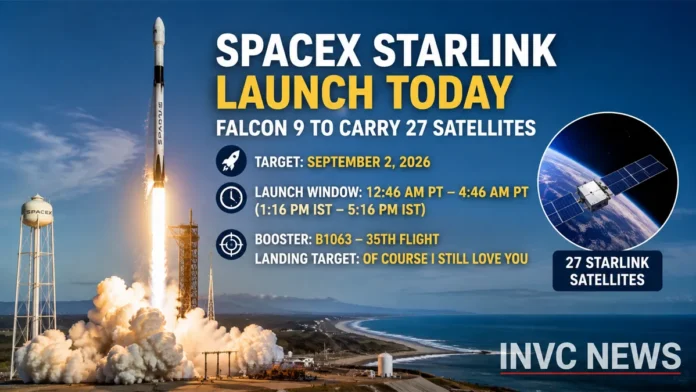
SpaceX Starlink launch today is set to become one of Wednesday’s most closely watched space events as Elon Musk’s company prepares to launch another 27 Starlink satellites aboard a Falcon 9 rocket from California.
The Starlink 15-23 mission is scheduled to lift off from Space Launch Complex 4 East at Vandenberg Space Force Base during a launch window that opens at 12:46 AM Pacific Time on September 2, or 1:16 PM IST.
The window runs for four hours, giving SpaceX until approximately 5:16 PM IST to launch if weather or technical conditions delay the opening opportunity.
The mission carries added significance because the Falcon 9 first-stage booster assigned to the flight, B1063, will attempt its 35th launch.
That makes reusable rocket technology one of the biggest talking points surrounding today’s mission.
SpaceX Targets September 2 for Starlink 15-23
SpaceX is targeting Wednesday for the Starlink 15-23 mission after the launch moved from an earlier September 1 target.
The US Space Force has cleared the mission for launch from Vandenberg.
Falcon 9 will carry 27 Starlink V2 Mini satellites into low-Earth orbit.
After liftoff, the rocket’s second stage will continue carrying the satellites toward orbit while the first-stage booster returns toward Earth.
SpaceX plans to land the booster on its droneship Of Course I Still Love You in the Pacific Ocean.
If successful, the landing will once again demonstrate the rapid-reuse model that has transformed Falcon 9 operations.
Booster B1063 Heads for Flight Number 35
Booster B1063 stands at the centre of today’s launch story.
The Falcon 9 first stage has already completed 34 missions.
Today’s launch will mark its 35th flight, according to mission schedules.
B1063 has previously supported a long list of major missions, including:
Sentinel-6 Michael Freilich
NASA’s DART planetary defence mission
Transporter-7
Iridium OneWeb
Space Development Agency missions
National security launches
and numerous Starlink flights.
SpaceX’s ability to fly the same booster repeatedly has dramatically changed the economics and frequency of orbital launches.
Instead of discarding the first stage after every mission, the company lands, inspects and reuses boosters across multiple flights.
27 More Starlink Satellites Head to Orbit
The mission will deploy another batch of 27 Starlink satellites.
Starlink operates as SpaceX’s satellite-based internet network.
The constellation provides broadband connectivity to users through thousands of satellites orbiting relatively close to Earth compared with traditional communications satellites.
SpaceX continues to expand the network aggressively.
Each successful mission adds more capacity, strengthens coverage and gives the company additional flexibility to serve users across different regions.
Starlink has become one of SpaceX’s most important commercial businesses alongside rocket launches.
Starlink Continues Rapid Global Expansion
Starlink has expanded into markets around the world, targeting households, businesses, maritime users, aircraft and remote areas where conventional broadband can be unreliable or unavailable.
The company also increasingly works with telecom operators through direct-to-device and satellite connectivity partnerships.
Satellite internet competition is growing rapidly.
Amazon’s Project Kuiper and other global players are building or planning competing networks.
However, SpaceX currently holds a major first-mover advantage because it has already deployed a massive constellation and operates its own launch vehicles.
That combination gives Starlink an unusual level of control over both satellite production and launch schedules.
Falcon 9 Reuse Remains SpaceX’s Competitive Weapon
Falcon 9 has become one of the world’s most frequently launched orbital rockets.
Its reusable first stage gives SpaceX a key cost and schedule advantage.
After a typical launch, Falcon 9’s first stage separates from the upper stage and performs a controlled descent.
Depending on mission requirements, the booster can land on a droneship at sea or return to a landing zone near the launch site.
For Starlink 15-23, B1063 will target the droneship Of Course I Still Love You.
SpaceX can then transport the booster back to port and prepare it for another mission if inspections confirm it remains flightworthy.
Vandenberg Becomes Critical for Starlink Missions
Vandenberg Space Force Base has become increasingly important for SpaceX’s Starlink programme.
The California launch site allows Falcon 9 to place satellites into orbital paths that complement launches from other locations.
SpaceX has recently concentrated more Falcon 9 Starlink activity at Vandenberg as its wider launch infrastructure evolves.
The base regularly supports commercial, military, Earth-observation and satellite-internet missions.
Residents across parts of California may see the Falcon 9 climbing through the sky if weather and lighting conditions allow.
Some communities may also hear sonic effects associated with launch operations, depending on trajectory and atmospheric conditions.
Launch Window Opens at 1:16 PM India Time
For Indian space enthusiasts, the key time is 1:16 PM IST on September 2.
That corresponds to the opening of the 12:46 AM Pacific launch window.
If SpaceX does not launch at the first available opportunity, additional attempts could occur within the four-hour window.
Therefore, viewers should avoid treating the opening time as a guaranteed liftoff time.
Rocket launches can move because of:
Weather
Technical checks
Range availability
Vehicle readiness
and last-minute mission constraints.
SpaceX normally confirms the final countdown status shortly before liftoff.
What Happens After Liftoff?
Falcon 9 will climb through the atmosphere before first-stage separation.
The upper stage will continue toward low-Earth orbit with the 27 Starlink satellites.
Meanwhile, booster B1063 will begin its return sequence.
The first stage will perform engine burns to control its descent toward the Pacific Ocean droneship.
If the landing succeeds, SpaceX will recover the booster for potential future reuse.
The upper stage will later deploy the Starlink satellites into their initial orbit.
Each spacecraft will then begin a separate process of reaching its operational orbital position.
Why Today’s Launch Matters
At first glance, another Starlink mission may look routine because SpaceX launches satellites so frequently.
But that frequency is precisely what makes the programme important.
SpaceX has transformed orbital launch operations from occasional events into a high-cadence industrial system.
Launching the same booster for a 35th time would once have appeared extraordinarily ambitious.
Today, SpaceX treats booster reuse as a core operational strategy.
That shift has influenced competitors, governments and space agencies worldwide.
SpaceX Pushes Toward Even Bigger Reusability Goals
Falcon 9 remains crucial to SpaceX, but the company’s longer-term strategy centres increasingly on Starship.
Starship aims to make both major stages of the launch system fully reusable.
SpaceX ultimately wants Starship to carry far larger payloads while reducing launch costs even further.
However, Falcon 9 continues handling the bulk of the company’s current satellite-launch workload.
Starlink missions also give SpaceX a steady stream of launch opportunities that help the company test operations, booster turnaround and ground infrastructure.
Starlink Becomes Central to SpaceX Business
Starlink does more than provide internet connectivity.
The network creates recurring subscription revenue for SpaceX.
That revenue can support the company’s larger ambitions, including Starship development and future Mars missions.
Starlink also increasingly carries strategic importance.
Governments and emergency agencies have used satellite internet during natural disasters, conflicts and telecommunications outages.
That growing role means every major expansion of the constellation has both commercial and geopolitical significance.
What to Watch Today
Three moments will dominate today’s mission.
First comes Falcon 9 liftoff from Vandenberg.
Second comes the attempted landing of booster B1063 on Of Course I Still Love You.
Third comes successful deployment of all 27 Starlink satellites into orbit.
A successful launch and landing would add another milestone to one of the most frequently reused Falcon 9 boosters in service.
For the SpaceX Starlink launch today, the countdown now points toward a launch window opening at 1:16 PM IST.
If everything proceeds as planned, SpaceX will add 27 more satellites to its Starlink network while pushing Falcon 9 booster B1063 to an extraordinary 35th flight.