By Team INVC | INVC NEWS
Published: September 1, 2026 |10 : 04 AM IST
SYDNEY, Australia | September 1, 2026 —
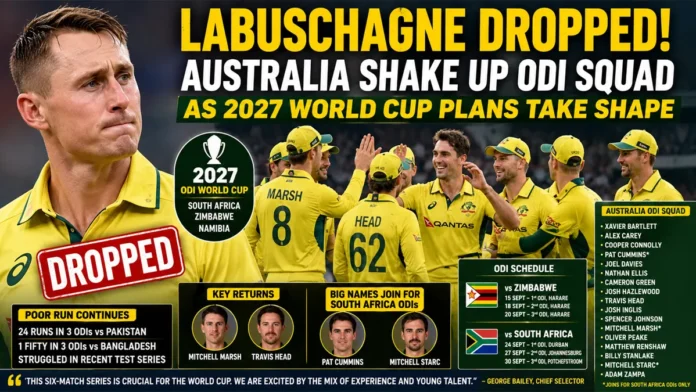
Australia have made one of their biggest selection calls ahead of the 2027 ODI World Cup, dropping Marnus Labuschagne from the squad for September’s six one-day internationals against Zimbabwe and South Africa.
The decision sends a clear message: reputation alone will no longer guarantee a place as Australia begin shaping the team that will defend their World Cup crown in Africa next year.
Labuschagne, a key member of Australia’s 2023 World Cup-winning side, has struggled badly for consistency in recent months and now finds himself outside the ODI setup despite having been one of the team’s most regular middle-order batters since 2022.
Australia Lose Patience With Labuschagne
Labuschagne’s numbers had been heading in the wrong direction for some time.
He is averaging just 21.87 across his last 18 ODI innings, and his recent series against Pakistan and Bangladesh failed to produce the sustained run of scores selectors were looking for.
His position had already appeared vulnerable when Australia pushed him down the batting order during the Bangladesh series.
Now the selectors have acted.
With the 2027 World Cup scheduled in South Africa, Zimbabwe and Namibia, Australia have decided that these six ODIs are too valuable to be treated as routine bilateral matches.
Instead, they will use them as a live audition for players who could form part of their World Cup defence.
Marsh and Head Return, Youngsters Stay In
The biggest boost for Australia is the return of Mitchell Marsh and Travis Head, who missed the recent ODI series in Pakistan and Bangladesh.
Their comeback immediately reshapes the top order.
Youngsters Cooper Connolly, Oliver Peake and Joel Davies have also retained their places, underlining Australia’s willingness to give emerging players serious exposure ahead of the World Cup.
Peake impressed enough during the Pakistan and Bangladesh tours to remain in the squad, while Davies has been rewarded after making his international breakthrough against Bangladesh.
The message from selectors is unmistakable: Australia want to combine their established core with players capable of forcing their way into the long-term World Cup plan.
Pat Cummins and Mitchell Starc Join for South Africa
Australia will not field their full-strength pace attack in Zimbabwe.
Pat Cummins and Mitchell Starc will join the squad only for the South Africa leg, while Josh Hazlewood has been included for the full tour.
Mitchell Marsh will captain Australia during the three ODIs in Zimbabwe.
Cummins, Australia’s official ODI captain, will return for the South Africa series, although workload management means he may not play every match.
That gives Australia flexibility while also allowing their leading fast bowlers to prepare for the three-Test series against South Africa that follows in October.
George Bailey: These Six Matches Matter for the World Cup
Chief selector George Bailey made it clear that Australia view the tour as part of their World Cup preparation rather than simply another bilateral assignment.
The six-match run gives Australia an opportunity to test combinations in the same region that will host next year’s tournament.
Bailey said the return of Marsh, Head and Hazlewood, followed by Cummins and Starc for the South Africa leg, gives Australia a strong core while still allowing younger players to develop.
For Peake and Davies, the tour could be especially important.
A strong performance in Africa could push either player much closer to a permanent place in the ODI setup.
Labuschagne’s World Cup Place Now in Serious Doubt
For Labuschagne, the timing of the omission is significant.
He has been one of Australia’s most frequently selected ODI batters over the past four years and played a major role in the 2023 World Cup final against India.
But Australia are no longer selecting on past achievements.
With Steve Smith already retired from ODI cricket, selectors need to identify a new middle-order structure capable of succeeding in African conditions.
Labuschagne’s ability to rotate strike and control an innings once made him an obvious anchor.
Now Australia appear prepared to explore more aggressive and flexible alternatives.
His omission does not permanently end his ODI career, but he will need runs—and plenty of them—to force his way back into the World Cup conversation.
Australia ODI Squad for Zimbabwe and South Africa
Mitchell Marsh, Pat Cummins, Xavier Bartlett, Alex Carey, Cooper Connolly, Joel Davies, Nathan Ellis, Cameron Green, Josh Hazlewood, Travis Head, Josh Inglis, Spencer Johnson, Oliver Peake, Matthew Renshaw, Billy Stanlake, Mitchell Starc, Adam Zampa.
Pat Cummins and Mitchell Starc will join for the South Africa leg only.
Australia vs Zimbabwe ODI Schedule
September 15: First ODI — Harare Sports Club
September 18: Second ODI — Harare Sports Club
September 20: Third ODI — Harare Sports Club
South Africa vs Australia ODI Schedule
September 24: First ODI — Kingsmead, Durban
September 27: Second ODI — Wanderers Stadium, Johannesburg
September 30: Third ODI — JB Marks Oval, Potchefstroom
The timing makes the tour especially important.
Zimbabwe and South Africa are two of the three host nations for the 2027 ODI World Cup, meaning Australia will gain valuable experience of conditions, pitches and venues they could face when defending the trophy next year.
Australia’s World Cup Rebuild Has Started
Labuschagne’s omission should therefore be viewed as more than one selection decision.
It marks the beginning of a harder phase in Australia’s World Cup planning.
Established players now have to prove they still belong, while youngsters are being given genuine opportunities to take their places.
For Labuschagne, the equation has suddenly become simple:
score heavily, force the selectors to reconsider—or risk watching Australia’s 2027 World Cup defence from outside the squad.
Also Read – : WTC Final 2027 Qualification Scenarios: Australia Lead as India Face Tough Road