By Team INVC | INVC NEWS
Published: August 29, 2026 | 8 : 53 AM IST
SAN FRANCISCO, UNITED STATES | August 29, 2026 —
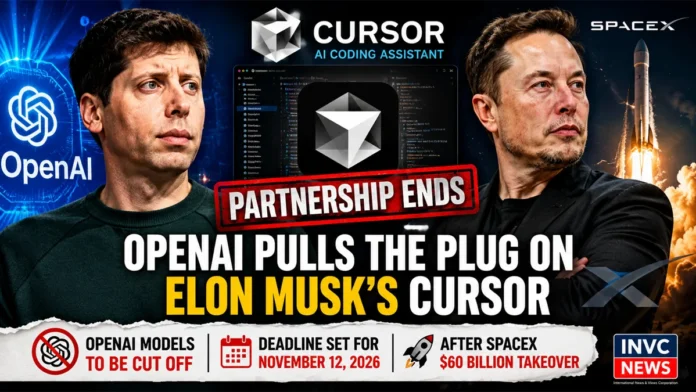
The OpenAI Cursor partnership is heading for a dramatic breakup after OpenAI moved to stop supplying its artificial intelligence models to Cursor, escalating the technology rivalry surrounding Sam Altman and Elon Musk into one of the world’s most popular AI coding platforms.
The trigger is Cursor’s new owner.
Elon Musk’s SpaceX completed its $60 billion acquisition of Cursor maker Anysphere on August 14, transforming the fast-growing coding assistant into part of Musk’s expanding technology empire.
Just two weeks later, OpenAI has told SpaceX that it intends to wind down the agreement that allows Cursor users to access OpenAI models.
The proposed cutoff date is:
November 12, 2026
And OpenAI’s explanation makes this much more than an ordinary commercial breakup.
The company says it is not confident that SpaceX will use OpenAI technology within its terms of service.
That has turned a model-supply agreement into the latest front in the increasingly fierce Musk-Altman AI battle.
OpenAI Gives Cursor a November 12 Deadline
OpenAI says it is giving Cursor the maximum notice permitted under the existing agreement, allowing developers time to prepare before access is withdrawn.
Until the shutdown date, users may continue accessing eligible OpenAI models through Cursor under the current arrangement.
But OpenAI has made another important move:
Future OpenAI models will not be supplied to Cursor under the existing partnership.
That could prove more important than losing access to older models.
AI coding tools compete heavily on how quickly they can integrate the newest and most capable models. If Cursor cannot offer upcoming OpenAI technology while rival coding platforms can, developers may begin reassessing which tools they use.
SpaceX’s $60 Billion Cursor Deal Changed Everything
Cursor was originally developed by San Francisco-based Anysphere.
SpaceX announced a deal in June to acquire the company, valuing Cursor at approximately $60 billion.
The transaction officially closed on August 14.
Cursor confirmed the takeover, saying becoming part of SpaceX would give it access to enormous computing resources and help develop more powerful AI coding models at lower cost.
The acquisition also brought Cursor closer to Musk’s wider AI ecosystem.
SpaceX already controls xAI, and Cursor has begun highlighting the potential of combining its coding platform with the huge computing capacity available across Musk’s companies.
For Cursor, that opens a path toward deeper integration with Grok and SpaceX-backed AI infrastructure.
For OpenAI, however, the change of ownership created a new problem.
OpenAI Says It No Longer Trusts the Arrangement
OpenAI has said its decision followed Cursor’s change of control.
According to the company, agreements with large partners require confidence that OpenAI models will be deployed according to contractual and safety requirements.
OpenAI argued that its past experience dealing with Musk-controlled companies left it unable to maintain that confidence after SpaceX acquired Cursor.
SpaceX had not publicly responded to Reuters’ request for comment when the development was first reported.
That distinction matters.
This is currently OpenAI’s stated reason for terminating the arrangement, rather than a finding by a court or regulator that SpaceX has violated the Cursor agreement.
Musk vs Altman Battle Enters the Coding Wars
The decision adds a fresh dimension to the long-running rivalry between Elon Musk and Sam Altman.
Musk helped co-found OpenAI but later separated from the organization and became one of its most persistent critics.
He subsequently built xAI and Grok as direct competitors in the generative-AI market.
Now the rivalry touches a product used daily by software developers.
Cursor has become one of the most prominent examples of AI-assisted coding, where developers use large language models to write, debug, explain and modify software.
That makes control over the models powering Cursor strategically valuable.
Also Read – : Elon Musk’s X Promises Clearer Notices When Governments Restrict Content
What Happens to Cursor Users?
There is no immediate shutdown of Cursor itself.
Cursor will continue operating.
The issue concerns OpenAI models available through the platform.
Developers may increasingly see Cursor rely on alternative models, including technology from Musk’s own AI ecosystem and other providers.
Cursor already supports multiple AI-model choices rather than depending exclusively on OpenAI.
That provides it with an important buffer.
However, developers who specifically prefer OpenAI models could eventually face a choice:
stay with Cursor and use another model—or move to another coding platform that continues providing OpenAI access.
OpenAI’s Next Model Raises the Stakes
The dispute becomes even more interesting because AI companies are moving rapidly toward a new generation of increasingly autonomous coding agents.
OpenAI has indicated that future models will not automatically become available inside Cursor after the partnership ends.
That gives OpenAI greater control over where its most advanced technology is deployed.
At the same time, SpaceX and Cursor now have a powerful incentive to accelerate their own alternatives.
This could turn what looks like a commercial divorce into a much larger technology race.
A Coding Tool Becomes an AI Battleground
There is an extraordinary irony in the situation.
SpaceX spent $60 billion acquiring one of the hottest AI coding businesses.
Within weeks, one of Cursor’s major model suppliers decided to walk away.
But Cursor is hardly powerless.
SpaceX brings enormous computing capacity, Musk’s xAI operation and its own financial firepower.
OpenAI brings some of the world’s most widely used AI models and a massive developer ecosystem.
The result is increasingly clear:
Cursor is no longer just an AI coding tool. It has become another battlefield in the Musk vs Altman war.
November 12 may therefore mark more than the end of one commercial agreement.
It could mark the moment when two rival AI ecosystems begin competing much more aggressively for the developers who actually build the software of the future.