
BENGALURU, India | August 27, 2026 —
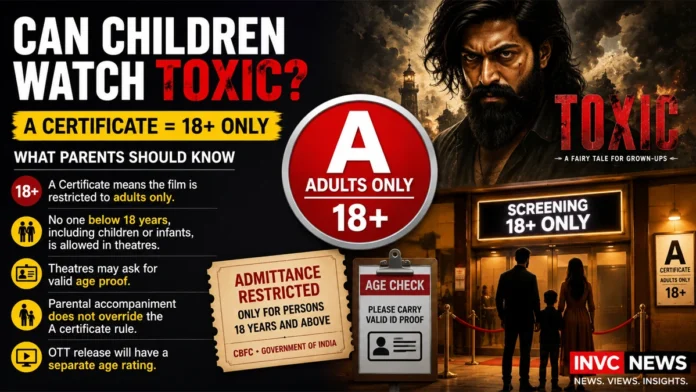
Can children watch Toxic? The answer for theatrical screenings in India is straightforward: no, if they are under 18.
Yash’s Toxic: A Fairy Tale for Grown-Ups carries an A certificate from the Central Board of Film Certification, meaning its public exhibition is restricted to adults.
Under India’s film-certification framework, an adult is a person who has completed 18 years of age. A parent or guardian accompanying a minor does not convert an A-rated film into a family-viewing film.
That distinction has become particularly relevant after online discussion over reports of children being seen at some screenings of Toxic.
For parents planning to watch the film, here is what the A certificate actually means, why Toxic received an adult classification and what theaters are expected to enforce.
Can Children Below 18 Watch Toxic in Theaters?
No.
An A certificate means the film is certified for public exhibition restricted to adults.
The Cinematograph Act defines an adult as someone who has completed their eighteenth year.
That means:
- A 17-year-old cannot legally be admitted to an A-rated theatrical screening.
- Accompanying the child as a parent or guardian does not override the certification.
- A cinema ticket purchased online does not remove the age restriction.
- Even very young children or infants are not automatically exempt.
A January 2026 CBFC advisory to cinema exhibitors specifically reiterated that for A-certified films, no person below 18 years, including lap children, should be admitted.
Official CBFC certification guidance:
https://cbfcindia.gov.in/cbfcAdmin/certification.php
What Does an A Certificate Mean in India?
India currently uses several major film-certification categories.
U: Suitable for unrestricted public exhibition.
UA 7+, UA 13+ and UA 16+: Suitable for public exhibition, but parents or guardians are advised to exercise discretion for children below the relevant age marker.
A: Restricted to adults.
S: Restricted to members of a specified profession or class of persons.
The key difference is that UA is parental guidance; A is an age restriction.
Parents can use their judgment with a UA-classified film depending on the age marker.
That option does not apply to an A-rated movie.
Official CBFC information:
https://www.cbfcindia.gov.in/cbfcAdmin/about.php
Why Did Toxic Get an A Certificate?
CBFC’s official public records list Toxic: A Fairy Tale for Grown-Ups in the A category.
The Board’s published description of the film refers to a gangster story set in post-independence Goa involving loyalty, morality, redemption, violence and jealousy.
The official description also refers to brutal action sequences and morally conflicted characters.
That gives parents a useful indication of why the film falls outside ordinary family-viewing certification.
Toxic is not being presented as a conventional family action entertainer simply because it stars a major mainstream actor.
Its title itself—A Fairy Tale for Grown-Ups—also signals the adult-oriented tone of the movie.
Does A Certificate Mean the Film Is Banned or Obscene?
No.
An A certificate does not mean a film is banned.
It means the CBFC has certified the film for public exhibition, but only for adult audiences.
An A-rated movie can be legally released in theaters across India, advertised and viewed by adults, subject to applicable certification and exhibition rules.
The distinction is important because an adult classification is a restriction on the permitted audience, not a refusal of certification.
Can Parents Take Their Children if They Accept the Content?
No.
This is one of the most common misunderstandings around A-rated films.
For a UA movie, parental discretion is built into the certification system.
For an A-rated film, it is not.
A parent cannot simply tell the theater that they are comfortable with their child watching the movie and expect the age restriction to disappear.
The theatrical classification remains adults-only.
Can Theaters Ask for Age Proof?
Viewers who appear to be under 18 should be prepared for age verification when entering an A-rated screening.
Cinema operators are responsible for enforcing certification conditions, and a venue may refuse entry if it cannot establish that a viewer meets the age requirement.
For young-looking adult viewers, carrying valid government-issued age identification can therefore avoid problems at the entrance.
Parents should also avoid assuming that successful online booking guarantees entry.
Ticket purchase and admission are separate issues when an age restriction applies.
Why Has Toxic Triggered a Debate About Children?
Toxic has generated unusually high public attention because of Yash’s return after the KGF phenomenon and its massive nationwide theatrical rollout.
That means the audience includes families and younger fans who may associate Yash primarily with mainstream action cinema.
But Toxic’s A rating changes the equation.
Reports and social-media posts suggesting that minors may have been present at some screenings have led to questions about theater enforcement and parental responsibility.
The useful takeaway is not to turn individual social-media claims into a larger controversy.
The important point is simply that the official certification rule is clear: an A-rated theatrical screening is restricted to adults.
Is Toxic More Mature Than KGF?
Parents should not assume that because a child previously watched a Yash film, Toxic carries the same classification or content profile.
Every film is certified separately.
Toxic has a darker gangster setting, mature themes and intense violence, and the CBFC has classified it accordingly.
That means families should judge Toxic by its own certificate rather than Yash’s previous films.
Also Read – : Yash’s Toxic Creates Box Office Storm Before Release as Advance Booking Surges
What About Toxic on OTT?
The theatrical A certificate governs public exhibition in cinemas.
Streaming platforms operate under a different age-classification and parental-control framework.
When Toxic eventually becomes available digitally, the streaming platform should display its own age rating and content information.
Parents should therefore check the OTT classification separately rather than assuming that theatrical and streaming labels will appear in exactly the same format.
Also Read – : Yash’s Toxic Movie: ₹600 Crore Pre-Release Business, Budget and OTT Deal Explained
Toxic A Certificate: Quick Answers for Parents
Can a 17-year-old watch Toxic in a theater?
No.
Can a child watch Toxic if accompanied by parents?
No. Parental accompaniment does not override an A certificate.
Can an infant be taken inside an A-rated screening?
CBFC’s 2026 exhibitor advisory specifically says persons below 18, including lap children, are not permitted.
Does A certificate mean Toxic is banned?
No. It is certified for adults-only theatrical exhibition.
Can theaters verify age?
Viewers should expect theaters to enforce the age restriction and potentially seek proof of age where necessary.
Is Toxic meant as a family movie?
Its A classification means it is not certified for unrestricted family viewing.
What Parents Should Know Before Booking Toxic
For adult Yash fans, the A certificate does not prevent watching Toxic in theaters.
For families, however, it is important to check the certificate before buying multiple tickets.
The simplest rule is:
If a viewer has not completed 18 years of age, Toxic is not permitted for that viewer in an Indian theatrical screening under its A certification.
That remains true even if a parent is present.
Understanding the certificate before booking can prevent confusion at the theater entrance and helps ensure that families make viewing choices based on the actual classification rather than only a star’s popularity or the film’s marketing.