NEW DELHI, INDIA | AUGUST 25, 2026 —
MeitY AI empanelment 2026 has reopened as the Indian government looks to expand its pool of technology companies capable of supplying artificial-intelligence and machine-learning expertise for Digital India and other government technology projects.
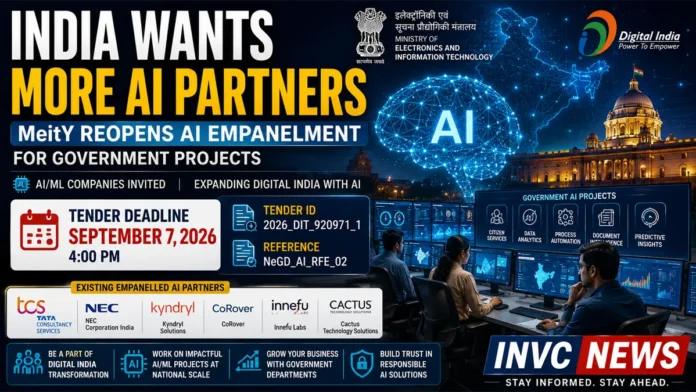
The National e-Governance Division, or NeGD, functioning under the Ministry of Electronics and Information Technology, has reopened its Request for Empanelment of Partner Agencies for Deployment of AI/ML Resources, creating another opportunity for qualified technology companies to become approved partners for government AI projects.
The tender was published on August 10, 2026, while bid submissions opened on August 18.
Companies have until:
September 7, 2026, at 4:00 PM
to submit bids.
The bids are scheduled to be opened on:
September 8, 2026, at 5:00 PM
The move follows an earlier empanelment exercise that created an initial pool of six AI technology partners, including Tata Consultancy Services, NEC Corporation India, Kyndryl Solutions, CoRover, Innefu Labs and Cactus Technology Solutions.
The reopened process signals that the government wants a larger AI implementation ecosystem as ministries, departments and public-sector organizations increasingly explore artificial intelligence for citizen services, analytics, workflow automation and digital governance.
MeitY AI Empanelment 2026: Key Details
| Detail | Information |
|---|---|
| Tender | Reopening of Request for Empanelment |
| Purpose | Deployment of AI/ML resources |
| Authority | National e-Governance Division |
| Ministry | MeitY |
| Tender Reference | NeGD_AI_RFE_02 |
| Tender ID | 2026_DIT_920971_1 |
| Published | August 10, 2026 |
| Bid submission started | August 18, 2026 |
| Bid deadline | September 7, 2026, 4:00 PM |
| Bid opening | September 8, 2026, 5:00 PM |
| Tender fee | ₹0 |
| EMD | ₹0 |
| Location | NeGD, New Delhi |
Interested companies should examine the complete Request for Empanelment documents before submitting a bid because technical, qualification and financial requirements apply.
Why Is MeitY Looking for More AI Companies?
The simplest explanation is scale.
Artificial intelligence is moving from experimental government pilots toward wider deployment across public administration.
Government organizations may need AI capabilities for areas such as:
- Citizen-service automation
- Machine-learning models
- Document processing
- Data analytics
- Workflow optimization
- Government chatbots
- Language technologies
- Predictive analytics
- Decision-support systems
- Fraud or anomaly detection
- Public-service delivery
- Process automation
Rather than forcing every ministry or government body to conduct a completely separate procurement exercise every time it needs specialized AI expertise, an empanelled vendor framework can provide a ready pool of qualified companies.
That can potentially shorten procurement timelines and create more standardized access to AI talent and project-delivery capabilities.
Also Read – : Digital India Completes 11 Years as Technology Reshapes Governance and Public Services
Six Companies Are Already on the Government AI Panel
The first empanelment round attracted significant interest from India’s technology industry.
Official vendor records currently list six AI/ML partners:
- Tata Consultancy Services
- NEC Corporation India
- Kyndryl Solutions
- CoRover
- Innefu Labs
- Cactus Technology Solutions
These companies form the existing pool available for AI/ML resources and AI-specific manpower requirements under the government framework.
The reopening does not necessarily mean the existing companies are being replaced.
Instead, the objective is to widen the pool of eligible technology partners.
That could increase competition, broaden technical expertise and give government departments more implementation choices.
What Could Empanelled AI Companies Actually Do?
The opportunity is considerably broader than supplying a few AI developers.
Government AI projects can involve an entire technology lifecycle.
A project may begin with identifying a government problem suitable for AI.
It can then require:
AI strategy → data preparation → model development → testing → deployment → monitoring → maintenance.
Different projects can require machine-learning engineers, data scientists, AI architects, developers, project managers and specialists in areas such as natural-language processing or computer vision.
Government departments may also require support integrating AI with existing digital platforms.
That makes the empanelment commercially relevant to companies offering both skilled manpower and end-to-end project delivery.
AI Could Become a Bigger Part of Digital Government
India already operates digital public infrastructure at enormous scale.
Platforms involving identity, payments, digital documents and citizen-service delivery have created large volumes of structured and unstructured data.
Artificial intelligence can potentially help governments use that infrastructure more effectively.
For example, AI systems could help:
- Translate citizen services into Indian languages
- Search large government document repositories
- Automate repetitive administrative work
- Identify patterns in public data
- Improve grievance processing
- Assist government call centers
- Detect suspicious transactions or anomalies
- Improve service personalization
The challenge is ensuring those systems are accurate, secure, auditable and appropriate for government use.
Responsible AI Will Matter as Government Adoption Expands
Government AI is different from deploying an ordinary consumer chatbot.
Public-sector systems can influence services used by millions of citizens.
That creates additional requirements around:
- Privacy
- Data protection
- Cybersecurity
- Accuracy
- Bias
- Explainability
- Human oversight
- Auditability
- Model monitoring
IndiaAI project roles published by MeitY have already emphasized compliance with responsible-AI principles along with relevant government standards, including MeitY requirements, CERT-In cybersecurity standards and India’s Digital Personal Data Protection framework.
That suggests vendors competing for government AI work will increasingly need expertise beyond model development alone.
India Is Building a Much Larger AI Ecosystem
The NeGD tender is part of a wider shift in India’s technology economy.
Artificial intelligence is increasingly connecting government policy with semiconductors, cloud infrastructure, data centers, software, electronics manufacturing and investment.
India is simultaneously attempting to strengthen domestic compute capacity, AI development and strategic technology partnerships.
Also Read – : India and US Deepen Semiconductor and AI Partnership on Chips, Supply Chains and Critical Minerals
That broader ecosystem matters because large-scale AI deployment depends on much more than software engineers.
It requires computing infrastructure, chips, networking, cloud systems, data centers, cybersecurity and skilled human resources.
AI Data Centers Are Becoming Part of the Same Story
The enormous computing demands of advanced AI are also driving investment in data-center infrastructure.
Companies building AI applications for government and private customers ultimately depend on the physical infrastructure capable of training and serving those systems.
INVC NEWS has tracked this investment wave, including Reliance and Meta’s move toward major AI-focused infrastructure in Gujarat.
Also Read – : Reliance-Meta AI Data Center: Jamnagar to Host Major AI Infrastructure Project
The emerging chain increasingly looks like:
AI models → cloud infrastructure → data centers → chips → application developers → government and enterprise deployment.
The NeGD empanelment sits at the application and implementation end of that chain.
Could the Tender Benefit Indian AI Startups?
Potentially—but empanelment should not be confused with an open startup grant.
Companies must satisfy the tender’s eligibility and technical requirements.
However, expanding the approved vendor pool could create opportunities for a broader mix of AI-focused businesses if they qualify.
The earlier process included large multinational technology companies alongside specialized Indian AI companies.
That is significant.
It suggests government AI procurement does not necessarily have to be dominated exclusively by India’s biggest IT-services groups.
Specialized firms with expertise in conversational AI, cybersecurity, analytics, machine learning or other areas could also compete where tender conditions are met.
India Is Also Attracting New AI Investment
Government procurement is only one side of India’s AI opportunity.
Private investment in artificial intelligence, technology infrastructure and manufacturing is also expanding.
Recent changes to India’s foreign-investment framework have begun drawing proposals across sectors including AI, IT, data centers and advanced manufacturing.
Also Read – : India’s New FDI Rules Attract $511 Million as AI, Manufacturing and Data Centers Draw Investors
Together, government AI procurement and private-sector investment could create a reinforcing technology ecosystem.
Government becomes a large buyer of AI solutions while companies invest in the infrastructure and skills needed to deliver them.
Does This Mean New Government AI Jobs?
This distinction is important.
The current NeGD notice is not a government recruitment advertisement for individual candidates.
It is a vendor-empanelment exercise for eligible partner agencies.
Individual AI engineers should therefore not treat September 7 as a job-application deadline.
However, there could be an indirect employment effect.
Companies that win government AI projects may need more:
- AI engineers
- Machine-learning engineers
- Data scientists
- AI architects
- Full-stack developers
- Data engineers
- Project managers
- Cybersecurity specialists
- MLOps professionals
- Natural-language-processing specialists
Government demand can therefore increase business opportunities for AI companies and, over time, potentially increase hiring demand.
But there is no guarantee that every empanelled firm will immediately hire additional employees.
Government Has Also Been Hiring AI Specialists Directly
Separately from vendor empanelment, government digital organizations have advertised specialized AI roles during 2026.
NeGD, IndiaAI and Digital India Corporation have sought professionals for AI/ML and technology-project positions in various recruitment rounds.
That illustrates another side of the government’s AI strategy:
external technology partners + internal technical capability.
The two approaches can complement each other.
Government agencies need enough internal expertise to evaluate, supervise and govern AI projects even when outside vendors build or operate the systems.
Why Standardized AI Procurement Matters
One challenge with emerging technology is that different government departments can value identical skills differently.
Procurement can become fragmented.
A centralized empanelment model can create greater consistency around:
- Vendor qualification
- Technical standards
- Commercial rates
- Procurement processes
- Resource categories
- Contract terms
The earlier NeGD empanelment exercise also established a rate structure for AI-specific manpower.
Companies entering through the reopened process are expected to operate within the framework established through the original exercise rather than starting an entirely new pricing exercise.
That can potentially make procurement faster for participating government bodies.
What Could Government AI Projects Mean for Citizens?
Most citizens will never interact directly with an “AI procurement framework.”
They will experience its effects through services.
A successful AI project could mean:
faster grievance resolution
or
better multilingual government services
or
less paperwork
or
quicker processing of large document sets.
But poor implementation could create new problems.
An inaccurate automated decision system used in a public-service context could affect citizens at scale.
That is why government AI requires strong oversight and clearly defined accountability.
AI Cannot Simply Replace Human Decision-Making Everywhere
Artificial intelligence is especially useful where systems need to analyze large amounts of information or automate repetitive work.
But that does not mean every government decision should be delegated to an algorithm.
High-impact decisions involving rights, benefits, eligibility or legal consequences may require substantial human oversight.
The best public-sector AI systems are therefore likely to function as tools supporting government officials rather than automatically replacing them.
How Can Companies Apply for MeitY AI Empanelment?
Eligible technology companies should use the Government of India’s Central Public Procurement Portal.
The key tender details are:
Tender ID: 2026_DIT_920971_1
Tender Reference: NeGD_AI_RFE_02
Title: Re Opening of Request for Empanelment
Work Description: Re Opening of Request for Empanelment of Partner Agencies for Deployment of AI/ML Resources
Companies should download and read the complete tender documents before applying.
The portal currently lists:
Tender fee: ₹0
EMD: ₹0
The submission deadline is:
September 7, 2026 — 4:00 PM
Bids are scheduled to open:
September 8, 2026 — 5:00 PM
Companies should not rely solely on news reports for eligibility requirements or document preparation.
The tender document and any subsequent corrigendum on the official procurement portal should be treated as authoritative.
Why This Matters for India’s IT Industry
The development creates another potentially important customer category for India’s AI sector:
Government itself.
India’s technology-services industry has traditionally generated enormous revenue from global corporations.
Government AI programs can create a separate domestic opportunity around digital transformation.
That is particularly relevant as generative AI begins reshaping conventional IT outsourcing.
Companies increasingly need to offer:
AI + cloud + data + cybersecurity + consulting + domain expertise.
Government projects can provide another market for those capabilities.
Could Smaller AI Companies Compete With TCS and Kyndryl?
Scale matters, but specialization matters too.
Large IT companies have advantages in staffing, delivery, cybersecurity and project governance.
Smaller AI specialists may have advantages in:
- Language models
- Conversational AI
- Computer vision
- Intelligent document processing
- Fraud analytics
- Cyber intelligence
- Narrow industry use cases
The original panel itself illustrates this mix, combining large international technology groups with specialized AI companies.
Expanding the panel could potentially broaden that diversity further.
What Happens After September 7?
Once bidding closes, NeGD is scheduled to open bids on September 8.
The submissions will then be evaluated against the requirements of the RFE.
Companies that successfully complete the empanelment process could join the existing pool of AI/ML partner agencies.
That does not automatically guarantee a fixed volume of government business.
Empanelment primarily gives agencies eligibility to participate within the approved procurement framework.
Actual project opportunities will depend on requirements generated by ministries, departments and other participating government entities.
That distinction is important for investors and companies evaluating the commercial opportunity.
FAQ: MeitY AI Empanelment 2026
What has MeitY reopened?
NeGD has reopened the Request for Empanelment of partner agencies for deployment of AI and machine-learning resources.
What is the last date to apply?
The current deadline is September 7, 2026, at 4:00 PM.
When will bids open?
Bids are scheduled to open on September 8 at 5:00 PM.
Is this an AI recruitment drive for individuals?
No. This is an agency/vendor empanelment exercise, not direct government recruitment for individual candidates.
Which companies are already empanelled?
The existing pool includes TCS, NEC Corporation India, Kyndryl Solutions, CoRover, Innefu Labs and Cactus Technology Solutions.
Can startups apply?
Companies that satisfy the eligibility, technical and other conditions specified in the RFE can participate. Applicants should check the official tender document rather than assuming eligibility based only on company size.
Does empanelment guarantee government contracts?
No. Empanelment makes a company part of an approved vendor framework; it should not be treated as a guarantee of a particular volume of project work.
Bottom Line
The MeitY AI empanelment 2026 reopening provides a revealing look at the next stage of India’s digital-government strategy.
The government already has six approved AI/ML technology partners.
Now it wants more.
The September 7 tender deadline creates a fresh opportunity for qualified AI and technology companies to join a framework supporting government projects across artificial intelligence, machine learning, automation, analytics and digital-service delivery.
For India’s technology industry, the opportunity is potentially significant because government is becoming not just a policymaker for AI—but also a major customer.
For AI professionals, the development could eventually translate into more demand for specialized skills, although this specific tender is not a direct recruitment exercise.
And for citizens, the larger question will be whether wider AI adoption can genuinely make public services faster and more accessible while maintaining privacy, security, accuracy and meaningful human oversight.
That balance will determine whether artificial intelligence becomes simply another government technology layer—or the next major chapter of Digital India.