CHENNAI / AMARAVATI, INDIA | AUGUST 24, 2026
The South India fertility rate 2026 story is rapidly turning into one of India’s most unusual political and economic debates: states that once successfully encouraged smaller families are now asking whether people need more children.
Tamil Nadu has expanded maternity benefits for women government employees having a third child, while Andhra Pradesh has developed an ambitious population-management framework offering financial, education and healthcare support to larger families.
Behind these moves lies a demographic shift that is difficult to ignore.
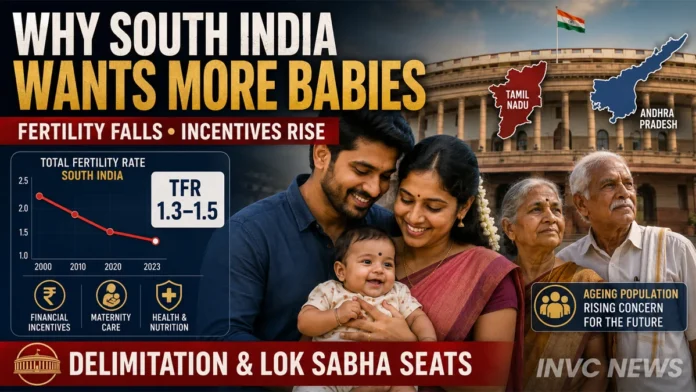
Official Sample Registration System data for 2024 puts the total fertility rate, or TFR, at just 1.3 in Tamil Nadu and Kerala, 1.4 in Andhra Pradesh, and 1.5 in Karnataka and Telangana.
India’s overall TFR is 1.9.
The generally accepted replacement level is about 2.1 children per woman.
In other words, every major southern state is now well below replacement-level fertility.
But this is not only about babies.
It is about an ageing society, a future shortage of workers, the cost of caring for elderly populations — and an increasingly sensitive question over how many Lok Sabha seats southern states could command after future delimitation.
Why Is South India Suddenly Talking About More Babies?
For decades, India’s policy challenge was rapid population growth.
Governments promoted family planning, later marriages and smaller families.
Southern states were among the most successful.
Higher female education, urbanization, better healthcare, increased use of contraception and changing family preferences brought fertility down much faster in the South than in many northern states.
Now policymakers are confronting the other side of that success.
When fertility remains below replacement level for a long period, the number of young people entering the population eventually declines.
At the same time, people live longer.
That gradually changes the age structure of society.
There are fewer children, fewer future workers and a growing number of elderly people who may require healthcare, pensions and family support.
That is the demographic challenge driving the new debate.
South India Fertility Rate 2026: What the Latest Numbers Show
The latest SRS Statistical Report for 2024 shows a striking divide.
Total fertility rates in major southern states:
- Tamil Nadu: 1.3
- Kerala: 1.3
- Andhra Pradesh: 1.4
- Karnataka: 1.5
- Telangana: 1.5
By comparison:
- Bihar: 2.9
- Uttar Pradesh: 2.6
- Madhya Pradesh: 2.4
- Rajasthan: 2.3
India’s national TFR stands at 1.9.
These figures matter because fertility rates below replacement level, if sustained for decades without offsetting migration, eventually lead to slower population growth and potentially population decline.
That transition is already shaping public policy across southern India.
Tamil Nadu Gives 365 Days of Maternity Leave for Third Child
Tamil Nadu has made one of the most eye-catching policy changes.
The state announced that women government employees having a third child will receive up to 365 days of maternity leave, compared with the earlier 12-week entitlement in such cases.
The move effectively puts maternity leave for a third birth closer to the benefit available for earlier births.
The announcement has attracted national attention because it appears to mark a significant shift from the older policy environment built around the two-child norm.
Tamil Nadu’s Health Minister has also publicly discussed the possibility of further incentives as the state confronts very low fertility.
The debate comes only months after a major political transition in the state. INVC previously reported on Vijay taking office as Tamil Nadu chief minister and announcing his first major welfare measures.
Population and family support could now become another defining area of his government’s policy agenda.
Tamil Nadu’s Fertility Rate Has Fallen to 1.3
Tamil Nadu’s latest TFR of 1.3 is among the lowest recorded by a major Indian state.
That means the average number of children being born per woman is substantially below the replacement benchmark of 2.1.
The state has historically performed strongly on population stabilization.
But success in reducing population growth is now producing a different long-term policy question.
Who will make up the workforce 20 or 30 years from now?
And who will support a rapidly expanding elderly population?
Those questions are becoming increasingly important because demographic changes happen slowly but are difficult to reverse once deeply established.
Andhra Pradesh Goes From ‘Population Control’ to ‘Population Care’
Andhra Pradesh has moved even further.
Its official Population Management framework explicitly proposes moving from “population control” to “population management” or “population care.”
The state estimates its fertility rate at around 1.5 in its population-management framework, while the latest national SRS data places Andhra Pradesh’s 2024 TFR at 1.4.
The government argues that prolonged low fertility could shrink the youth population and weaken the future workforce.
Chief Minister N. Chandrababu Naidu has repeatedly encouraged families to consider having more children.
But Andhra Pradesh’s strategy goes beyond political speeches.
It includes direct financial and social-support proposals.
What Incentives Is Andhra Pradesh Proposing?
The state’s Population Management framework contains an unusually broad family-support package.
Among the proposals are:
₹25,000 Birth Incentive
The framework proposes a ₹25,000 direct financial incentive to mothers from the birth of a second child onward.
₹1,000 a Month for Third Child
For a third child and subsequent children, the proposed nutrition support includes a ₹1,000 monthly direct cash transfer for the first five years, subject to conditions such as immunization and growth monitoring.
That could amount to ₹60,000 over five years for an eligible child.
Free Education Until Age 18
The proposed education component would cover educational costs for a third or subsequent child in eligible government or residential schooling arrangements until the age of 18.
Enhanced Health Protection
The framework also proposes comprehensive health-insurance support for households with three or more children.
More Support for Working Parents
Andhra Pradesh is also exploring a broader parental-leave model, better childcare infrastructure, workplace crèches and increased participation by fathers in childcare.
The idea is simple: governments increasingly recognize that merely telling couples to have more children may not work if the cost of raising those children remains too high.
Why Childcare Costs Matter More Than Government Appeals
This may ultimately determine whether these policies succeed.
Modern families make decisions about children based on far more than government slogans.
Parents consider:
- Housing costs
- School fees
- Healthcare expenses
- Childcare availability
- Career interruptions
- Job security
- Cost of higher education
- Time available for parenting
- Availability of grandparents or family support
For working women, the impact on careers can be particularly significant.
That means cash incentives alone may not reverse falling fertility.
Countries including Japan, South Korea, Singapore and several European nations have spent heavily on pro-family policies while continuing to struggle with extremely low fertility rates.
South India could face the same challenge.
The Other Big Problem: South India Is Ageing Faster
Low fertility is only half the story.
Southern states are also ageing significantly faster than much of India.
Government population projections cited in the India Ageing Report show how dramatic this could become by 2036.
The share of people aged 60 and above is projected to reach approximately:
- 22.8% in Kerala
- 20.8% in Tamil Nadu
- 19% in Andhra Pradesh
- 17.2% in Karnataka
- 17.1% in Telangana
That means roughly one in five residents could be a senior citizen in some southern states.
An ageing population increases pressure on healthcare, pensions, eldercare and working-age family members.
Andhra Pradesh Warns Its Demographic Window Is Closing
Andhra Pradesh’s own population-management framework puts the challenge in stark terms.
The state estimates its median age at around 32.5 years, compared with a national average of about 28.4 years.
Its demographic window of opportunity is projected to last only until around 2040 before ageing pressures intensify.
The share of children aged 0–14 is also expected to decline sharply.
A smaller generation of young workers would eventually have to support a larger retired population.
That is what economists call a rising old-age dependency burden.
Why Delimitation Has Turned Fertility Into Politics
This is where demographic policy becomes national politics.
Lok Sabha representation has historically been frozen in a way intended partly to prevent states that successfully controlled population growth from being politically disadvantaged.
That freeze is now approaching a major constitutional turning point.
Future delimitation could reshape parliamentary representation.
Southern states fear that if Lok Sabha seats are distributed mainly on the basis of newer population numbers, states with faster population growth could gain political weight relative to states that successfully stabilized their populations.
Tamil Nadu and other southern governments have therefore demanded guarantees that their proportionate representation in Parliament will not be reduced.
The issue has become even more important as India’s 2026-27 Census moves forward with a massive nationwide population-counting exercise.
Population data collected through the census will eventually shape some of India’s most consequential political and economic decisions.
Did the Government Already Decide How Delimitation Will Work?
No.
This is an important distinction.
The Centre introduced a major delimitation package in April 2026, including a constitutional amendment that proposed raising the maximum size of the Lok Sabha.
The government argued that its model could increase the number of seats for all southern states while broadly protecting their share of Parliament.
Home Minister Amit Shah said the five southern states’ combined Lok Sabha strength could rise from 129 to around 195 under the proposed expansion.
However, the constitutional amendment did not receive the special majority required in the Lok Sabha.
Therefore, that proposal did not become law.
The final formula for future delimitation remains politically contested.
Why Southern States Still Fear Losing Political Influence
The disagreement is partly about absolute seats versus percentage share.
A state can gain additional MPs and still lose relative influence if other states gain even more.
That is why southern governments are focused not simply on whether their number of seats rises, but whether their percentage of total Lok Sabha representation remains protected.
The debate has created an unusual political message:
States that were once rewarded for successful population stabilization do not want that success to weaken their future influence in Parliament.
That concern is now appearing alongside the push for larger families.
Is Delimitation the Main Reason South India Wants More Babies?
No.
It is an important political factor, but demographic policy works on a much longer timeline.
A baby born in 2026 will not enter the full-time workforce for roughly two decades.
Therefore, encouraging births today cannot materially alter an immediate delimitation exercise.
The stronger demographic argument concerns the 2040s, 2050s and beyond.
States are worried about:
- A shrinking labor force
- More elderly residents
- Higher healthcare costs
- Pension burdens
- Economic dependency
- Slower consumption growth
- Migration dependence
- Long-term population decline
Delimitation adds urgency to the political debate, but ageing and workforce concerns are more structural.
Will Southern States Need More Workers From North India?
Possibly — and in many industries that process is already visible.
Southern states have become major destinations for interstate migrant workers.
Construction, manufacturing, hospitality, logistics and other industries increasingly depend on workers arriving from states with younger populations.
Migration can help balance demographic differences within India.
In fact, it may prove more economically realistic than trying to rapidly reverse fertility decline.
However, large-scale migration also creates demands for housing, healthcare, education, language integration and social infrastructure.
Why Are Families Having Fewer Children?
There is no single cause.
Fertility tends to fall as societies become richer and more urbanized.
Major factors include:
- Higher female education
- Later marriage
- Greater employment aspirations
- Better contraception
- Higher cost of raising children
- Smaller homes in cities
- Delayed first pregnancies
- Infertility concerns
- Changing lifestyles
- Preference for investing more resources in fewer children
For many urban couples, the question is no longer whether they want three or four children.
It is whether they can afford a second.
That is why maternity leave, affordable childcare and education support may prove more important than one-time cash payments.
Could Pro-Baby Policies Hurt Women’s Employment?
There is also a risk policymakers must consider.
Generous maternity benefits provide important protection for mothers.
However, if the cost of those benefits falls disproportionately on employers or if employers perceive women as more expensive workers, discriminatory hiring behavior can emerge.
A successful pronatalist policy therefore needs to involve fathers as well.
Paid paternity leave, shared parental leave, affordable childcare and flexible workplaces can reduce the career penalty faced by mothers.
Andhra Pradesh’s population framework explicitly recognizes this and proposes greater male participation in childcare.
Does India Really Need More People?
That question has no simple national answer.
India is already the world’s most populous country.
Its national population will continue to be enormous even as fertility declines.
At the national level, falling fertility can reduce pressure on infrastructure and allow families to invest more in each child.
But demographics vary dramatically between states.
Bihar and Uttar Pradesh remain much younger and have higher fertility rates.
Tamil Nadu and Kerala are much further along in the ageing process.
Therefore, India may increasingly require different demographic strategies for different states rather than a single national population slogan.
Could Migration Solve South India’s Population Problem?
Migration will almost certainly be part of the solution.
Workers can move from younger regions to states where labor shortages emerge.
India’s single national labor market provides an important demographic advantage compared with ageing countries that depend entirely on international immigration.
But migration alone cannot address every issue.
An ageing population still creates healthcare and eldercare costs.
States also need to retain skilled young workers, increase productivity and bring more women into the workforce.
Can Cash Incentives Really Increase Birth Rates?
The international evidence is mixed.
Financial support can reduce the cost of having children.
But reversing very low fertility has proven extremely difficult in advanced economies.
Countries have tried:
- Baby bonuses
- Tax benefits
- Subsidized childcare
- Free preschool
- Housing assistance
- Long parental leave
- Fertility treatment subsidies
Many still struggle to reach replacement-level fertility.
This suggests that India’s southern states will need a broader family-support system rather than depending on cash incentives alone.
What Should South India Do Beyond Offering Baby Incentives?
The most effective strategy may combine demographic and economic policies.
States could focus on:
- Affordable childcare
- Better maternal healthcare
- Fertility and infertility treatment
- Flexible working arrangements
- Paid maternity and paternity leave
- Affordable housing for young couples
- Reduced education costs
- Increased female workforce participation
- Elderly healthcare
- Skill development
- Responsible interstate migration
The objective need not be simply “more babies.”
It can be creating an environment in which people who already want children do not postpone or abandon that choice because family life has become economically unmanageable.
Why This Debate Will Grow After the Census
The demographic argument is likely to intensify once newer census data becomes available.
The census will provide a much clearer picture of:
- State populations
- Age structures
- Urbanization
- Household size
- Migration patterns
- Regional population growth
Those numbers will influence debates over delimitation, taxation, welfare allocation, infrastructure and long-term workforce planning.
That is why fertility is rapidly moving from the health pages into the center of Indian politics.
FAQ: Why Does South India Want More Babies?
Why are southern states encouraging larger families?
Fertility rates are far below replacement level, while populations are ageing. Governments are worried about future workers, elderly dependency and long-term population decline.
What is the fertility rate in Tamil Nadu?
The latest SRS data for 2024 puts Tamil Nadu’s TFR at 1.3 children per woman.
What is Andhra Pradesh’s fertility rate?
SRS 2024 puts Andhra Pradesh at 1.4, while the state’s population-management framework uses an estimate around 1.5.
What is replacement-level fertility?
Replacement fertility is generally considered to be approximately 2.1 children per woman, the level required for a population to replace itself over time in the absence of significant migration.
Is Tamil Nadu offering benefits for a third child?
Tamil Nadu has announced 365 days of maternity leave for eligible women government employees having a third child, replacing the much shorter earlier entitlement.
Is Andhra Pradesh paying families to have children?
Its official population-management framework proposes financial incentives beginning with the second child, as well as nutrition, education and healthcare support for larger families.
Will low fertility reduce South India’s Lok Sabha seats?
Not automatically. Future delimitation rules remain politically and constitutionally contested. Southern states are demanding protection for their share of parliamentary representation.
South India Fertility Rate 2026: The Bottom Line
The South India fertility rate 2026 debate represents a remarkable reversal in Indian public policy.
For decades, success meant persuading families to have fewer children.
Today, Tamil Nadu, Andhra Pradesh and other southern states are asking what happens when that success goes too far.
Tamil Nadu is expanding maternity support.
Andhra Pradesh is building a population-management model around cash assistance, education, healthcare and childcare.
Meanwhile, southern political leaders are fighting to ensure low population growth does not weaken their influence when India eventually redraws its parliamentary map.
But the biggest challenge is bigger than delimitation.
South India is getting older.
Its future workforce is growing more slowly.
And families increasingly believe that raising children is expensive, time-consuming and difficult to combine with modern careers.
The real policy challenge, therefore, may not be convincing people to “have more babies.”
It may be making family life affordable enough that people who want another child feel they can actually have one.