
NEW DELHI, INDIA | AUGUST 23, 2026 —
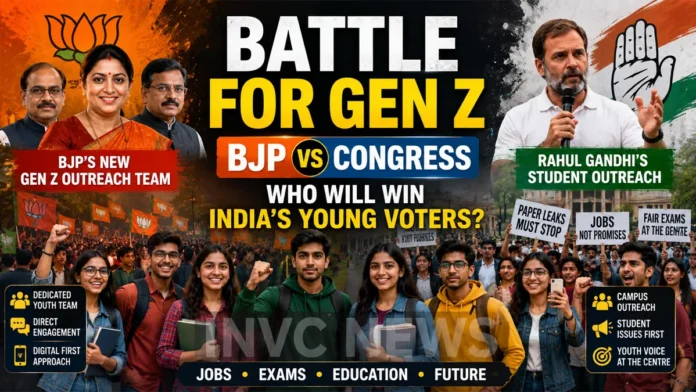
BJP Gen Z outreach has pushed India’s youngest voters to the center of a rapidly developing political contest, with the ruling Bharatiya Janata Party creating a dedicated team to engage young Indians just as Rahul Gandhi and the Congress expand their own nationwide student campaign.
The emerging battle is significant because it is not centered only on traditional political rallies or party workers. Both sides are increasingly trying to meet young people where their concerns are most immediate — jobs, competitive examinations, paper leaks, education costs, technology, social media and opportunities for the future.
For the BJP, the new approach involves a dedicated Gen Z outreach structure featuring prominent party leaders.
For the Congress, Rahul Gandhi’s “Chhatron Ki Goonj” initiative is becoming the centerpiece of a broader student-focused political campaign.
Together, the developments suggest that India’s next major political battleground may not begin at a conventional election rally.
It could begin on a college campus.
BJP Forms Dedicated Team for Gen Z Outreach
The BJP has created a special team to strengthen its engagement with Generation Z and other young voters.
The outreach effort includes senior and younger leaders such as BJP national president Nitin Nabin, Smriti Irani and Vinod Tawde, along with other party figures involved in the youth-connect initiative.
The program is expected to emphasize direct interaction with young Indians rather than relying exclusively on conventional political communication.
Educational institutions, digital platforms and face-to-face interactions are likely to play an important role as the party seeks to better understand the aspirations and concerns of young citizens.
That represents an important strategic shift.
Young voters increasingly consume political information through smartphones, short-form video, podcasts, social media creators and direct online interactions rather than only through television debates, newspapers or political rallies.
For every major party, reaching this audience requires a different political language.
Why BJP Is Focusing on Gen Z
India’s young population makes the political importance of Gen Z difficult to ignore.
Many younger voters are either entering the electorate for the first time or moving into the period of life when employment, higher education, housing, income and career mobility become immediate concerns.
Their political priorities may therefore differ from those of older generations.
A voter preparing for a government examination could be focused on recruitment schedules and examination integrity.
A university student may care about tuition costs, internships and employment opportunities.
A young entrepreneur may be more interested in access to capital, regulation, technology and the startup ecosystem.
And young professionals may evaluate governments through wages, job creation, infrastructure, digital services and quality of life.
A successful youth strategy therefore requires more than a single campaign slogan.
Rahul Gandhi Expands Student Outreach
The BJP’s new initiative is developing at the same time that Rahul Gandhi is intensifying his engagement with students.
His “Chhatron Ki Goonj” campaign has focused on issues including competitive examinations, alleged paper leaks, recruitment problems, education expenses and unemployment.
The initiative has already moved through important student centers and Congress now wants to expand the campaign substantially across the country.
Rahul Gandhi’s latest major interaction took place in Pune on August 22, where the program focused particularly on women students.
Participants raised concerns related to examinations, careers, social pressures and opportunities.
This gives the Congress strategy a distinctive political approach: rather than beginning with a large national political message and taking it to students, the party is attempting to begin with student grievances and turn them into a larger national political narrative.
Also Read
Kota was an especially symbolic choice for an early phase of Rahul Gandhi’s outreach because the city is one of India’s largest coaching and competitive-examination centers.
Students from Uttar Pradesh, Bihar, Rajasthan, Madhya Pradesh, Jharkhand and many other states study there, making the city an important window into the pressures faced by aspirants seeking university admissions or government jobs.
Paper Leaks Could Become a Major Youth Political Issue
Competitive examinations are becoming one of the most politically sensitive issues affecting young Indians.
For an examination aspirant, a delayed recruitment cycle or an alleged paper leak is not an abstract political question.
It can mean months or years of preparation, financial pressure on the family and uncertainty over employment.
That gives examination integrity unusually high emotional and political importance.
Congress has repeatedly attempted to place paper leaks and examination irregularities at the center of its youth outreach.
Rahul Gandhi has also raised questions about examination administration and student costs in other contexts.
Also Read
‘Students Paying for Board Errors’: Rahul Gandhi Questions CBSE Re-Evaluation Fees
The wider political challenge for the BJP will be to demonstrate that government recruitment systems and examination reforms can address such concerns while also presenting its own record on youth opportunities.
Jobs May Be the Biggest Battlefield of All
Behind many individual youth issues lies one much larger question: employment.
Young voters do not evaluate jobs only through headline unemployment statistics.
Their experience is shaped by whether they can find work matching their education, whether salaries are sufficient, whether government recruitment is completed on schedule and whether private-sector growth is generating meaningful opportunities.
That gives both BJP and Congress a complicated political challenge.
The BJP can highlight economic growth, infrastructure expansion, manufacturing, startups, digitalization, skill programs and government initiatives aimed at connecting young people with employers.
Congress, meanwhile, is seeking to turn unemployment, recruitment delays and examination-related grievances into a broader political argument about economic opportunity.
The outcome may depend less on which party produces the strongest slogan and more on which side young voters believe understands their daily experience.
BJP Has Its Own Youth Opportunity Narrative
The BJP and the central government also have policy initiatives they can use to make a direct economic argument to younger citizens.
Programs involving skill development, entrepreneurship, internships, manufacturing and startups provide the ruling party with a counter-narrative to opposition criticism over unemployment.
One example is the PM Internship Scheme, which seeks to give eligible young people practical work experience with major companies.
Also Read
For the BJP, the political task will be to connect such programs with the everyday aspirations of young Indians and demonstrate measurable outcomes.
Congress Has Been Building This Campaign for Months
Rahul Gandhi’s latest student outreach is not an isolated development.
Congress has been building a wider campaign around inflation, unemployment and examination-related controversies.
The party announced a nationwide political program earlier this year that specifically identified employment and examination concerns among the issues it wanted workers and leaders to take directly to citizens.
Also Read
Congress Launches Nationwide Campaign Against Inflation, Unemployment and Exam Scandals
“Chhatron Ki Goonj” therefore appears to fit into a broader Congress effort to create a sustained youth narrative rather than a one-event campaign.
Women Students Could Become an Important Part of the Contest
Rahul Gandhi’s Pune event put particular emphasis on young women.
That is politically significant.
Young women are increasingly visible in higher education, competitive examinations and India’s professional workforce.
Their concerns can overlap with those of male students — jobs, fees, examinations and career opportunities — but can also include personal safety, social expectations, workplace participation and barriers to economic independence.
A political campaign capable of connecting economic opportunity with the specific experiences of younger women could gain an important audience.
Both major parties are therefore likely to pay increasingly close attention to this segment.
Social Media Will Be a Major Battlefield
The Gen Z contest will not be fought only through physical events.
It will unfold on Instagram, YouTube, X, short-form video platforms, podcasts and other digital spaces where younger Indians spend significant time.
This creates opportunities and risks for every political party.
A compelling 30-second video can reach millions of voters faster than a traditional speech.
But political mistakes can travel just as quickly.
Young voters can also compare claims, watch old statements, produce memes, challenge politicians directly and amplify local grievances nationally.
That makes authenticity particularly important.
A highly scripted campaign may reach young people without necessarily persuading them.
Why Traditional Political Messaging May Not Be Enough
Gen Z has grown up during a very different information environment from previous generations.
Many young Indians have never experienced a world without smartphones, social media, online payments, digital education and instant access to information.
They also encounter political narratives from multiple competing sources every day.
As a result, loyalty cannot automatically be assumed.
Young voters may support a government on infrastructure or technology while criticizing it on jobs.
They may agree with the opposition on examination reform but disagree with it on another national issue.
This makes Gen Z potentially more difficult to address through a single ideological or emotional message.
BJP vs Congress: Two Different Youth Strategies
At this stage, the two parties appear to be approaching the youth contest from somewhat different directions.
BJP’s strategy is organizational and outreach-driven: create a dedicated team, increase direct engagement, use prominent leaders and communicate government opportunities and achievements.
Congress’ strategy is increasingly grievance-driven: listen to students, highlight examination and recruitment problems, raise education costs and unemployment, and position Rahul Gandhi as a direct listener to younger citizens.
Both strategies have potential strengths.
Both also face significant tests.
The BJP must show that its outreach is more than political communication and leads to meaningful engagement with difficult youth questions.
Congress must demonstrate that student dissatisfaction can be converted into sustained political organization and electoral support.
The Battle Goes Beyond BJP and Congress
Although the national focus is on BJP and Congress, India’s youth vote cannot be reduced to a two-party contest.
Regional parties remain powerful in several states and often have their own student organizations, welfare programs and employment narratives.
Issues also vary dramatically by region.
An examination aspirant in Uttar Pradesh may have different priorities from an IT professional in Bengaluru, an engineering student in Chennai, a first-time voter in Bihar or a young entrepreneur in Gujarat.
That means national parties will have to localize their Gen Z campaigns.
One message is unlikely to work everywhere.
Why This Matters Ahead of Future Elections
India’s next Lok Sabha election is due by 2029, but political organizations rarely wait until election year to build relationships with an emerging voter bloc.
The people who are university students today will include employees, entrepreneurs, job seekers and first-time or second-time voters by the next general election.
That makes 2026 an important period for political parties seeking to establish long-term credibility with younger Indians.
Assembly elections before 2029 will provide earlier tests of whether these outreach strategies are changing voter behavior.
India’s Gen Z Political Battle Has Just Begun
The creation of a dedicated BJP Gen Z outreach team and the expansion of Rahul Gandhi’s student campaign point toward a larger transformation in Indian politics.
For decades, parties built electoral coalitions around caste, community, geography, welfare and leadership.
Those factors remain important.
But age and aspiration are becoming increasingly important political variables.
For India’s youngest voters, the central questions may be remarkably practical:
Will I get a good job?
Will examinations be fair and conducted on time?
Can I afford quality education?
Will my skills create a better income?
Will political leaders actually listen to me?
The party that develops convincing answers to those questions could gain an advantage far beyond one election.
That is why the emerging BJP vs Congress battle for Gen Z may become one of the most consequential political contests to watch in India over the next several years.








Comments are closed.