
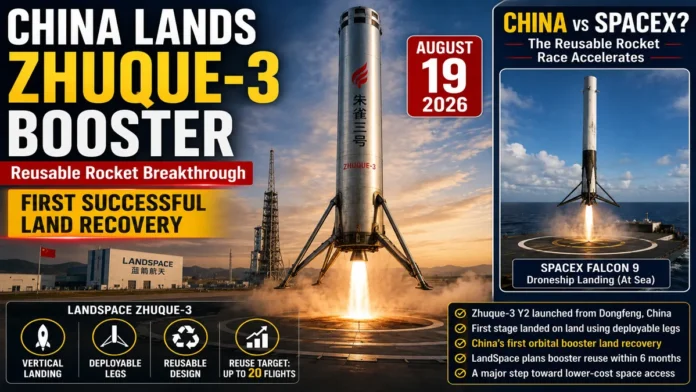
Jiuquan, China, August 19, 2026
Zhuque-3 Rocket Landing has delivered a major breakthrough for China’s rapidly expanding commercial space industry, with private aerospace company LandSpace successfully returning the first stage of its reusable orbital rocket to a landing zone on Wednesday.
The Zhuque-3 Y2 rocket lifted off Wednesday morning from the Dongfeng Commercial Space Innovation Pilot Zone in northwest China, successfully completing its orbital mission before its first-stage booster descended back toward Earth and performed a controlled landing.
The achievement marks China’s first successful recovery of an orbital-class rocket booster on land using deployable landing legs, bringing the country a significant step closer to the reusable launch model pioneered at commercial scale by Elon Musk’s SpaceX.
It also comes just weeks after China achieved its first successful orbital booster recovery at sea, signaling that Beijing’s reusable-rocket program is beginning to move from experimental demonstrations toward increasingly sophisticated operations.
Zhuque-3 Makes History for China
The Zhuque-3 Y2 mission represents a landmark moment for China’s space program.
According to state media, Wednesday’s flight was the country’s first successful attempt to bring the first stage of an orbital launch vehicle back to a designated landing zone on land.
The first stage used deployable landing legs, a configuration similar in principle to the vertical-landing architecture used by SpaceX’s Falcon 9.
China’s earlier successful recovery in July used a very different system.
This time, the booster essentially performed a controlled powered descent and landed vertically on its own legs.
That technological difference is significant because vertical propulsive landing is considered one of the key building blocks for rapidly reusable orbital rockets.
Where Did Zhuque-3 Launch and Land?
The Zhuque-3 Y2 lifted off from the Dongfeng Commercial Space Innovation Pilot Zone, part of China’s growing commercial launch infrastructure in the northwest.
The rocket launched at approximately 7:35 a.m. Beijing time on August 19.
After stage separation, the booster executed its return sequence and descended to a recovery zone approximately 390 kilometers downrange in Gansu province, according to details reported following the mission.
The successful landing followed LandSpace’s unsuccessful first recovery attempt during Zhuque-3’s maiden orbital flight in December 2025.
First Zhuque-3 Landing Attempt Ended in Failure
The significance of Wednesday’s success becomes clearer when compared with Zhuque-3’s first flight.
LandSpace launched the first Zhuque-3 orbital mission in December 2025.
The upper stage successfully reached orbit, but the booster failed during the final phase of its landing attempt after an abnormal combustion event.
The stage was unable to complete a soft landing.
LandSpace nevertheless said the mission generated valuable flight data covering reentry, guidance, aerodynamic control and recovery operations.
Less than nine months later, the Y2 vehicle successfully completed the maneuver that the first flight could not.
China Had Already Recovered a Booster at Sea in July
Wednesday’s landing is not China’s first successful rocket-stage recovery overall.
That milestone came on July 10, 2026, during the maiden flight of the state-developed Long March-10B.
After separating from the upper stage, its first-stage booster returned toward Earth and was recovered on a sea-based platform.
Instead of touching down on conventional landing legs, however, the stage was captured using a specialized net-based recovery system.
That mission represented China’s first successful recovery of a rocket stage during an orbital launch.
Zhuque-3 has now added something new: a conventional powered landing on land.
Why Reusable Rockets Matter So Much
Traditional orbital rockets have historically been expendable.
After launching a satellite or spacecraft, major sections of the rocket are allowed to fall into the ocean, burn up in the atmosphere or otherwise become unusable.
That means a new booster must be manufactured for the next mission.
Reusable rockets seek to change that economics.
If the most expensive hardware can be recovered, inspected and launched again, companies can potentially reduce manufacturing costs while dramatically increasing launch frequency.
SpaceX has demonstrated this model at scale with Falcon 9.
Its first-stage boosters routinely return either to landing zones near launch sites or to autonomous droneships at sea.
Can Zhuque-3 Really Challenge SpaceX?
The successful Zhuque-3 Rocket Landing puts China much closer technologically, but it does not yet mean LandSpace has matched SpaceX operationally.
That distinction is crucial.
SpaceX achieved its first successful orbital-class booster landing on land on December 21, 2015.
It followed that with the first successful Falcon 9 droneship landing in April 2016 and the first reflight of an orbital-class booster in March 2017.
Since then, Falcon boosters have accumulated years of repeated flights and landings.
LandSpace has now demonstrated that it can land Zhuque-3.
Its next major challenge is proving that the recovered booster can be inspected, refurbished quickly and flown again reliably.
LandSpace Wants Zhuque-3 Booster to Fly Up to 20 Times
LandSpace’s ambitions go far beyond a single successful recovery.
The Chinese company aims to make Zhuque-3’s first stage reusable for up to 20 flights, according to current plans.
Following Wednesday’s successful recovery, LandSpace intends to attempt to reuse the recovered booster within six months.
That next flight could become an even more important milestone.
Landing proves the hardware can survive return from an orbital mission.
Reflight proves whether reusable-rocketry economics can actually begin to work.
Reflight Is the Real Test
A rocket stage can technically be described as recoverable after a successful landing.
But genuine commercial reusability requires much more.
Engine systems must survive the flight.
The booster structure must tolerate launch, atmospheric reentry and landing stresses.
Thermal protection must remain usable.
Avionics and control systems must function reliably.
And most importantly, refurbishment must be economical and relatively fast.
SpaceX’s advantage comes not merely from landing rockets but from repeatedly flying the same boosters.
That is the benchmark LandSpace must now approach.
Zhuque-3 Uses Methane Fuel
Zhuque-3 also stands out because of its propulsion system.
The stainless-steel rocket uses liquid methane and liquid oxygen, often referred to as methalox propulsion.
Methane has attracted significant interest in next-generation reusable rockets because it can burn relatively cleanly compared with some traditional rocket fuels.
Cleaner combustion can potentially reduce engine residue and simplify refurbishment between flights.
SpaceX’s Starship also uses methane-based propulsion, although Falcon 9 uses kerosene-based RP-1 fuel.
Zhuque-3 Is a Large Orbital Rocket
The Zhuque-3 is approximately 66 meters tall and is designed as a medium-to-heavy orbital launch vehicle.
The rocket has been developed primarily for commercial satellite missions and future high-frequency launches.
Its design combines stainless-steel construction with reusable first-stage architecture.
That places the vehicle in a class of rockets increasingly designed around the assumption that boosters should return rather than be discarded.
China’s Satellite Ambitions Make Reusability Critical
China has major plans for large satellite constellations.
Those networks could eventually require hundreds or thousands of satellites to be launched into low Earth orbit.
Such programs create enormous demand for frequent, relatively inexpensive launches.
Reusable rockets could help China accelerate deployment while lowering the cost per mission.
That is one reason Zhuque-3’s progress has implications beyond LandSpace itself.
It could contribute to China’s ability to compete in the global commercial launch industry and deploy large domestic satellite networks.
SpaceX’s Starlink Model Shows What Is Possible
SpaceX’s Starlink constellation demonstrates how reusable rockets can transform satellite deployment.
The company can repeatedly launch batches of satellites using Falcon 9 rockets, with boosters returning for additional missions.
High launch frequency has become a competitive advantage.
China is developing its own large communications constellations, making access to cheaper reusable rockets increasingly important.
A mature Zhuque-3 system could therefore become part of a broader Chinese strategy to expand space-based communications infrastructure.
LandSpace Emerging as Major Chinese Space Player
LandSpace is one of several Chinese private aerospace companies seeking to develop reusable launch systems.
Its successful Zhuque-3 landing significantly strengthens its position.
The company is also reportedly seeking to raise approximately 7.5 billion yuan, around $1.1 billion, through an initial public offering on Shanghai’s STAR Market.
A successful reusable launch vehicle could improve LandSpace’s prospects in China’s increasingly competitive commercial space market.
China Is Pursuing More Than One Reusable Rocket Strategy
Another important aspect of China’s progress is that it is not relying on a single recovery technology.
The July Long March-10B test used a sea-based net capture system.
The August Zhuque-3 mission used deployable landing legs and a powered descent to a land recovery zone.
That means China is experimenting with different approaches simultaneously.
Such diversity could eventually allow different launch systems to optimize recovery strategies according to mission requirements.
SpaceX Still Holds a Huge Operational Lead
Despite Wednesday’s breakthrough, SpaceX remains far ahead in operational experience.
Its Falcon 9 is described by SpaceX as the world’s first orbital-class reusable rocket and has performed repeated booster recoveries and reflights for years.
Falcon 9 recovery is no longer treated as experimental on routine missions.
It has become part of normal launch operations.
That maturity took years of launches, failures, engineering changes and repeated reuse.
China is now demonstrating similar fundamental technologies but remains earlier in that development cycle.
Blue Origin Is Also Part of the Reusable Rocket Race
SpaceX is not the only U.S. company pursuing reusable launch vehicles.
Jeff Bezos’ Blue Origin successfully landed its New Shepard booster in November 2015 and subsequently demonstrated booster reuse.
Its much larger New Glenn orbital launcher has also successfully recovered its reusable first stage at sea.
Blue Origin says New Glenn’s first stage is designed for at least 25 missions.
The global reusable-rocket race is therefore broadening rapidly.
Japan Is Developing Reusable Technology Too
Asia’s reusable-launch competition is also intensifying.
Just one day after China’s July sea-recovery milestone, Japan conducted the first test flight of an experimental reusable rocket.
The vehicle took off and safely returned to land during the test.
Japan is pursuing reusable launch technology for essentially the same reasons: lower costs, greater flight frequency and improved competitiveness in the commercial launch market.
What Happens Next for Zhuque-3?
The next stage of the program could be more important than Wednesday’s historic landing.
LandSpace must now inspect the recovered first stage.
Engine condition, structural integrity, thermal damage, avionics and landing hardware will all need to be evaluated.
If the company successfully flies the same booster again within its stated six-month target, Zhuque-3 will move from being a rocket that can be recovered to one that has demonstrated actual reuse.
That is the distinction that could begin changing launch economics.
Reusability Could Reshape China’s Commercial Space Sector
China’s commercial space industry has expanded rapidly in recent years.
Private companies are increasingly developing rockets, engines and satellite technologies alongside the country’s established state-owned aerospace enterprises.
A commercially viable reusable rocket could significantly accelerate that transformation.
Lower launch costs could attract more satellite customers.
Higher launch frequency could support large constellations.
And successful reuse could reduce the time and manufacturing capacity required to support repeated missions.
Is China Preparing to Challenge SpaceX?
The answer after the Zhuque-3 Rocket Landing is: China is clearly moving toward competing in the same technological arena, but it has not yet matched SpaceX’s operational scale.
Wednesday’s mission establishes something important.
China can now point to a successful orbital-class booster landing on land.
But the bigger challenge begins after touchdown.
To truly compete with SpaceX, LandSpace will need to demonstrate repeated reflight, rapid refurbishment, high launch frequency, reliable performance and competitive pricing.
SpaceX has spent more than a decade building that system.
China has now crossed one of the most difficult technical thresholds needed to pursue it.
The Zhuque-3 landing therefore may not represent the moment China caught SpaceX.
But it could be remembered as the moment China’s reusable rocket race entered a new phase.