
New Delhi, August 15, 2026
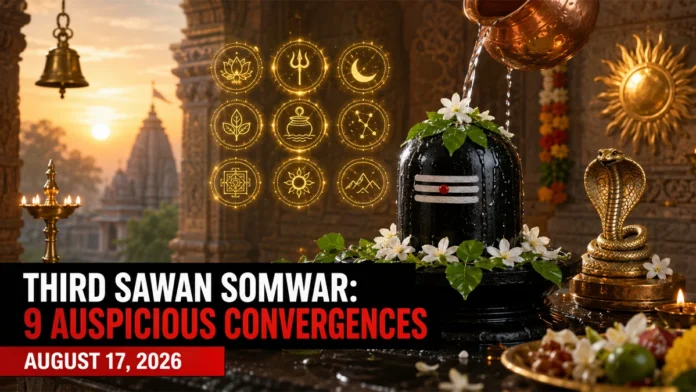
Third Sawan Somwar 2026 will be observed on August 17 amid an unusual concentration of festivals, Panchang events and astrological combinations that are expected to make the day especially important for devotees of Lord Shiva.
The third Monday of Sawan will coincide with Nag Panchami, Simha Sankranti, the transition toward Skanda Shashti and the beginning of the Malayalam month of Chingam. Traditional calculations also identify Shubh Yoga, Ravi Yoga and several significant planetary combinations around the day.
Devotees may observe the Monday fast, perform jalabhishek, offer bel leaves and chant “Om Namah Shivaya.” They may also worship a symbolic representation of Nag Devta and participate in charitable activities according to their ability.
Although these events are collectively being described as “nine auspicious combinations,” they are not all astrological yogas in the strict technical sense. The list includes festivals, a solar transition, a calendar observance and planetary formations.
Why is the third Sawan Somwar important?
Mondays during Sawan are traditionally dedicated to Lord Shiva. Devotees commonly visit Shiva temples, observe a fast and perform water or milk abhishek according to their family customs.
Religious tradition associates sincere Shiva worship with spiritual discipline, peace and the strength to face personal difficulties. Devotees also pray for family well-being and the fulfillment of righteous wishes.
The third Sawan Monday assumes additional importance because several religious observances and celestial events occur on or around August 17.
Nine notable alignments on August 17
The nine events and combinations associated with the third Sawan Monday are:
- Shubh Yoga
- Ravi Yoga
- Nag Panchami
- Simha Sankranti
- Beginning of Shashti Tithi and Skanda worship
- Malayalam New Year, or Chingam 1
- A three-planet concentration in Cancer before sunrise transition
- Hamsa Raja Yoga-related Jupiter placement
- Budhaditya Yoga
Timings and classifications can vary according to location, calculation method and astrological tradition.
1. Shubh Yoga
Shubh Yoga will remain active for a substantial part of August 17 under widely followed Panchang calculations.
This Nitya Yoga is traditionally regarded as favorable for worship, spiritual study, charity and constructive work. Devotees may use the period for Shiva Puja, mantra chanting or meditation.
Location-based calculations vary. For New Delhi, one widely used Panchang places Shubh Yoga from the evening of August 16 until approximately 5:59 p.m. on August 17, after which Shukla Yoga begins. Readers should verify the timing for their city.
2. Ravi Yoga
Ravi Yoga is another auspicious period associated with August 17.
Some Panchang traditions list a morning Ravi Yoga from approximately 5:51 a.m. to 8:04 a.m., while other location-based calculations place a separate Ravi Yoga period later in the day.
The variation occurs because Panchang timings depend on the location and the specific tithi-nakshatra method being followed. Devotees should use a local calendar rather than treating one national timing as universal.
In astrology, Ravi Yoga is traditionally associated with overcoming obstacles and weakening unfavorable influences.
3. Nag Panchami
Nag Panchami will be observed on Monday, August 17, because Panchami Tithi will be present at sunrise.
The Panchami period is expected to begin at approximately 4:52 p.m. on August 16 and end at approximately 5:00 p.m. on August 17.
Nag Panchami is dedicated to Nag Devta. Its conjunction with Sawan Somwar is considered meaningful because Lord Shiva is traditionally depicted with the serpent Vasuki around his neck.
Devotees may worship an image or idol of Nag Devta after performing Shiva Puja. Living snakes should never be captured, disturbed or forcibly fed milk.
4. Simha Sankranti
The Sun is expected to move from Cancer into Leo on August 17, marking Simha Sankranti.
Different astrological calculation systems place the transition at approximately 8 a.m. IST, with a variation of several minutes. The supplied Panchang calculation lists the transition at about 8:03 a.m.
The associated Punya Kaal is generally placed between sunrise and shortly after the Sankranti moment. Bathing, prayer, charity and the donation of food are traditionally considered meaningful during this period.
Because Leo is ruled by the Sun, the transition is associated in astrology with confidence, authority and self-expression. These interpretations remain matters of astrological belief.
5. Shashti Tithi and Skanda worship
Panchami Tithi is expected to end at approximately 5 p.m. on August 17, after which Shashti Tithi begins.
Shashti is associated with Lord Kartikeya, also known as Skanda, the son of Lord Shiva and Goddess Parvati.
Some calendars connect the evening transition on August 17 with Skanda Shashti worship, while the principal Shashti observance may be listed on August 18 because the tithi continues after sunrise that day.
Devotees following an evening tradition may worship Lord Kartikeya after Shashti begins. Those observing a formal fast should follow their regional calendar or temple guidance.
6. Malayalam New Year and Chingam 1
August 17 will also mark Chingam 1, the first day of the Malayalam month of Chingam and the beginning of Kollavarsham 1202.
Chingam is associated with new beginnings and the approaching harvest season in Kerala. The month also includes the Onam festival period.
Simha Sankranti and Chingam 1 are closely connected because the Malayalam solar calendar begins the month of Chingam with the Sun’s transition into the corresponding solar sign.
Some families regard Vishu as the principal traditional new-year celebration, while Chingam 1 marks the beginning of the Malayalam calendar year.
7. Three-planet concentration in Cancer
Before the Sun moves into Leo, the Sun, Mercury and Jupiter are described as occupying Cancer, producing a temporary three-planet concentration.
This formation will end when the Sun changes signs around 8 a.m.
Astrologers examine such combinations according to the ascendant, Moon sign, planetary degrees and house positions in an individual horoscope. Therefore, the formation should not be presented as universally beneficial to everyone.
Its personal effect cannot be determined from the date alone.
8. Hamsa Raja Yoga-related Jupiter placement
Jupiter’s presence in Cancer, its sign of exaltation in traditional Vedic astrology, is regarded as an important planetary position.
However, exalted Jupiter does not automatically create Hamsa Mahapurusha Raja Yoga for every person.
In its strict technical definition, Hamsa Yoga requires Jupiter to occupy its own or exaltation sign in a Kendra house—first, fourth, seventh or tenth—from the relevant ascendant or another framework used by the astrologer.
Therefore, the date carries a strong Jupiter placement, but whether it produces Hamsa Raja Yoga for an individual depends on that person’s birth chart.
Traditional interpretations associate a well-placed Jupiter with knowledge, ethics, guidance and spiritual development.
9. Budhaditya Yoga
Budhaditya Yoga is formed through the conjunction of the Sun and Mercury.
According to the supplied planetary calculation, the combination will remain in Cancer until the Sun enters Leo at approximately 8:03 a.m. on August 17.
Once the Sun changes signs, that particular Cancer-based conjunction will end. The strength and results of Budhaditya Yoga depend on planetary degrees, combustion, house placement and the complete birth chart.
It should not be promoted as a guarantee of intelligence, career advancement or financial success.
Third Sawan Somwar jalabhishek timings
The following worship periods are based on a general northern India Panchang calculation:
| Auspicious period | Approximate time |
|---|---|
| Brahma Muhurta | 4:24 a.m.–5:08 a.m. |
| Amrit Choghadiya | 5:51 a.m.–7:30 a.m. |
| Shubh Choghadiya | 9:08 a.m.–10:47 a.m. |
| Abhijit Muhurta | 11:59 a.m.–12:51 p.m. |
These timings can shift by city because they depend on sunrise and local geography.
Lord Shiva may traditionally be worshipped with devotion throughout the day. Those unable to perform jalabhishek during a listed muhurat do not need to abandon their worship.
How to perform Shiva Puja
Devotees may follow a simple worship method:
- Bathe and wear clean clothes.
- Clean the worship area and light a lamp.
- Meditate on Lord Shiva and take a prayerful resolution.
- Offer clean water to the Shiva lingam.
- Present bel leaves, flowers, akshat and fruit.
- Chant “Om Namah Shivaya.”
- Worship a symbolic Nag Devta image for Nag Panchami.
- After Shashti begins, devotees may remember Lord Kartikeya according to their tradition.
- Donate food or essential items to someone in need.
- Conclude with Shiva Aarti and a prayer for the welfare of all living beings.
Fasting should be observed according to individual health and physical ability. People with medical conditions should not undertake a restrictive or waterless fast without appropriate guidance.
Disclaimer: This article is based on traditional religious beliefs, astrology and Panchang calculations. Timings may vary by location and calculation method. Astrological combinations do not guarantee specific outcomes.







Comments are closed.