NEW DELHI, August 12, 2026 —
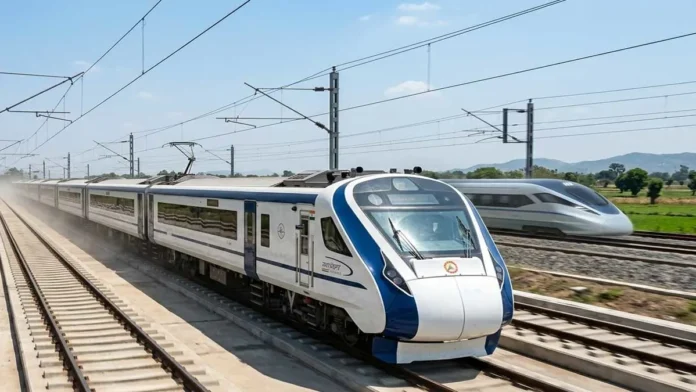
27 New Vande Bharat Trains are expected to strengthen Indian Railways’ premium passenger fleet during the current financial year as production of both Chair Car and Sleeper trainsets gathers momentum across the country’s major coach-manufacturing facilities.
The new trainsets, estimated to involve an investment of around ₹2,700 crore, form part of Indian Railways’ wider effort to modernize passenger travel with faster, self-propelled trains, upgraded interiors, advanced safety systems and improved onboard facilities.
The expansion comes as the Vande Bharat program enters a new phase. According to the latest official government figures, 162 Vande Bharat Chair Car services and two Vande Bharat Sleeper services were operating across the Indian Railways network as of July 23, 2026.
At the same time, India is pushing beyond semi-high-speed trains. The Integral Coach Factory in Chennai and BEML are developing an indigenous high-speed trainset with a design speed of 280 kmph, a project that could significantly expand India’s domestic rail-manufacturing capabilities.
27 New Vande Bharat Trainsets Could Be Completed This Financial Year
Indian Railways is working toward completing approximately 27 additional Vande Bharat trainsets during the current fiscal year, combining Chair Car and Sleeper configurations.
Production is being carried out across India’s major railway coach-manufacturing facilities, including the Integral Coach Factory in Chennai, Modern Coach Factory in Rae Bareli and Rail Coach Factory in Kapurthala.
The production program is significant because demand for Vande Bharat services has continued to rise as the trains are introduced on more intercity and long-distance routes.
Indian Railways may adjust production according to operational requirements and passenger demand, meaning the eventual number of trainsets manufactured could change as the year progresses.
The estimated ₹2,700-crore figure is based on an indicative cost of more than ₹100 crore for a modern Vande Bharat trainset, although the final cost varies depending on the number of coaches, configuration, propulsion equipment and onboard systems.
Vande Bharat Fleet Now Includes Chair Car and Sleeper Trains
The Vande Bharat program was originally built around premium Chair Car services designed primarily for daytime intercity travel.
That model has now expanded.
India launched its first Vande Bharat Sleeper service in January 2026, creating a long-distance overnight version of the indigenous train platform.
Official Railway Ministry data released on July 23 showed that 162 Chair Car services and two Sleeper services were operating nationally.
The Sleeper version is designed to bring Vande Bharat-style acceleration, modern passenger amenities and self-propelled technology to longer journeys traditionally served by premium trains such as Rajdhani Express.
The first Vande Bharat Sleeper has 16 coaches and capacity for 823 passengers, according to official government information.
Why Vande Bharat Production Is Becoming More Important
Vande Bharat represents one of Indian Railways’ most prominent indigenous rolling-stock programs.
Unlike conventional locomotive-hauled trains, Vande Bharat is a distributed-power electric multiple-unit trainset, meaning traction equipment is distributed throughout the train rather than relying on a separate locomotive at the front.
This configuration helps provide faster acceleration and deceleration, potentially reducing journey times on routes where track conditions and operating schedules allow higher average speeds.
The trains also incorporate features aimed at improving passenger comfort, safety and accessibility.
The Railway Ministry has highlighted systems including Kavach-compatible safety technology, CCTV surveillance, fire detection and suppression systems, jerk-free couplers and accessibility features for passengers with disabilities in its new-generation rolling stock.
Vande Bharat Demand Continues to Grow
Passenger demand provides an important reason for expanding the fleet.
Government figures show that around 3.98 crore passengers traveled on Vande Bharat Express services during FY 2025-26, representing significant growth compared with the previous year.
Since the first Vande Bharat Express entered service in February 2019, the network has expanded rapidly across major regional and intercity corridors.
The government said in January 2026 that its longer-term vision envisages expanding the Vande Bharat fleet to around 800 trains by 2030 and 4,500 by 2047.
That official projection underlines the scale of manufacturing capacity that Indian Railways will need over the next two decades.
Indian Railways Pushes Toward Large-Scale Vande Bharat Manufacturing
The current batch of new trains is only one element of a much broader manufacturing strategy.
Indian Railways is expanding domestic production capacity for several train families, including Vande Bharat Chair Car, Vande Bharat Sleeper, Amrit Bharat and Namo Bharat.
The objective is to modernize different segments of passenger travel rather than rely on a single premium train model.
Vande Bharat Chair Car trains are primarily intended for medium-distance journeys, while Sleeper trainsets are designed to address longer overnight routes.
This mixed fleet allows Indian Railways to deploy the technology across a wider range of routes while matching train configuration to passenger demand and journey duration.
India’s Indigenous 280-Kmph High-Speed Train Program Advances
Perhaps the most ambitious development now underway is India’s plan to manufacture its own 280-kmph high-speed trainset.
The Integral Coach Factory and BEML are jointly designing and manufacturing these trainsets as part of the government’s Make in India and Aatmanirbhar Bharat strategy.
The project represents a major technological jump from Vande Bharat.
Standard Vande Bharat trains have a design speed of up to 180 kmph, while the indigenous high-speed train currently under development has a design speed of 280 kmph.
The project also involves development of tooling, testing facilities and a broader domestic manufacturing ecosystem that could support future high-speed rail projects in India.
Will India’s 280-Kmph Train Run on the Bullet Train Corridor?
India’s high-speed rail program is developing alongside the Mumbai-Ahmedabad High-Speed Rail corridor, the country’s first dedicated bullet-train project.
The Mumbai-Ahmedabad system is being built to standards designed for trains with speeds considerably higher than conventional Indian Railways services. Government information notes that trains planned for the high-speed rail system have a design speed of up to 350 kmph.
The indigenous 280-kmph trainset therefore represents a separate but strategically important manufacturing effort.
While it may support future high-speed rail requirements, any deployment on a particular corridor would depend on technical compatibility, certification, signaling, track standards and operational approval.
For that reason, it would be premature to describe the domestically developed 280-kmph train as a confirmed replacement for trains planned for the Mumbai-Ahmedabad corridor.
Why the Indigenous High-Speed Train Matters for India
The strategic significance of the project extends beyond speed.
Building a high-speed train domestically requires expertise in aerodynamics, propulsion, braking systems, bogies, lightweight structures, suspension, train control, passenger safety and high-speed testing.
Developing those capabilities within India can reduce dependence on imported technology in future high-speed rail programs.
The government has explicitly linked the 280-kmph program to efforts to create an indigenous high-speed rail manufacturing ecosystem.
This means the project could eventually have implications for future train procurement, domestic supply chains and potentially export opportunities.
Why Vande Bharat Costs More Than a Conventional LHB Train
A Vande Bharat trainset is generally more expensive than a conventional train made up of Linke Hofmann Busch, or LHB, coaches.
The principal difference is that a conventional LHB rake normally depends on a separate locomotive for traction, while Vande Bharat integrates propulsion equipment across the trainset.
That requires more sophisticated electrical systems, traction motors, braking technology, electronics and control equipment.
Vande Bharat trains also include modern automatic doors, advanced passenger information systems, improved interiors and multiple systems required for self-propelled operation.
For this reason, estimates for a complete Vande Bharat trainset can exceed ₹100 crore, depending on its configuration.
Using that broad benchmark, approximately 27 trainsets would represent investment on the order of ₹2,700 crore, although actual procurement and manufacturing costs can differ between train variants and contracts.
Vande Bharat Sleeper Could Transform Long-Distance Rail Travel
The expansion of Sleeper trainsets is especially important for Indian Railways because the country’s longest and busiest journeys are typically overnight.
Until recently, the Vande Bharat brand was largely associated with premium daytime travel.
The Sleeper version opens the possibility of using the same broad trainset concept on journeys of 800 km, 1,000 km or more.
The first Vande Bharat Sleeper service began operating between Howrah and Guwahati in January 2026. Government data later showed that it carried about 1.21 lakh passengers across 119 trips during its first three months.
That early passenger response could encourage further deployment as additional Sleeper trainsets become available.
Indian Railways’ Modernization Drive Moves Into a New Phase
The proposed production of 27 New Vande Bharat Trains this fiscal year illustrates how Indian Railways is moving from limited introduction of premium trainsets toward larger-scale fleet modernization.
Chair Car Vande Bharat services have already become established across multiple regions, while the Sleeper model is opening a new market for overnight premium rail travel.
The next technological step — the indigenous 280-kmph high-speed train — could be even more significant.
If the ICF-BEML program progresses through design, manufacturing, testing and certification as planned, India would gain valuable domestic capability in a segment of railway technology traditionally dominated by a relatively small group of global manufacturers.
The near-term priority, however, remains expanding Vande Bharat capacity, producing more Sleeper and Chair Car trainsets and deploying them on routes where passenger demand, infrastructure and operational conditions support their introduction.
With more Vande Bharat trains under production and a homegrown high-speed platform under development, Indian Railways is increasingly combining passenger modernization with domestic train-manufacturing ambitions.